
Percussion (medicine)
A tapping technique to assess underlying body structures.

Stephen Head · CC BY-SA 4.0
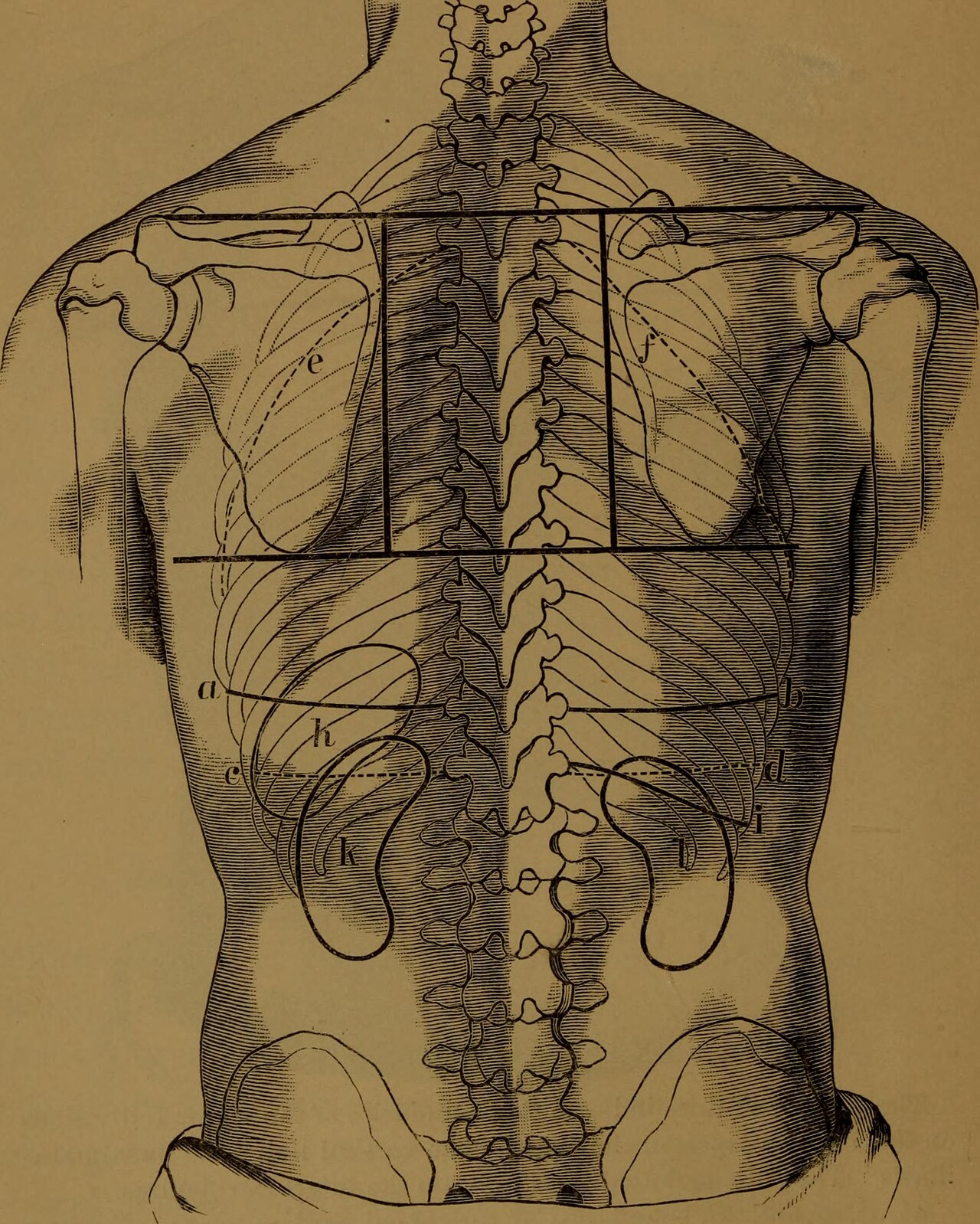
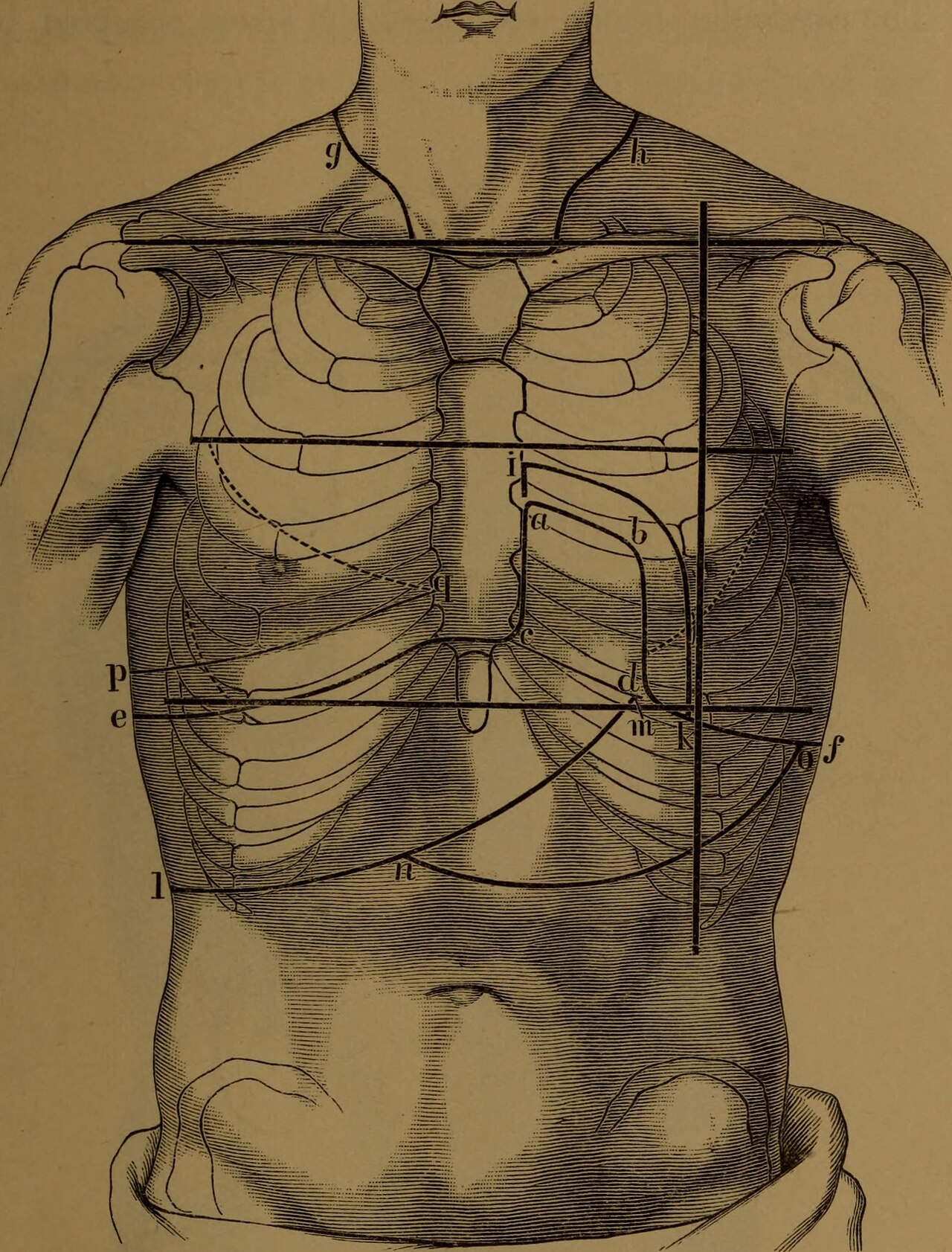
Percussion is a clinical examination technique involving tapping on a body surface to evaluate the structures beneath. It is commonly applied to the thorax or abdomen and is one of the four core methods of clinical examination, alongside inspection, palpation, and auscultation.
The procedure typically uses the middle finger of one hand to tap the middle finger of the other hand, with motion coming from the wrist. The finger that is not striking—called the pleximeter—is pressed firmly against the body over the tissue being examined. When percussing bony areas, such as the clavicle, the pleximeter may be omitted and the bone tapped directly, as is sometimes done to detect an apical cavitary lung lesion from tuberculosis.
There are two types of percussion: direct, using one or two fingers, and indirect, using only the middle or flexor finger. The sounds produced fall into four broad categories: resonant, hyper-resonant, stony dull, or dull. A dull sound suggests a solid mass beneath the surface, while a more resonant sound indicates hollow, air-filled structures. In addition to audible differences, the examiner can feel distinct sensations in the pleximeter finger.
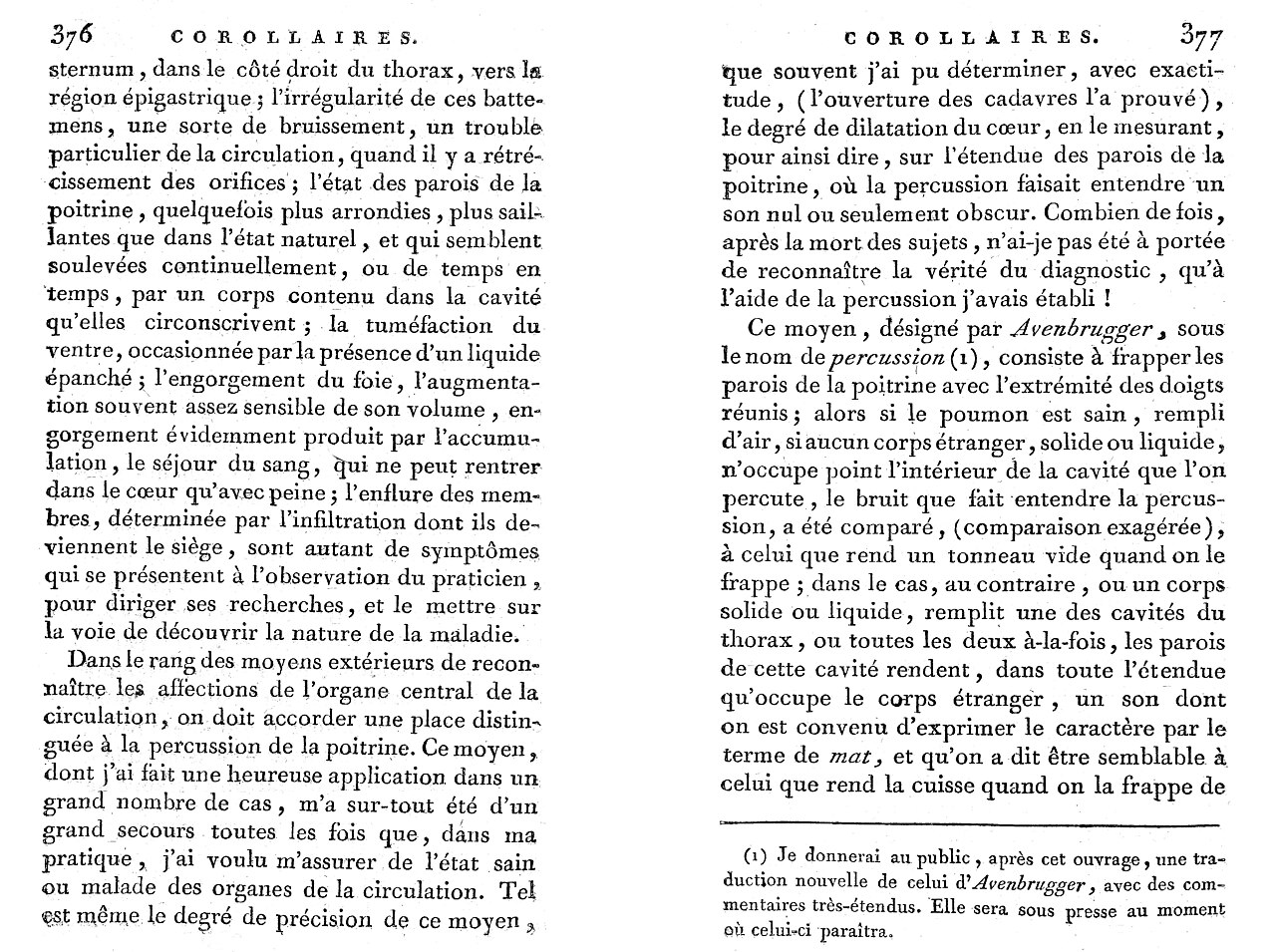
Percussion was first used to distinguish empty from full liquor barrels. Dr. Leopold Auenbrugger is credited with introducing the technique to modern medicine, though Avicenna employed it about a thousand years earlier for medical purposes, such as percussing the stomach to assess fullness and differentiating ascites from tympanites.
For the thorax, percussion helps diagnose conditions like pneumothorax and emphysema, and can assess the respiratory mobility of the chest. For the abdomen, it is used to detect organ enlargement (organomegaly) by setting tissue and the spaces between them into vibration; the resulting sound indicates whether the tissue is healthy or diseased.
Based on auditory and tactile perception, percussion notes are categorized as: tympanitic (drum-like, heard over air-filled structures during abdominal exam); hyperresonant (similar to percussing puffed-up cheeks, as in pneumothorax); normal resonance (heard over a normal chest); impaired resonance (lower than normal, indicating mass or consolidation); dull (similar to percussing a solid mass like the liver, indicating consolidation); and stony dull (produced by the pleximeter with no contribution from the underlying area). If percussion induces pain, this is also noted, as it may signal underlying pathology.
- field
- Medicine
- known_for
- Technique of clinical percussion
- introduced_to_modern_medicine_by
- Dr. Leopold Auenbrugger
- earlier_user
- Avicenna
Lore & Background
Percussion is a method of clinical examination that involves tapping on a surface to assess the condition of underlying structures, particularly in the thorax or abdomen. It is one of the four core clinical examination techniques, alongside inspection, palpation, auscultation, and inquiry. The technique is performed by using the middle finger of one hand to tap the middle finger of the other hand, with motion generated from the wrist. The finger that receives the tap, called the pleximeter, is placed firmly on the body over the tissue being examined. When percussing bony areas such as the clavicle, the pleximeter may be omitted and the bone is struck directly, as is done when assessing for an apical cavitary lung lesion typical of tuberculosis. There are two types of percussion: direct, using one or two fingers, and indirect, using only the middle finger. The sounds produced fall into four broad categories: resonant, hyper-resonant, stony dull, or dull. A dull sound suggests a solid mass beneath the surface, while a more resonant sound indicates hollow, air-filled structures. In addition to audible notes, percussion generates distinct tactile sensations in the pleximeter finger. Historically, the technique was first used to distinguish empty from filled liquor barrels. Dr. Leopold Auenbrugger is credited with introducing percussion to modern medicine, though Avicenna employed it roughly one thousand years earlier for medical purposes, such as percussing the stomach to assess fullness and differentiating between ascites and tympanites. In the thorax, percussion helps diagnose pneumothorax, emphysema, and other diseases, and can assess respiratory mobility. In the abdomen, it is used to detect organ enlargement, such as organomegaly, by setting tissues and spaces into vibration; the resulting sound indicates whether tissue is healthy or pathological. Percussion notes are further categorized as tympanitic (drum-like over air-filled abdominal structures), hyperresonant (like puffed cheeks, as in pneumothorax), normal resonant (over a healthy chest), impaired resonance (lower than normal, suggesting mass or consolidation), dull (like percussing a liver, indicating consolidation), and stony dull (produced with no contribution from underlying area). Percussion may also induce pain, which is noted as it can signal underlying pathology.
Reader's Guide
Percussion is a fundamental clinical examination technique used to assess the thorax and abdomen. It produces different sounds—resonant, hyper-resonant, stony dull, or dull—that help diagnose conditions such as pneumothorax, emphysema, and organ enlargement. The technique relies on both auditory and tactile perception, and the notes heard can be categorized as tympanitic, hyperresonant, normal resonant, impaired resonance, dull, or stony dull. Percussion may induce pain, which can indicate underlying pathology. Its historical roots include use by Avicenna and later introduction to modern medicine by Dr. Leopold Auenbrugger. The method remains a core part of physical diagnosis, providing non-invasive insight into the state of internal organs and tissues.
Did You Know?
- Percussion was first used to distinguish between empty and filled barrels of liquor.
- Dr. Leopold Auenbrugger is credited with introducing percussion to modern medicine.
- There are five recognized types of percussion sounds: tympanitic (or tympanic), hyperresonant, resonant, dull, and flat.
Defining the Procedure
Percussion in medicine is understood through the lens of how major medical dictionaries frame procedural action. The International Dictionary of Medicine and Biology characterizes such an activity as one directed at or performed on an individual, with the object of improving health, treating disease or injury, or making a diagnosis. Stedman's Medical Dictionary, authored by Thomas Lathrop Stedman, describes it more concisely as the act or conduct of diagnosis, treatment, or operation. Dorland's Medical Dictionary, by William Alexander Newman Dorland, frames it as a series of steps by which a desired result is accomplished, while Mosby's Medical, Nursing, & Allied Health Dictionary emphasizes the sequence of steps to be followed in establishing some course of action. Within this definitional landscape, percussion occupies the space of a propaedeutic medical procedure—specifically one whose intention is to determine, measure, or diagnose a patient condition or parameter, which also qualifies it as a medical test in the broader procedural taxonomy.
Propaedeutic Classification
Percussion is catalogued among the propaedeutic procedures, a category that also includes auscultation, medical inspection of body features, palpation, and vital signs measurement such as blood pressure, body temperature, or pulse. This grouping positions percussion as a foundational step in the clinical encounter—one that precedes more elaborate diagnostic testing and therapeutic intervention. The propaedeutic cluster represents the earliest tier of the procedural hierarchy, where the clinician gathers initial information about a patient's condition before moving into the diagnostic tier, which encompasses lab tests, imaging, electrophysiology, and endoscopy, or the therapeutic tier, which spans everything from hemodialysis to radiation therapy. By sitting alongside auscultation and palpation, percussion is implicitly framed as a direct-examination method performed on the individual, forming part of the same foundational assessment layer that underpins every subsequent clinical decision.
The Procedural Taxonomy
The broader framework in which percussion is situated divides medical procedures into several major categories: propaedeutic, diagnostic, therapeutic, surgical, anesthesia, and a miscellaneous other group. Percussion belongs to the first of these, the propaedeutic tier, which is distinguished by its intent to determine, measure, or diagnose a patient condition or parameter. This distinguishes it from therapeutic procedures—intended to treat, cure, or restore function or structure, such as surgical and physical rehabilitation procedures—and from the surgical tier, which includes ablative, amputative, and reconstructive interventions. The anesthesia tier covers dissociative, general, local, topical, epidural, spinal, and regional approaches, while the other category captures interventional radiology and screening. Percussion's placement at the very top of this hierarchy underscores its role as a preliminary, foundational step in the delivery of healthcare, a course of action intended to achieve a result before more complex interventions are considered.
Context in the Clinical Framework
Percussion does not exist in isolation within medical practice; it is embedded in a wider web of related concepts and procedural contexts. The source material links it to the physical examination, to screening in medicine, and to the broader notion of a medical algorithm—a structured sequence of decision-making steps. It also sits near concepts such as medical error, iatrogenesis, contraindication, and the distinction between invasive and non-invasive approaches. As a propaedeutic procedure, percussion is conceptually adjacent to vital signs measurement, suggesting it forms part of the same initial assessment layer a clinician performs before ordering a blood test, an electrocardiogram, a colonoscopy, or a computed tomography scan. The therapeutic tier, which includes everything from chemotherapy and gene therapy to acupuncture and animal-assisted therapy, represents the downstream consequences of the diagnostic information that propaedeutic methods like percussion help to generate, making percussion an upstream contributor to the entire clinical pipeline.
Gallery
Frequently Asked Questions
Who is Percussion (medicine)?
Percussion is a clinical examination technique in which a practitioner taps on the body's surface to gauge the condition of structures beneath. It sits alongside inspection, palpation, and auscultation as one of the four foundational pillars of physical examination.
What are Percussion (medicine)'s powers/role?
Its primary role is to reveal whether underlying tissue is solid, fluid-filled, or air-filled by producing distinct sounds when the chest wall or abdominal surface is tapped. It is most commonly applied to evaluate the thorax and abdomen during a routine clinical assessment.
How does Percussion (medicine)'s story end?
The procedure concludes when the examiner has mapped out the relevant area and interpreted the resulting tones—dull, resonant, or tympanitic—to form a picture of what lies beneath the surface. No incision or intervention is required; the 'ending' is simply a diagnostic reading.
Why is Percussion (medicine) important?
It remains one of the four standard methods of clinical examination, giving physicians a quick, non-invasive way to detect issues such as pleural effusion or organ enlargement. Its simplicity means it can be performed at the bedside with nothing more than a set of fingers.
Who brought Percussion (medicine) into the modern era?
Dr. Leopold Auenbrugger is credited with introducing the technique to modern Western medicine in the early eighteenth century. However, the Persian polymath Avicenna had described a similar tapping practice centuries before Auenbrugger's work.
More in Medical Procedures And Treatments 1-23
Spotted an error? Know more?
This is a living reference — every entry is fact-audited, and reader corrections feed straight into our audit queue. Suggest an edit · See this site's audit record