Umbrella octopus
Deep-sea octopuses with an umbrella-like web between their arms.
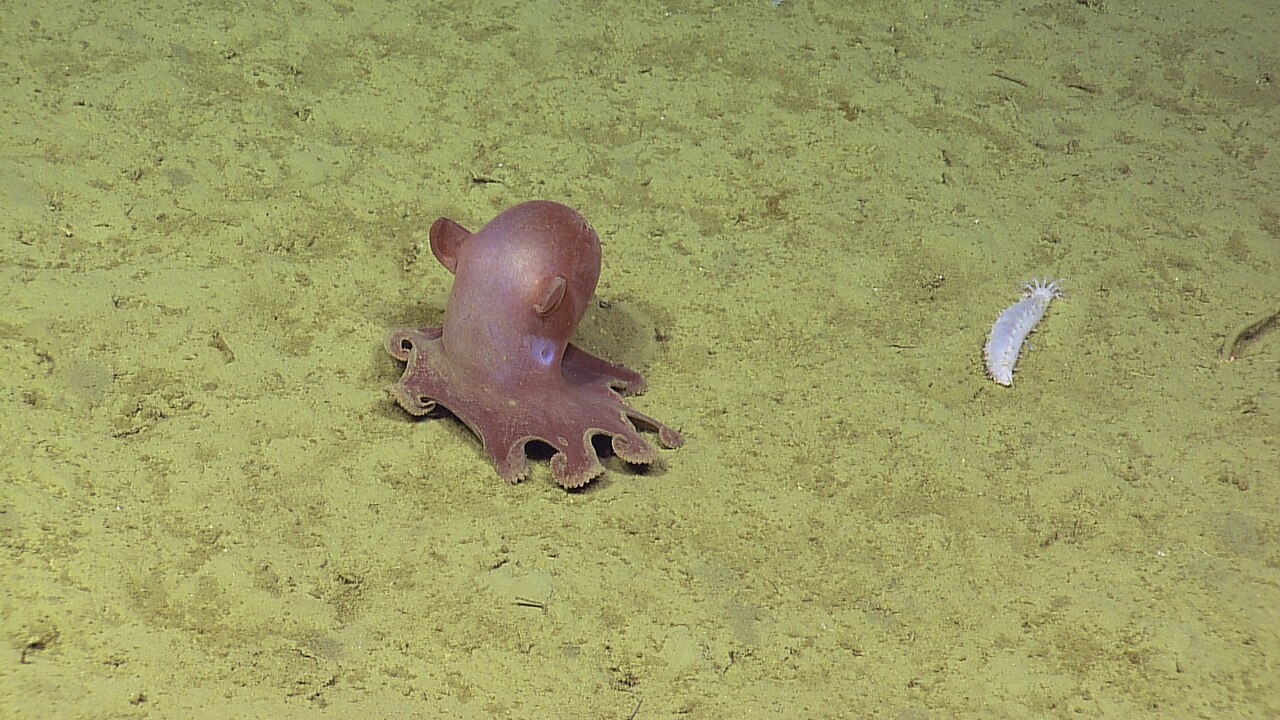
Umbrella octopuses, members of the family Opisthoteuthidae, are pelagic octopuses whose name derives from Ancient Greek words meaning "back" and "squid." Their most distinctive feature is a web of skin connecting their arms, which, when spread, gives them the appearance of an opened umbrella. Unlike some other cirrate octopuses, they lack an intermediate web; instead, the web between their arms serves a similar function, and the absence of this intermediate structure creates indentations along the outer edges of the arms, reinforcing the umbrella-like shape. Their bodies are supported by a broad, U-shaped internal shell that anchors muscles for a pair of small fins on the mantle. These fins are far less developed than in other cirrate families and serve primarily as stabilizers when the animal swims using a medusoid motion of its arms and webbing. The oral surface is positioned below the mantle, with the web and arms surrounding the mantle’s bottom. Their outer skin is notably delicate, and when damaged, white spots appear on the surface.
In defense, umbrella octopuses mimic a ballooning behavior by extending the web between their arms as much as possible and curving the outer edges of the arms inward so that only the edges touch the ground. They extend their fins parallel to the floor for balance or curve them around the mantle, and have been observed holding this posture for up to five and a half minutes. Another defensive tactic is web-inversion, where the arms are turned upward and the oral surface faces outward, either toward the floor or with the octopus lying laterally. These behaviors may also occur during feeding, though this could be due to stress from captivity. When resting on the seafloor, they employ either bottom-resting—erecting the mantle and curving arm edges inward to contact the floor—or flat-spreading, where the arms and web are spread parallel to the bottom with the head angled slightly backward. These deep-sea creatures have been found in the Clipperton-Clarion Fracture Zone in the Pacific Ocean at depths around 4,800 meters, as well as in the South China Sea, typically hovering between 3,000 and 4,000 meters below sea level.
- depth_range
- 200–4,000+ meters below sea level
Lore & Background
Umbrella octopuses are pelagic octopuses belonging to the family Opisthoteuthidae. Their most defining feature is a web of skin stretched between the arms, which, when spread, gives them the appearance of an opened umbrella. They possess a broad, U-shaped internal shell that supports muscles for a pair of small fins on the mantle; these fins are far less developed than those of other cirrate octopuses and function primarily as stabilizers during swimming, which is accomplished through a medusoid motion of the arms and webbing. The oral surface is positioned below the mantle, with the web and arms surrounding the bottom of the mantle. Their outer skin is extremely delicate, and white spots appear on it when the skin is damaged. Unlike other cirrates, umbrella octopuses lack an intermediate web; instead, they use the web between their arms to mimic one, and this absence causes indentations along the outer edges of the arms, further enhancing the umbrella-like shape. As deep-sea creatures, they have been found in the Clipperton-Clarion Fracture Zone in the Pacific Ocean at depths around 4,800 meters, as well as in the South China Sea, generally staying between 3,000 and 4,000 meters below sea level and hovering over the ocean floor. When resting on the bottom, they may either erect the mantle and curve the arm edges inward to make contact with the floor, or spread the arms and web flat while curving the edges inward, with the head angled slightly backward and fins used for stabilization. In a defensive posture called ballooning, they extend the web maximally and curve the outer arm edges inward to touch the ground, extending fins parallel to the floor or curving them around the mantle; they have been observed holding this position for over five minutes. Another defensive behavior, web-inversion, involves turning the arms upward so the web and oral surface face outward, with the oral surface either directed toward the floor or the octopus lying laterally. These same postures have been observed during feeding, though this may result from stress in captivity.
Reader's Guide
Umbrella octopuses are significant for their unique morphology and defensive behaviors. They lack an intermediate web found in other cirrates, instead using the web between their arms to mimic the intermediate web. Their defensive mechanisms include ballooning—extending the web and curving arm edges inward—and web-inversion, where arms turn upward with the oral surface facing outward. These behaviors have been observed in aquariums, though stress from capture may influence them. Resting behaviors include bottom-resting and flat-spreading. Found in the Clipperton-Clarion Fracture Zone at depths around 4,800 meters, they hover over the ocean floor. Their taxonomy has been revised, with genera Grimpoteuthis, Luteuthis, and Cryptoteuthis now placed in the family Grimpoteuthidae.
Did You Know?
- The name Opisthoteuthidae comes from Ancient Greek ὄπισθεν (ópisthen) meaning 'back' and τευθίς (teuthís) meaning 'squid'.
- Umbrella octopuses have a delicate outer skin that develops white spots when damaged.
Gallery
More in Marine Invertebrates 1-24
Spotted an error? Know more?
This is a living reference — every entry is fact-audited, and reader corrections feed straight into our audit queue. Suggest an edit · See this site's audit record