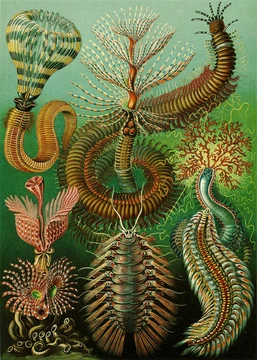
Ascidiacea
Sac-like marine filter feeders with a cellulose tunic.

Ascidiacea, commonly known as ascidians or sea squirts, is a paraphyletic class within the subphylum Tunicata, comprising sac-like marine invertebrate filter feeders. There are approximately 2,300 species, which are categorized into three main types: solitary individuals, social ascidians that form clumped communities by attaching at their bases, and compound ascidians consisting of many small zooids that form large colonies. Some authors now include the thaliaceans (salps, doliolids, and pyrosomes) within Ascidiacea, which would make the group monophyletic.
These animals are found worldwide, typically in shallow waters with salinities exceeding 2.5%. After a free-swimming larval phase, they become sessile, firmly attaching to solid surfaces such as rocks, coral, or shells. Their body is rounded or cylindrical, ranging in size, with one end permanently fixed to the substratum. The lower surface may be pitted or ridged, and some species possess root-like extensions for grip. The body is covered by a tough, often rigid tunic made of cellulose, proteins, and calcium salts; unlike mollusc shells, this tunic is living tissue with its own blood supply. In colonial species, the tunics of adjacent individuals may fuse.
The upper surface features two siphons: a larger oral siphon for intake and a smaller atrial siphon for expulsion. When removed from water, the animal violently expels water from these siphons, giving it the common name "sea squirt." The body is divided into up to three regions: the pharyngeal region containing the pharynx, the abdomen housing most organs, and a postabdomen containing the heart and gonads; however, in many species the postabdomen or entire abdomen is absent. The pharynx is ciliated and perforated with numerous stigmata arranged in a grid pattern. Beating cilia draw water through the oral siphon and across the pharynx, where a mucus sheet produced by the endostyle traps planktonic food particles. The collected food is passed via a dorsal groove into the esophagus, then to the stomach for digestion, and waste exits through the anus into a cloaca near the atrial siphon. The heart is a curved muscular tube that alternates the direction of blood flow every three to four minutes, pumping through sinuses that supply the pharynx, visceral organs, and tunic. Nitrogenous waste in the form of ammonia is excreted directly through the pharyngeal
- common_name
- Sea squirts
- classification
- Paraphyletic class in subphylum Tunicata
- size_range
- 0.5 to 10 cm
- habitat
- Shallow water worldwide, salinity over 2.5%
- distinctive_feature
- Tunic made of cellulose; sessile after larval phase
Lore & Background
Ascidians are rounded or cylindrical animals, ranging from about 0.5 to 10 cm in size. One end is firmly fixed to rock or coral, and the body wall is covered by a smooth, often rigid tunic composed of cellulose, proteins, and calcium salts. The tunic is living tissue with its own blood supply. The upper surface has two siphons; when removed from water, the animal violently expels water, giving it the common name 'sea squirt'. The body can be divided into pharyngeal, abdominal, and postabdominal regions, though many species lack the postabdomen or entire abdomen. They feed by taking in water through the oral siphon, which passes through mucus-covered gill slits into the atrium, then exits through the atrial siphon. The endostyle produces mucus that traps planktonic food particles. The heart is a curved muscular tube that alternates the direction of blood flow every three to four minutes. Blood contains four cell types: lymphocytes, phagocytic amoebocytes, nephrocytes, and morula cells, with some species having pigmented cells containing iron or vanadium.
Reader's Guide
Ascidiacea are significant as a paraphyletic class within Tunicata, illustrating the evolutionary transition from free-swimming larvae to sessile adults. Their larval form possesses a notochord and dorsal nerve tube, clearly indicating chordate affinities and providing insight into vertebrate origins. The presence of an endostyle, homologous to the vertebrate thyroid gland, further underscores their evolutionary importance. Some authors now include thaliaceans in Ascidiacea, making it monophyletic, though this remains a point of dispute. Their unique tunic, composed of cellulose—a material rare in animals—and their ability to accumulate metals like vanadium, make them subjects of biochemical and biomedical interest. Colonial species exhibit complex reproductive strategies, including mixed modes, and their shared cloacal systems demonstrate advanced social organization.
Did You Know?
- The heart of sea squirts alternates the direction of blood flow every three to four minutes.
- The tunic is made of cellulose, a polysaccharide, and is living tissue with its own blood supply.
- Some ascidians have blood cells containing vanadium, giving the blood a green color.
- The endostyle in the pharynx is homologous to the thyroid gland of vertebrates.
More in Marine Invertebrates 1-24
Spotted an error? Know more?
This is a living reference — every entry is fact-audited, and reader corrections feed straight into our audit queue. Suggest an edit · See this site's audit record