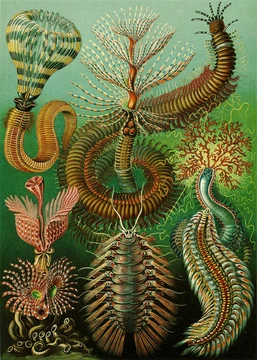
Sea cucumber
Benthic detritivores with a leathery skin and catch collagen.

Sea cucumbers are echinoderms belonging to the class Holothuroidea, and they are exclusively benthic marine animals inhabiting the sea floor across the globe. There are approximately 1,786 known holothuroid species worldwide, with the highest diversity found in the Asia–Pacific region. Their ecological role is significant: as detritivores, they consume detritus and other organic matter, breaking it down so that microbes can further the decomposition process, thereby recycling nutrients within marine ecosystems. The animals are named for their resemblance to the fruit of the cucumber plant, possessing a leathery skin and an elongated body that contains a single, branched gonad. Like all echinoderms, they have a calcified dermal endoskeleton, though in sea cucumbers this is usually reduced to isolated microscopic ossicles (or sclerites) joined by connective tissue; in some species, these ossicles may enlarge into flattened plates that form an armored cuticle. Certain abyssal or pelagic species, such as *Pelagothuria natatrix*, lack a skeleton entirely and have no calcareous ring. Many sea cucumber species are foraged as food, and some are cultivated in aquaculture. The harvested product is considered a delicacy, particularly in Asian cuisines, where it is known by various names including trepang, namako, bêche-de-mer, or balate. Their body shape ranges from almost spherical (as in “sea apples” of the genus *Pseudocolochirus*) to serpent-like (in the order Apodida) or the classic sausage form, with some resembling caterpillars. Most have five rows of tube feet, though the order Apodida lacks these and moves by crawling. A remarkable feature is the “catch” collagen in their body wall, which can be loosened or tightened at will, allowing the animal to liquefy its body to squeeze through small gaps and then firm up again for security.
- class
- Holothuroidea
- typical_length
- 10 to 30 cm (3.9 to 11.8 in)
- extremes_length
- 3 mm (0.12 in) to over 3 m (9.8 ft)
- habitat
- benthic marine, worldwide
- ecological_role
- detritivore
- notable_feature
- catch collagen that can liquefy and tighten body wall
Lore & Background
Sea cucumbers have a leathery skin and an elongated body containing a single, branched gonad; they are named for their overall resemblance to the fruit of the cucumber plant. Like all echinoderms, they have a calcified dermal endoskeleton, usually reduced to isolated microscopic ossicles joined by connective tissue. In some species these can be enlarged to flattened plates forming an armoured cuticle, while in some abyssal or pelagic species the skeleton is absent. Most have five rows of tube feet, though Apodida lacks these and moves by crawling. The mouth is surrounded by tentacles that can be pulled back inside the animal. A remarkable feature is the 'catch' collagen that forms their body wall, which can be loosened and tightened at will, allowing the animal to liquefy its body to squeeze through small gaps and then firm up again.
Reader's Guide
Sea cucumbers are significant as key detritivores in marine ecosystems, recycling nutrients by breaking down organic matter. Their unique collagen-based body wall allows them to inhabit crevices and cracks, contributing to benthic habitat complexity. They are also economically important as a harvested seafood delicacy, particularly in Asian cuisines, where they are known as trepang, namako, bêche-de-mer, or balate. Some species are cultivated in aquaculture systems. Their anatomy, including a water vascular system and respiratory trees that draw water in through the anus, illustrates adaptation to a benthic lifestyle. The absence of a true brain and the presence of a nerve ring that can be surgically removed without impairing movement highlight their decentralized nervous coordination.
Did You Know?
- Sea cucumbers have a 'catch' collagen that can liquefy their body wall to squeeze through small gaps.
- They breathe by drawing water in through the anus and extracting oxygen via respiratory trees.
- Some species, like Pelagothuria natatrix, lack a skeleton and calcareous ring entirely.
More in Marine Invertebrates 1-24
Spotted an error? Know more?
This is a living reference — every entry is fact-audited, and reader corrections feed straight into our audit queue. Suggest an edit · See this site's audit record