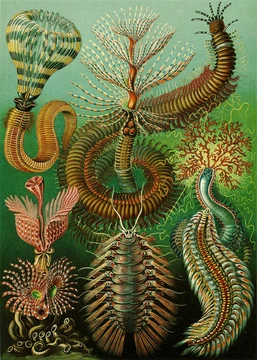
Tardigrade
Micro-animals known for extreme environmental tolerance.

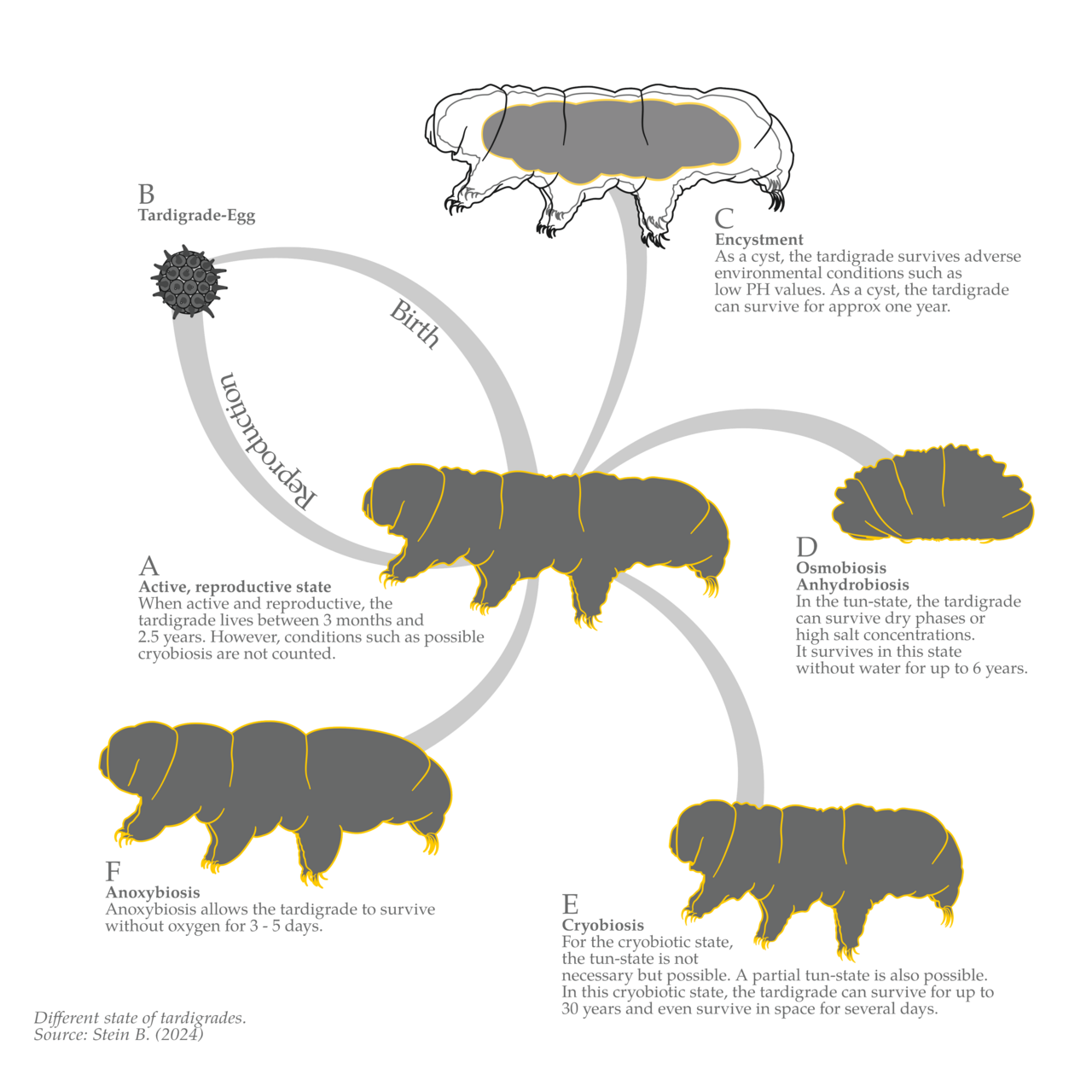
Benjamin Stein · CC BY-SA 4.0
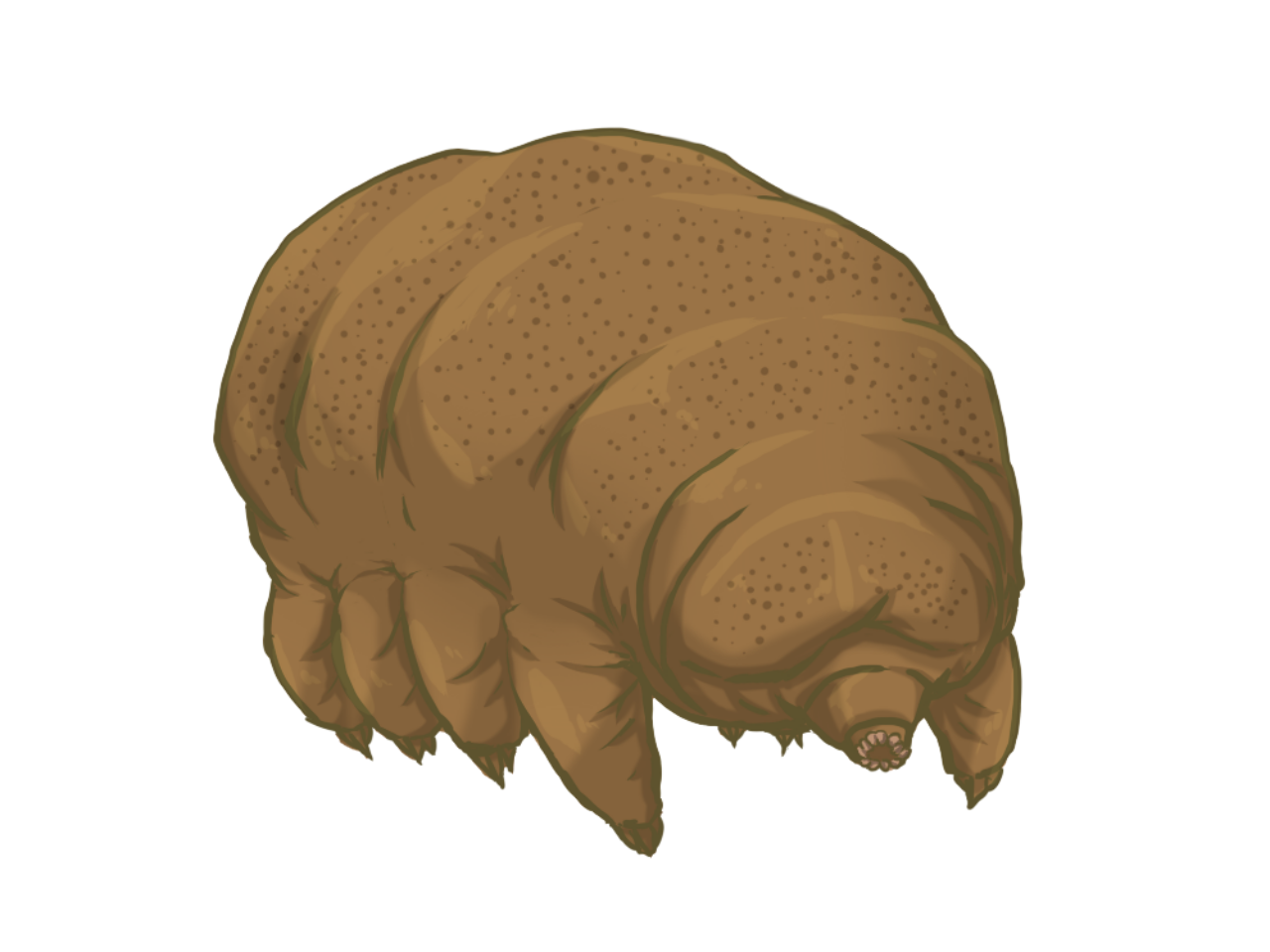
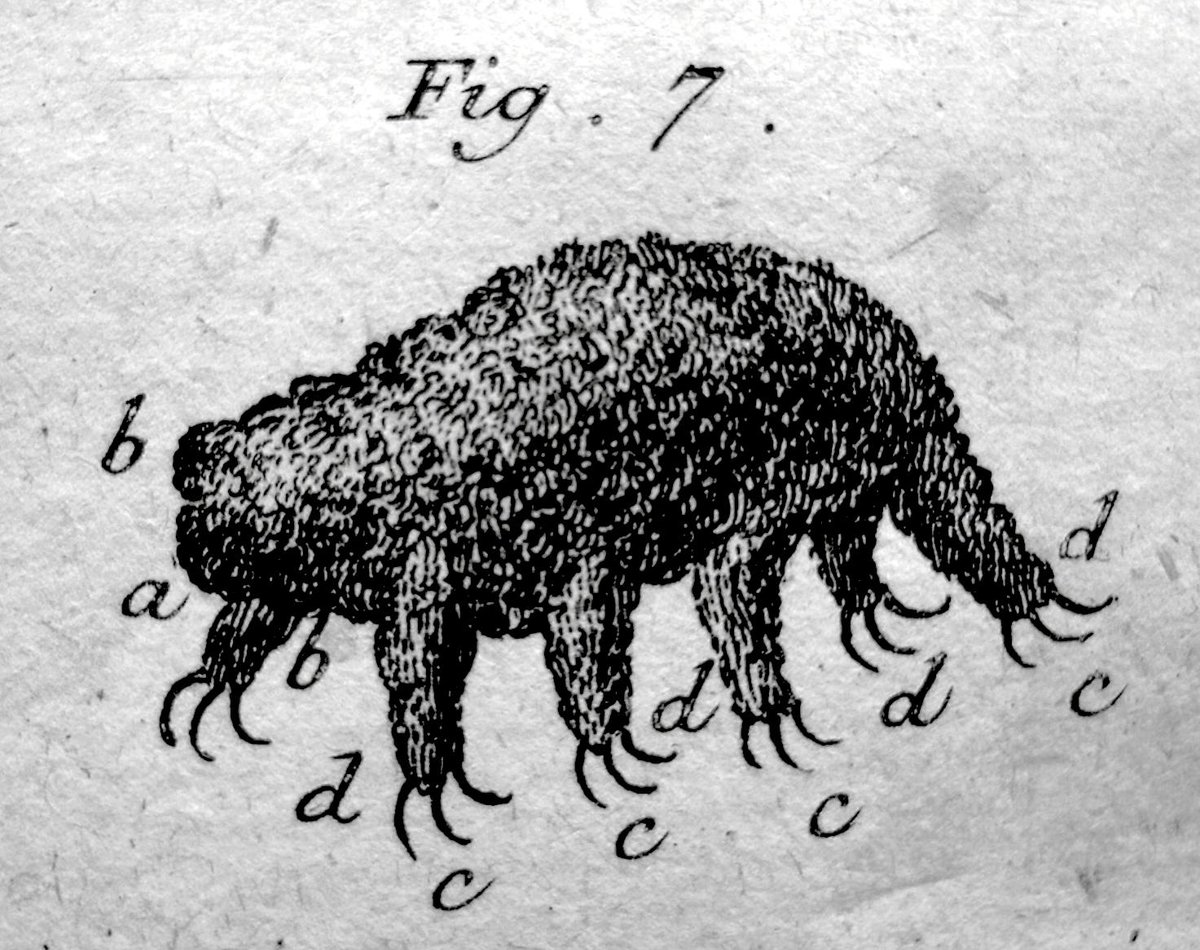
Tardigrades are tiny, eight-legged animals that belong to their own phylum. They are often called water bears or moss piglets. A German zoologist first described them in 1773, giving them the name "little water bear," and an Italian biologist renamed them Tardigrada—meaning "slow walkers"—a few years later.
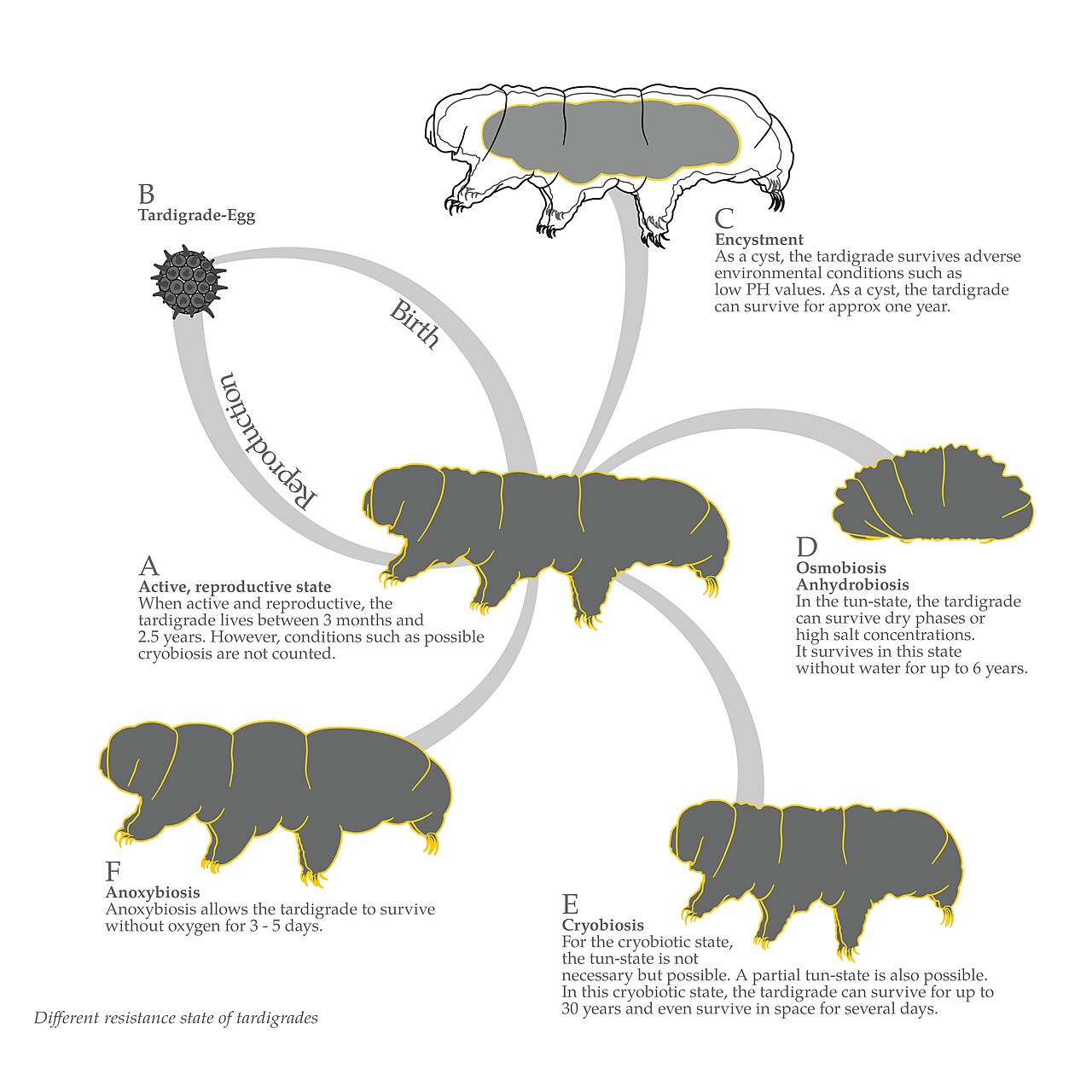
These creatures live in many parts of the world, from mountaintops and tropical rainforests to the deep sea and Antarctica. They are famous for their toughness: individual species can survive extreme heat, cold, high and low pressure, lack of air, radiation, dehydration, and starvation. Some have even survived in outer space. About 1,500 species are known, and the oldest fossil dates back around 500 million years to the Cambrian period. Unlike arthropods, tardigrades lack several Hox genes, and most of their body corresponds to an arthropod’s head rather than its thorax and abdomen.
Fully grown tardigrades are usually about 0.5 mm long, though the largest can reach 1.3 mm. They have a short, plump body and four pairs of legs, each ending in claws (typically four to eight) or sticky pads. Their body cavity is a haemocoel filled with colorless fluid, and they have an open circulatory system. The cuticle covering their body is replaced when they molt; it contains hardened proteins and chitin but is not calcified. In marine species, the legs are telescopic. Tardigrades have no lungs, gills, or blood vessels, so they rely on diffusion through the cuticle and body cavity for gas exchange. They may be eutelic (having a fixed number of body cells at maturity), but evidence suggests this is not always true.
Their nervous system includes a pair of ventral nerve cords with a ganglion for each leg pair, connected to a cerebral ganglion (brain) in the head. They have two eyespots in the brain, plus sensory cirri and hollow antenna-like clavae that likely act as chemoreceptors. One species, *Dactylobiotus dispar*, can be trained to curl into a defensive "tun" state when shown a blue light that was paired with a small electric shock, showing that tardigrades can learn.
Locomotion is not mainly hydrostatic, despite the flexible, fluid-filled body. Instead, muscles work in antagonistic pairs to move each leg forward and backward, with some flexors working against the haemocoel’s hydrostatic pressure. Claws help prevent slipping and aid gripping.
Tardigrades feed by sucking fluids from animal or plant cells, or from detritus. They use a pair of stylets made of aragonite to pierce prey, and pharynx muscles pump the fluids into the gut. Salivary glands secrete digestive fluid into the mouth and produce replacement stylets during molting. Non-marine species have Malpighian tubules for excretion, and some have excretory or other glands between or at the base of the legs.
Most tardigrade species have separate males and females, though some are hermaphroditic and self-fertilizing. Copulation methods vary. Females lay eggs—up to 30, depending on the species. Eggs can be spherical, ovoid, or ornamented with knobs, pyramids, or bottle shapes. Some species appear to have no males, suggesting parthenogenesis is common. Both sexes have a single gonad above the intestine. Males have a pair of ducts opening through a single gonopore in front of the anus; females have a single oviduct opening just above the anus or into the rectum, forming a cloaca. Sperm may be placed into the cloaca, injected through the female’s cuticle into her body cavity, or placed under her cuticle so eggs are fertilized when she lays them into her cast cuticle during molting. In some aquatic species, courtship occurs: the male strokes the female with his cirri to stimulate egg-laying, and fertilization is external. Terrestrial eggs have drought-resistant shells; aquatic eggs are glued to a substrate or left in a cast cuticle.
Tardigrades are common in mosses and lichens, easy to collect and view under a low-power microscope, making them popular with students and amateur scientists. Their clumsy crawling and extreme survival abilities have made them a fixture in science fiction and popular culture, appearing on clothing, statues, soft toys, and crochet patterns.
- phylum
- Tardigrada
- superphylum
- Ecdysozoa
- typical_length
- 0.05 to 0.5 mm
Quick Facts
- Taxon
- Tardigrada
- Subdivision
- Eutardigrada / Heterotardigrada / Mesotardigrada (dubious)
Facts from the source article.
Lore & Background
Tardigrades, also known as water bears or moss piglets, are eight-legged segmented micro-animals that form their own phylum. First described by German zoologist Johann August Ephraim Goeze in 1773, they were named Tardigrada, meaning "slow walkers," by Italian biologist Lazzaro Spallanzani in 1776. They inhabit an extraordinary range of environments across Earth's biosphere, including mountaintops, deep sea trenches, tropical rainforests, and the Antarctic. Their defining characteristic is extreme resilience: individual species can survive exposure to outer space, extreme temperatures, high and low pressures, air deprivation, radiation, dehydration, and starvation—conditions lethal to most other life forms. About 1,500 species are known, with the earliest fossil dating to the Cambrian period around 500 million years ago. Tardigrades lack several Hox genes found in arthropods, and most of their body corresponds to an arthropod's head rather than a thorax or abdomen. Adults are typically about 0.5 mm long, with a short, plump body and four pairs of unjointed legs, each ending in claws (usually four to eight) or sticky pads. They are common in mosses and lichens, easily collected and viewed under a low-power microscope, making them accessible to students and amateur scientists. Their clumsy crawling and legendary survival abilities have made them icons in science fiction and popular culture, inspiring clothing, statues, soft toys, and crochet patterns.
Reader's Guide
Tardigrades are significant as one of the most resilient forms of life, capable of surviving extreme temperatures, pressures, radiation, dehydration, and even outer space. They enter a cryptobiotic 'tun' state when dehydrated, suspending metabolism. Their ability to endure such conditions has made them subjects of scientific study and popular culture, appearing in clothing, statues, soft toys, and crochet patterns. They are cosmopolitan, living in diverse habitats from mountaintops to the deep sea, and are accessible to students and amateur scientists due to their prevalence in mosses and lichens.
Did You Know?
- They can survive exposure to outer space.
- Entering a defensive 'tun' state is an innate survival response to environmental stress, not a learned behavior.
A Long History in Small Packages
Tardigrades, the tiny eight-legged creatures also called water bears or moss piglets, carry a surprisingly rich taxonomic backstory. Genetically, tardigrades diverge from other ecdysozoans in notable ways. They lack several Hox genes that arthropods possess, and their body plan omits the equivalent of an arthropod thorax and abdomen. Instead, the majority of their compact frame is homologous to an arthropod's head, a structural quirk that sets them apart from their more familiar eight-legged cousins.
Masters of the Extreme
Few animals on Earth match the tardigrade's reputation for indestructibility. These micro-animals inhabit an astonishing range of environments, from the peaks of mountains and the crushing depths of the ocean to the humid understory of tropical rainforests and the frozen expanses of Antarctica. What truly sets them apart is their capacity to endure conditions that would be instantly lethal to nearly every other organism. Individual species can weather extreme heat and cold, both crushing and vacuum-level pressures, prolonged absence of oxygen, intense radiation, complete dehydration, and extended starvation. Most remarkably, tardigrades have been exposed to the vacuum of outer space and survived. Their cosmopolitan spread is aided by their tiny eggs and dormant life stages, known as cysts and tuns, which are small and tough enough to hitch rides on the feet of larger animals or drift on the wind across vast distances. This combination of global reach and extraordinary tolerance makes them one of the most hardy animal groups ever documented.
Anatomy of a Tiny Giant
Despite their diminutive size—most species measure between 0.05 and 0.5 millimetres, with the largest reaching 1.3 millimetres—tardigrades possess a surprisingly intricate internal architecture. Their short, plump bodies are supported by four pairs of hollow, unjointed legs, each tipped with claws numbering four to eight, or in some species, adhesive pads. The body cavity is a haemocoel, an open circulatory space filled with a clear fluid, and because tardigrades have no lungs, gills, or blood vessels, all gas exchange occurs by simple diffusion across the cuticle and into the body cavity. The outer covering is a cuticle rich in hardened proteins and chitin but lacking calcium, and it is shed and renewed at each moult. Their nervous system features a pair of ventral nerve cords with ganglia serving each leg, converging at a dorsal cerebral ganglion that also houses two eyespots and several sensory structures. Locomotion relies on antagonistic muscle pairs rather than purely hydrostatic mechanisms, and feeding involves a pair of aragonite stylets that pierce prey while pharyngeal muscles pump out the cell fluids.
Reproduction and the Tun State
Tardigrade reproduction is as varied as their habitats. While some species are hermaphroditic and capable of self-fertilisation, the majority have distinct male and female individuals, and in certain lineages no males appear to exist at all, pointing to widespread parthenogenesis. Mating strategies differ across species: a male may deposit sperm into the female's cloaca, pierce her cuticle to deliver sperm directly into the body cavity for fertilisation within the ovary, or place sperm beneath the cuticle so that when she moults and lays eggs into the shed exoskeleton, fertilisation occurs there. In some aquatic species, courtship involves the male gently stroking his partner with his cirri to prompt egg-laying, followed by external fertilisation. Females produce up to thirty eggs, whose shapes vary from smooth spheres to ovoid forms with pyramidal or bottle-shaped surface patterns. Terrestrial eggs are encased in drought-resistant shells, while aquatic species either cement their eggs to a substrate or deposit them in a cast cuticle. Hatching typically occurs within fourteen days, and the young use their own stylets to break free from the shell.
Gallery
Frequently Asked Questions
What is a Tardigrade?
Tardigrades are a phylum of tiny, eight-legged, segmented micro-animals that people often call water bears or moss piglets. They sit within the superphylum Ecdysozoa and are found in a wide range of aquatic and damp habitats.
What makes Tardigrades so famous among invertebrate fans?
They are widely regarded as the most environmentally hardy animals known, tolerating conditions that would be instantly lethal to nearly every other creature. Their extreme resilience even extends to surviving direct exposure to the vacuum of outer space.
More in Marine Invertebrates 1-24
Spotted an error? Know more?
This is a living reference — every entry is fact-audited, and reader corrections feed straight into our audit queue. Suggest an edit · See this site's audit record