Burasa
Bugis rice dumpling cooked with coconut milk in banana leaf.

Burasa (pronounced ['bu:rasaʔ]), also known as burasak or buras, is a rice dumpling from the Bugis people, made by cooking rice in coconut milk and wrapping it in a banana leaf pouch. It resembles lontong but has a richer taste due to the coconut milk. This dish is a specialty of the Bugis and Makassar communities in South Sulawesi, and it is also common among the Bugis diaspora in the Malaysian states of Johor, Selangor, Sabah, and Sarawak. It often serves as a staple in place of steamed rice or ketupat, and pairs well with a rich chicken dish braised with galangal (known as *ayam masak lengkuas* in Malay or *likku*/*lekku* in Buginese).
To prepare burasa, rice is first steamed until half-cooked, then cooked further in coconut milk seasoned with *daun salam* (Indonesian bay leaf) and salt until all the liquid is absorbed. The partially cooked rice is then wrapped in banana leaves into cylindrical or pillow shapes, tied with string—often made from banana leaf fibers—with two cylinders typically bound together. These packages are steamed again until fully cooked.
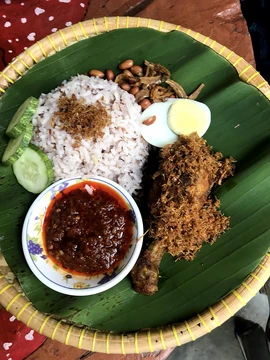
In Indonesia, burasa can be eaten as a snack with *serundeng* (spiced shredded coconut), hard-boiled egg, or *sambal kacang* (spicy peanut sauce). Bugis and Makassar people often eat it as a substitute for steamed rice or ketupat, commonly alongside *coto Makassar*, *konro*, *pallubasa*, or *lekku*. It is also frequently taken as travel provisions or rations during sailing trips.
Quick Facts
- Country
- Indonesia
- National Cuisine
- Indonesia, and Malaysia
- Region
- South Sulawesi
- Main Ingredient
- Rice, coconut milk, serundeng
Facts from the source article.
Lore & Background
Burasa is made by steaming rice until half-cooked, then cooking it further in coconut milk mixed with daun salam and salt until all the coconut milk is absorbed. The half-cooked coconut milk rice is then wrapped inside banana leaves in cylindrical or pillow shapes, secured with strings—most commonly from banana leaf fibers—with two cylinders usually tied together as one. The packages are then steamed further until completely cooked.
Reader's Guide
Burasa holds significance as a staple food for the Bugis and Makassar people of South Sulawesi, often consumed as a replacement for steamed rice or ketupat. It is a popular accompaniment to rich dishes such as chicken braised with galangal (ayam masak lengkuas, or likku/lekku in Buginese), as well as coto Makassar, konro, and pallubasa. In Indonesia, burasa can also be eaten as a snack with serundeng, hard-boiled egg, or sambal kacang. The dish is notably associated with the Bugis diaspora, particularly in Malaysian states with large established Bugis communities. Its portable banana-leaf wrapping made it a common food provision or ration for sailing or travelling.
Did You Know?
- Burasa is similar to lontong but has a richer flavour from coconut milk.
- Two cylinders of burasa are usually tied together as one.
- It is often taken as food provisions or rations during sailing or travelling.
- Burasa is a dish associated with the Bugis diaspora in Johor, Selangor, Sabah, and Sarawak.
More in Malaysian cuisine 1-24
Spotted an error? Know more?
Reader corrections go straight into our review queue. Suggest an edit · How this site is sourced