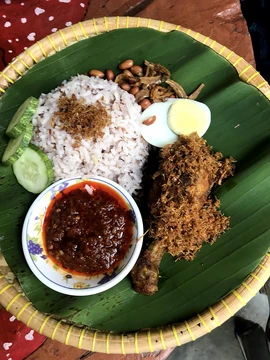
Penang cuisine
Multicultural hawker cuisine of Penang, Malaysia.

Penang's cuisine reflects the multicultural makeup of the Malaysian state. Most dishes are sold from roadside stalls, often called hawker food or, informally, "makan carts." Locals find these meals cheaper and more convenient than eating in restaurants, since the stalls are everywhere and stay open for most of the day and night. Lonely Planet named Penang the top culinary destination in 2014. Indian snacks include apom, a thin-skinned pancake that is crispy outside and soft, thick in the middle, with no fillings. Appalam is a thin, crisp disc-shaped crackler made from seasoned black gram dough, fried or dry-cooked; other flours like lentil, chickpea, rice, or potato may be used. Samosa is a fried or baked pastry with a savory filling such as spiced potatoes, onions, peas, lentils, macaroni, noodles, or minced meat. Bhajji is a spicy fritter-like snack, and vadai is another Indian snack. Chinese snacks include eu char kuih, deep-fried bread sticks often eaten with congee or almond cream. Lor bak is marinated minced pork rolled in thin soybean sheets and deep-fried, served with a thick, sweet dark sauce (often hoisin-based) or a vinegar-chili dip, plus chili sauce. Phong pneah is a light brown pastry filled with melted white sugar. Peranakan popiah is a Teochew-style spring roll filled with turnip, beancurd, egg bits, chili paste, and sweet sauce. Malay otak-otak blends fresh fish fillets with light spices, coconut milk, kaffir lime leaves, and other herbs into a fish mousse, which is wrapped in banana leaves and steamed or grilled. The dish is said to have originated in Johor. Banana leaf rice consists of white or parboiled rice served on a banana leaf with vegetables, curried meat or fish, pickles, and papadum. It is a favorite local food, especially in Little India within the George Town Heritage zone. Satti sorru, or Indian claypot rice, has curry gravy mixed into rice to clean out the pan or wok the curry was cooked in. Biryani, also called nasi beriani, comes in many variants. Fish head curry stews the head of a red snapper with okra, tomatoes, and brinjals in curry, usually served with rice; a place called Passion of Kerala at New World Park on Burmah Road is famous for this dish.
- Field
- Cuisine
- Nationality
- Malaysian (Penang)
- Known for
- Street food culture, multicultural dishes
- Notable rankings
- Voted by Lonely Planet as the top culinary destination in 2014
Lore & Background
Penang cuisine reflects the island's multicultural society, with dishes originating from Indian, Chinese, Peranakan, and Malay traditions. Snacks include Indian apom, appalam, samosa, bhajji, and vadai; Chinese eu char kuih, lor bak, and phong pneah; Peranakan popiah; and Malay otak-otak. Main dishes range from banana leaf rice and fish head curry to Hainanese chicken rice, Penang laksa, and nasi kandar, with many sold at hawker stalls.
Reader's Guide
Penang cuisine is significant for its role in the daily life of Penangites, offering affordable and accessible meals through ubiquitous hawker stalls. The cuisine's diversity—spanning Indian, Chinese, Peranakan, and Malay influences—has garnered international recognition, including a CNN Travel ranking as one of Asia's top street food cities in 2013 and Lonely Planet's top culinary destination in 2014. Dishes like char koay teow, nasi kandar, and cendol are emblematic of this street food culture, which remains a central part of Penang's identity and tourism appeal.
The Multi-Ethnic Table: A Melange of Traditions
The culinary landscape of Penang, situated within Peninsular Malaysia, is shaped by a population that divides roughly among three major groups—Malays, Chinese, and Indians—with further contributions from the indigenous Orang Asli, Peranakan and Eurasian creole communities, and a significant presence of foreign workers and expatriates. This demographic reality ensures the kitchen is never the province of a single tradition. Chinese cooking in the region draws predominantly on southern Chinese roots spanning Fujian, Teochew, Cantonese, Hakka, and Hainanese lineages, while Indian cooking blends northern and southern Indian techniques with Sri Lankan touches, often distinguishable by whether curries lean drier or wetter in preparation. Malay, Indonesian, Thai, Filipino, and Bornean indigenous traditions all leave their marks, layered with lighter or heavier influences from Arab, Portuguese, Dutch, and British cuisines. The result is a table where no single ethnic narrative dominates; the food itself becomes the living record of who arrived, who stayed, and who cooked side by side.
Maritime Crossroads: Trade, Colonisation, and the Arrival of New Ingredients
The roots of this cuisine stretch back to the 1400s, during the era of the Malacca Sultanate, when the region became a critical node in maritime trade. Arab merchants passing through carried Middle Eastern spices into local kitchens, while Portuguese, Dutch, and English traders and colonists introduced entirely new staples—peanuts, pineapples, avocados, tomatoes, squash, and pumpkin—that would eventually become everyday ingredients in home cooking. The 19th century, under British colonial administration, saw waves of Indian and Chinese laborers arrive, each bringing their own cooking traditions and deepening the diversity of flavors on the table. The modern Malaysian state was not formally established until 1963, yet the culinary identity had already been forged centuries earlier through this continuous exchange of people, spices, and techniques. Penang's position on the peninsula places it squarely within this shared Peninsular history, meaning its kitchens inherit the full weight of that maritime and colonial past, with every ingredient telling a story of a long voyage.
Adaptation and Fusion: Dishes That Crossed Cultural Lines
One of the most striking features of the region's food culture is how readily communities borrow and reshape one another's dishes to suit their own palates. Chinese Malaysians, for instance, took the Indian curry and softened it—making the broth more dilute and the heat less aggressive—to align with their own taste. Chinese noodles, when crossed with Indian and Malay seasoning philosophies, gave rise to distinct Malay fried noodles and Indian fried noodles, each a hybrid born at the intersection of different techniques. The adaptation of Thai tom yam is perhaps the most vivid example of this creative borrowing: in its Malay form, the soup takes on the visual character of an Assam gravy, thickened with pounded chili paste that lends a vivid orange-red hue, sweetened, soured with tamarind rather than lime, and spiced with dried chilies for a fiery kick. It tends to be heavily seafood-based. In Chinese-style eateries, the same dish is mellowed in heat and served as a base for noodle soup. Neither version claims originality; both are bold reimaginings.
Transboundary Flavors: A Shared Archipelago Table
Because Peninsular Malaysia shares a common history with Singapore, the same dishes appear on both sides of the border regardless of where they originated—laksa and chicken rice being prime examples. The culinary ties extend further: proximity, historic migration, and close ethnic and cultural kinship link the region to Indonesia, Thailand, and the Philippines, with shared dishes like satay and rendang crossing national lines as naturally as people once did. Across the sea, Borneo's states of Sabah and Sarawak contribute their own thread to the broader Malaysian table. There, rivers serve as the primary highways for inland communities, and the jungles yield wild plants, fungi, and fruits while coastlines and rivers provide abundant seafood and freshwater fish. Indigenous groups have developed preservation techniques—curing, fermenting, preserving—out of necessity for festivals and important occasions. The Murut of Sabah, for example, prepare tamba by stuffing raw wild boar or river fish into bamboo tubes with rice and salt, left to ferment for several weeks. The Brunei Sultanate's former thalassocratic reach also left a lasting mark on the cookery of coastal Muslim communities in East Malaysia.
Frequently Asked Questions
Who is Penang cuisine?
Penang cuisine is the multicultural street-food tradition of Penang, Malaysia, where Malay, Chinese, and Indian culinary influences mingle at roadside hawker stalls locals affectionately call "muckan carts."
What is Penang cuisine known for?
Its superpower is serving diverse, high-quality meals at prices far below restaurant fare, with stalls scattered everywhere and open for most of the day and night.
Why is Penang cuisine important?
It acts as an edible snapshot of Penang's multicultural society, folding Indian treats like the crispy-yet-soft apom pancake alongside Chinese and Malay dishes into one shared hawker-stall experience.
What's Penang cuisine's signature move?
The hawker cart itself—so pervasive and convenient that everyday Penangites simply treat the street stalls as their default dining room rather than seeking out a restaurant.
More in Malaysian cuisine 1-24
Spotted an error? Know more?
Reader corrections go straight into our review queue. Suggest an edit · How this site is sourced