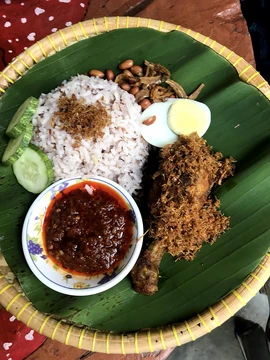
Acar
A vegetable pickle of Maritime Southeast Asia derived from Indian achar.

Acar is a vegetable pickle from Maritime Southeast Asia, most common in Indonesia, Malaysia, Singapore, and Brunei. It is a regional adaptation of Indian achar, and in Dutch cuisine it is called atjar. Typically made in large batches, acar can be stored in a sealed glass jar in the refrigerator for about a week and is used as a condiment alongside various meals.
Pickling began in India around 2400 BCE. As Indian cultural influence spread through Hinduism and the Indianisation of Southeast Asia, local kingdoms adopted many Indian practices, including food preservation. The name "acar" closely resembles the Indian "achar," suggesting a direct link. This pickling technique likely reached the maritime region during the Srivijaya period, between the 7th and 13th centuries. British navigator Thomas Forrest noted that acar made from salted limes and palm vinegar was used by Coromandel Muslim sailors (Chulias) to prevent scurvy and was traded as far as Aceh.
The Southeast Asian versions typically include vegetables like cucumber, carrots, cabbage, shallot, bird's eye chili, and yardlong beans, pickled in vinegar, sometimes with kaffir lime or dried chilies. Some recipes add ground peanuts. Acar is served as a condiment with main dishes such as martabak, nasi goreng, satay, and various soto. Its sour taste helps freshen a meal, especially fishy dishes like ikan bakar or rich, oily foods like mutton satay.
In Indonesia, acar often uses small chunks of cucumber, carrot, shallot, bird's eye chili, and sometimes pineapple, marinated in a sweet and sour mix of sugar and vinegar. Some households add lemongrass or ginger. It is commonly paired with grilled foods like satay but can also be a main dish, such as ikan acar kuning, where fish is served with acar pickles and a yellow spice paste. In Dutch cuisine, it is called atjar, reflecting colonial ties with Indonesia. Malaysian and Singaporean variations include acar awak (or Nyonya acar) and Malay acar, with acar awak being more elaborate, adding vegetables like eggplant and aromatic spices. In Thailand, the dish is called achat, made with cucumber, red chilies, red onions or shallots, vinegar, sugar, and salt, and served with Thai satay. In South Africa, brought by Indian and Malay slaves under British rule, atchar is a popular condiment, often made with green mangoes.
Quick Facts
- Region
- Indonesia, Brunei, Malaysia, the Netherlands, Singapore, South Africa and Thailand
- Course
- Side dish
- Main Ingredient
- Vegetables (cucumber, carrots, cabbage), shallot, bird's eye chili and yardlong beans, vinegar, dried chillies, pineapples
Facts from the source article.
Lore & Background
Pickling originated in India around 2400 BCE. With the expansion of Indian cultural influence on Greater India through transmission of Hinduism leading to Indianisation, native Southeast Asian kingdoms adopted many Indian cultural elements, including food processing techniques. The similar sounding name strongly suggests that acar was derived from the Indian achar pickle. Indian achar was transmitted in antiquity to the maritime realm of Southeast Asia, which today is recognized as acar in Indonesia, Malaysia, Singapore and Brunei, and then on to the Philippines as atchara. The adoption of this vegetable pickling technique possibly took place during the Srivijaya period between 7th to 13th century. British navigator Thomas Forrest wrote that acar made of salted limes and palm vinegar was often of use to Coromandel Muslim sailors (Chulias) to prevent scurvy and was sold as far as Aceh.
Reader's Guide
Acar holds significance as a preserved condiment that reflects the historical transmission of Indian pickling techniques to Southeast Asia, likely during the Srivijaya period. Its widespread presence across Indonesia, Malaysia, Singapore, Brunei, and the Philippines (as atchara) demonstrates its integration into regional cuisines. The Dutch adoption as atjar highlights colonial ties between the Netherlands and Indonesia. Acar's versatility is shown in its use as a condiment for dishes like satay, nasi goreng, and soto, or as part of complete dishes such as ikan acar kuning. Variations exist: Indonesian acar often includes cucumber, carrot, shallot, bird's eye chili, and pineapple in a sweet-sour solution; Malaysian and Singaporean acar awak adds eggplant and aromatic spices; Thai achat uses cucumber, red chilies, and shallots; and South African atchar, brought by Indian and Malay slaves, is made with green mangoes. The sour taste of acar is meant to freshen meals, especially fishy or rich dishes, neutralizing fat. Its ability to be stored for a week in a refrigerator makes it a practical staple.
Did You Know?
- Acar is a localized version of Indian achar, with the name derived from the Indian pickle.
- In Dutch cuisine, acar is known as atjar, reflecting colonial ties between the Netherlands and Indonesia.
- Acar can be stored in a well-sealed glass jar in a refrigerator for up to a week.
Ancient Roots and Maritime Transmission
The practice of pickling vegetables traces back to India roughly four thousand years ago, around 2400 BCE. As Indian cultural influence radiated outward through the spread of Hinduism and the broader Indianisation of surrounding regions, native kingdoms across maritime Southeast Asia absorbed a wide range of Indian traditions, and food-processing techniques were no exception. Linguistic evidence reinforces this connection: the name "acar" closely mirrors the Indian word "achar," strongly implying a direct lineage. Scholars suggest the vegetable-pickling technique reached the islands during the Srivijaya era, spanning the seventh through thirteenth centuries. From there it spread further, becoming atchara in the Philippines. A particularly vivid historical snapshot comes from British navigator Thomas Forrest, who recorded that Coromandel Muslim sailors known as Chulias relied on a preparation of salted limes and palm vinegar—essentially an early form of acar—to ward off scurvy at sea, and that the product was traded as far north as Aceh. This maritime thread links the humble pickle to centuries of seafaring survival and cross-cultural exchange.
Ingredients and the Role of Sourness
Across the region, the core vegetables vary but tend to include cucumber, carrot, cabbage, shallot, bird's-eye chili, and yardlong beans. These are submerged in a vinegar-based brine, and many cooks add kaffir lime to introduce a bright citrus note alongside dried chillies for heat. In some households the finished pickle is tossed with ground peanuts, lending a nutty texture. The defining purpose of acar on the table is to cut through richness. Its sharp, sour bite is designed to reset the palate, making it a natural companion to fatty or strongly flavored mains. It appears alongside fried rice (nasi goreng), martabak, satay skewers, and virtually every style of soto soup. It is especially prized next to grilled fish (ikan bakar), where the acidity offsets the fishiness, or beside mutton satay, where it neutralizes the heavy fat. In this way, acar functions less as a standalone dish and more as a culinary counterweight, a small jar of brightness that balances an entire plate.
A Pickle That Crossed Borders
What began as a localized Indian technique has branched into a remarkable family of regional dishes. In Indonesia, the classic version features small chunks of cucumber, carrot, shallot, and bird's-eye chili—sometimes pineapple—marinated in a sweet-sour sugar-and-vinegar solution, with some families adding lemongrass or ginger for extra warmth. It can also anchor an entire plate: ikan acar kuning serves fish such as gourami, mackerel, or tilapia nestled in the pickle alongside a yellow spice paste of turmeric, candlenut, ginger, garlic, and shallot. The Dutch colonial connection gave the world "atjar," a direct borrowing from Indonesian. In Malaysia and Singapore, the more elaborate Nyonya acar (acar awak) introduces eggplants and additional aromatic spices, while the Malay version stays closer to the simpler formula. Thailand adopted the concept as achat, pairing cucumber, red chilies, red onions, vinegar, sugar, and salt with its own satay. In South Africa, Indian and Malay people initially brought by the British Empire popularized a local atchar made with green mangoes. The Philippines carries the tradition forward as atchara.
Kitchen Practicality and Everyday Presence
One of acar's most practical qualities is its simplicity of storage and preparation. Because the vinegar brine preserves the vegetables effectively, cooks typically make it in generous batches and keep the finished product in a tightly sealed glass jar in the refrigerator, where it remains fresh for roughly a week. This makes it an ideal pantry staple: a small jar can be opened and spooned over whatever meal is on the table that day, from a quick grilled-fish dinner to a weekend spread of satay and fried rice. The bulk-preparation habit also suits communal eating, where a shared bowl of pickle sits at the center of the table and diners help themselves. In Indonesian households, the pickle is not merely a garnish but a regular, expected component of the meal, so much so that its absence would feel like a missing note. Whether served as a condiment or elevated into a complete dish like ikan acar kuning, acar occupies a flexible, everyday role that has kept it firmly embedded in the daily rhythms of Maritime Southeast Asian kitchens for centuries.
Frequently Asked Questions
What is Acar?
Acar is a vegetable pickle that serves as a tangy condiment across Maritime Southeast Asia, especially in Malaysia, Indonesia, Singapore, and Brunei. It is typically prepared in large batches and eaten alongside a variety of main dishes.
Where does Acar come from?
Acar is a local evolution of the Indian dish achar, whose pickling roots stretch back to roughly 2400 BCE in India. As Hinduism and broader Indian cultural influence spread through Southeast Asia, regional kingdoms adopted these preservation techniques and reshaped them into their own culinary traditions.
How long does Acar last and how should it be stored?
Because it is usually made in generous quantities, Acar is best kept in a sealed glass jar in the refrigerator, where it will remain fresh for about a week.
How is Acar typically used in a Malaysian meal?
Acar functions mainly as a side condiment rather than a standalone dish, bringing a sharp, tangy contrast to the plate. It is commonly placed alongside the main course to cut through richer or spicier flavors.
What are other names for Acar in different cultures?
In Dutch culinary tradition the same preparation is called atjar, while the Philippines uses the name atchara and Thailand refers to it as achat. These variations all trace back to the shared Indian achar origin that spread through trade and cultural exchange.
More in Malaysian cuisine 1-24
Spotted an error? Know more?
Reader corrections go straight into our review queue. Suggest an edit · How this site is sourced