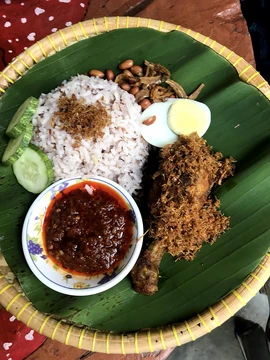
Ipoh cuisine
Ipoh cuisine blends Chinese, Malay, and Indian flavors.

Ipoh cuisine refers to the food culture of Ipoh, a city in Malaysia with a significant food scene driven by its plurality Chinese population, largely of Cantonese and Hakka descent, alongside Malay and Indian influences. The cuisine is known for dishes derived from Malay, Chinese, and Indian culinary traditions, and has seen an increase in international restaurants, bars, and gastropubs popular with locals and tourists.
- Field
- Cuisine
- Nationality
- Malaysian (Ipoh)
- Known for
- Ipoh white coffee, bean sprouts chicken, heong peng, nasi ganja
- Key influences
- Cantonese, Hakka, Malay, Indian
- Notable export
- Ipoh white coffee
Lore & Background
Ipoh's food culture is shaped by its majority Chinese population, particularly those of Cantonese and Hakka descent, who have contributed dishes such as bean sprouts chicken, Hakka mee, and salt-baked chicken. Malay and Indian foods are also prominent, including nasi kandar from a Mamak stall in continuous operation since the 1950s, nicknamed nasi ganja for its supposed addictive properties. Specialty foods from neighboring towns are available in Ipoh, such as curry chicken bread from Kampar.
Reader's Guide
Ipoh cuisine is significant for its distinctive dishes and exports, most notably Ipoh white coffee, made from coffee beans roasted with palm oil margarine, which originated in Ipoh's Old Town and inspired the OldTown White Coffee restaurant chain. The cuisine's legacy includes a wide array of savory dishes like Ipoh laksa, sar hor fun, and claypot chicken rice, as well as desserts like heong peng and chicken biscuits, which are popular souvenirs. The food scene continues to evolve with international influences while maintaining traditional hawker centers and restaurants.
Did You Know?
- Ipoh white coffee is made from coffee beans specially roasted with palm oil margarine.
- The nasi kandar from a prominent Mamak stall in Ipoh is nicknamed nasi ganja due to its supposed addictive properties.
- Heong peng, a flaky biscuit with sweet filling, is famous in the suburb of Gunung Rapat.
- Ipoh's chee cheong fun is served with minced pork and mushroom sauce, unlike the version in Kuala Lumpur.
The Multi-Ethnic Tapestry
Malaysian food culture is fundamentally shaped by the country's extraordinary demographic diversity. The population is broadly divided among Malay, Chinese, and Indian communities, but the full picture also includes the indigenous peoples of Sabah and Sarawak in East Malaysia, the Orang Asli of the peninsula, Peranakan and Eurasian creole groups, and a significant foreign worker and expatriate presence. This layered mosaic means that a single dining table can echo centuries of migration, trade, and settlement. The Chinese community's culinary heritage draws heavily on southern Chinese traditions—Fujian, Teochew, Cantonese, Hakka, and Hainanese—while the Indian community's food, despite its southern Indian origins, blends north-south Indian and Sri Lankan elements, often set apart by whether curries are prepared in a drier or wetter style. The outcome is a national food identity that no single ethnic tradition can claim as its own.
Maritime Trade and Colonial Ingredients
The culinary foundations of the region reach back to the fifteenth century, when the Malacca Sultanate turned the surrounding waters into a critical artery of maritime commerce. Arab merchants passing through the strait carried Middle Eastern spices, while successive waves of Portuguese, Dutch, and English colonists and traders introduced entirely new food staples: peanuts, pineapples, avocados, tomatoes, squash, and pumpkin. The nineteenth century added another transformative layer under British colonial rule, as large numbers of Indian and Chinese laborers were recruited to the region, each bringing their own cooking traditions and ingredients. The modern Malaysian kitchen is therefore not a single inherited recipe book but a layered palimpsest—local Malay and indigenous Bornean practices interwoven with Indian, Chinese, Indonesian, Thai, Filipino, and Arab influences, plus lighter touches from Portuguese, Dutch, and British cooking. No single era or culture can claim ownership of the result.
Cross-Cultural Culinary Adaptation
One of the most distinctive features of Malaysian food is the willingness of communities to adopt, modify, and ultimately make their own dishes that originated elsewhere. Chinese Malaysians, for example, have taken the Indian curry and rendered it more dilute and less fiery to suit their palates, while Chinese noodle traditions have merged with Indian and Malay flavor profiles to produce distinctly local fried noodle varieties. A particularly striking case is tom yam, a dish originally from Thailand, which after crossing into Malaysia has taken on the visual character of a local assam gravy. Its flavor shifts toward a sweet-sour-spicy balance, it is thickened with pounded chili paste for a vivid orange-red hue, and tamarind replaces lime juice as the souring agent. Dried chilies supply the heat rather than fresh ones. In Malay-style kitchens the soup leans heavily on seafood, whereas in Chinese-style restaurants the spiciness is toned down and the broth is typically served as a base for noodle soup.
Borneo's Foraged and Fermented Traditions
Across the sea in Sabah and Sarawak, culinary life remains closely tied to the natural environment. Outside the major cities, rivers often serve as the primary highways for inland communities, and the surrounding jungles offer wild plants, fungi, and fruits, while sweeping coastlines and large rivers supply abundant seafood and freshwater fish. Because fresh produce has historically been scarce for nomadic and semi-nomadic groups, preservation techniques—curing, fermenting, and salting—became essential, especially for festivals and important gatherings. The Murut people of Sabah, for instance, prepare tamba by stuffing raw wild boar or river fish with rice and salt inside bamboo tubes and allowing it to ferment for several weeks, a method also practiced by the Lun Bawang across the Sarawak border. Dayak households in Sarawak might sauté their own fermented meat with garlic and pickled tapioca leaves, while tempoyak, a fermented durian product, features prominently in everyday cooking. The Bruneian Malay community, a legacy of the old Brunei Sultanate's maritime reach, has left a lasting imprint on the coastal Muslim cuisines of East Malaysia.
Frequently Asked Questions
What is Ipoh cuisine?
Ipoh cuisine is the food culture rooted in the Malaysian city of Ipoh, built around a large Cantonese and Hakka Chinese population that coexists with Malay and Indian communities. It is recognized as a distinct regional scene where all three culinary traditions overlap and influence one another.
What dishes is Ipoh cuisine most famous for?
The go-to signature items are Ipoh white coffee, bean sprouts chicken (heong peng), and nasi ganja. These dishes are what most food travelers and locals point to when describing the city's identity on a plate.
Which cultural traditions shaped the flavors of Ipoh cuisine?
Cantonese and Hakka Chinese cooking form the backbone, while Malay and Indian techniques and spices are woven in alongside. This multi-ethnic layering is what gives Ipoh's dishes their particular depth and variety.
What is Ipoh cuisine's most notable export?
Ipoh white coffee is the standout product, widely recognized well beyond the city as its own distinct style of brewed coffee. It has become the single most recognizable item the region is known for internationally.
Why is Ipoh cuisine considered important in the broader Malaysian food landscape?
It stands as one of the clearest examples of multi-ethnic culinary fusion in Malaysia, drawing both domestic and international food travelers. The scene has also grown to include gastropubs and international restaurants, cementing Ipoh's status as a dedicated food destination.
More in Malaysian cuisine 1-24
Spotted an error? Know more?
Reader corrections go straight into our review queue. Suggest an edit · How this site is sourced