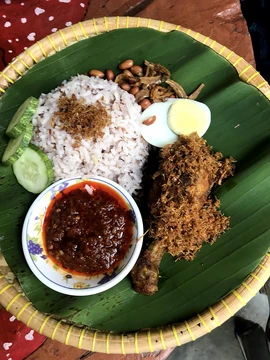
Peranakan cuisine
A fusion cuisine of Chinese, Malay, and other influences.

Peranakan cuisine, often called Nyonya cuisine, was developed by the Peranakan people—the descendants of early Chinese migrants who married local Malays in Penang, Malacca, Singapore, and Indonesia. In Baba Malay, a Peranakan woman is called a nonya (or nyonya), and a man is called a baba. This cooking style blends Chinese ingredients with Malay, Javanese, South Indian, and other traditions, creating dishes that are tangy, aromatic, spicy, and herbal.
Nyonya cooking often reinterprets Malay and Indonesian food, using Chinese ingredients alongside local spices and techniques. It also adopts Malay dishes like assam fish and beef rendang. Key ingredients include coconut milk, galangal, candlenuts (used for flavor and thickening), laksa leaf, pandan leaves, belachan, tamarind juice, lemongrass, torch ginger bud, jicama, kaffir lime leaf, and cincalok—a pungent, sour, salty shrimp condiment often mixed with lime, chilies, and shallots.
Regional differences exist. Penang’s dishes show Thai influence, with more tamarind and sour elements. Singapore and Malacca’s cooking leans Indonesian, using more coconut milk. A classic example is laksa: Penang’s sour asam laksa contrasts with the coconut milk–based laksa lemak from Singapore and southern Malaysia.
The flavor of laksa and other Nyonya recipes comes from rempah, a Malay term for spices. These are pounded into a paste with a mortar and pestle to a specific texture and density. It is said a Nyonya can judge a new daughter-in-law’s cooking skill by listening to her prepare rempah. Recipes are passed down through generations, and because preparation is time-consuming, the cuisine is often best enjoyed at home—though laksa is a notable exception.
Specialties include otak-otak (fish, coconut milk, chili paste, galangal, and herbs wrapped in banana leaf), ayam buah keluak (chicken with nuts from the kepayang tree in a rich sauce), and itek tim (duck soup with tomatoes, green peppers, salted vegetables, and preserved sour plums). Desserts include colorful cakes (kue) and sweet, sticky treats.
- Field
- Cuisine
- Known for
- Blending Chinese ingredients with Malay/Indonesian spices and techniques
- Key ingredients
- Coconut milk, galangal, candlenuts, laksa leaf, pandan leaves, belachan, tamarind juice, lemongrass, torch ginger bud, jicama, kaffir lime leaf, cincalok
- Regional variants
- Penang (Thai influence, sour), Singapore and Malacca (Indonesian influence, coconut milk)
Lore & Background
Nyonya cooking blends Chinese ingredients with distinct spices and cooking techniques from the Malay/Indonesian community. Key ingredients include coconut milk, galangal, candlenuts, laksa leaf, pandan leaves, belachan, tamarind juice, lemongrass, torch ginger bud, jicama, kaffir lime leaf, and cincalok, a sour and salty shrimp-based condiment. Regional variations exist: Penang dishes show Thai influences with more tamarind and sour ingredients, while Singapore and Malacca dishes show greater Indonesian influence, such as the use of coconut milk. A classic example is laksa, which has two variants: sour asam laksa from Penang and coconut milk-based laksa lemak from Singapore and southern Peninsular Malaysia.
Reader's Guide
The flavor of Nyonya dishes is determined by rempah, a spice paste pounded with a mortar and pestle to a specific texture and density. Recipes are handed down through generations, and the cuisine is often best served at home due to time-consuming preparation, though laksa is a notable exception. Examples of specialities include otak-otak (fish, coconut milk, chilli paste, galangal, and herbs wrapped in banana leaf), ayam buah keluak (chicken with nuts from the kepayang tree), and itek tim (duck soup with tomatoes, green peppers, salted vegetables, and preserved sour plums). Nonya desserts include colorful cakes (kue) and sweet, sticky delicacies.
Did You Know?
- A Nyonya can determine the culinary skill of a new daughter-in-law by listening to her preparing rempah with a mortar.
- Asam laksa from Penang is considered one of Penang's three signature dishes.
- Bak chang, Nyonya-style zongzi, is sometimes wrapped in pandan leaves in Bangka and Belitung islands instead of bamboo leaves.
- Lam mee is always served at birthdays to wish the birthday person a long life.
Roots in Intermarriage and Culinary Synthesis
The Peranakan food tradition was born from a unique demographic event: early Chinese migrants who established communities in Penang, Malacca, Singapore, and across Indonesia chose to intermarry with local Malay populations. Over generations, this blending of lineages produced a distinct people — men called baba and women called nonya or nyonya in their own Baba Malay — whose kitchen became a living laboratory of cross-cultural exchange. Rather than simply preserving a purely Chinese repertoire, these families wove together Chinese foundational ingredients with the spice philosophies and cooking methods of their Malay, Javanese, and South Indian neighbours. The result is a cuisine that can reinterpret classic Malay dishes such as assam fish and beef rendang through a Peranakan lens, while also creating entirely new combinations that belong to no single tradition. This syncretic identity is what gives Nyonya cooking its unmistakable character: neither wholly Chinese nor wholly Malay, but something genuinely new forged at the intersection of both worlds.
The Rempah: Spice, Skill, and Generational Memory
At the heart of every serious Nyonya dish lies the rempah — a ground spice paste whose preparation is as much a cultural ritual as a cooking step. In Malay, the word simply means "spices," but in Peranakan kitchens it carries far deeper weight. The various spice combinations are pounded by hand into a paste using a mortar and pestle, and the target is a very particular texture and density that cannot be replicated by a blender. This tactile, auditory process has become a kind of oral exam: it is traditionally said that an experienced Nonya can assess the culinary competence of a newly married daughter-in-law simply by listening to the rhythm and sound of her pestle against the mortar. Because these recipes are passed down through generations rather than written in cookbooks, and because the preparation is deliberately time-consuming, Nyonya cooking is at its finest when prepared in a home kitchen. Laksa stands as a notable exception to this domestic rule, having crossed over into restaurant culture.
Two Shores, Two Flavours: Regional Divergence
Although Nyonya cuisine shares a common Peranakan DNA, its expression shifts noticeably depending on geography. In the northern reaches of Peninsular Malaysia, particularly the island of Penang, Thai culinary influence pushes the flavour profile toward greater sourness, with tamarind and other acidic ingredients used more liberally. South of that, in Singapore and Malacca, the Indonesian imprint is stronger, and coconut milk takes centre stage. Nowhere is this divide more visible than in laksa, the region's most iconic noodle soup. Penang's asam laksa is a sharp, tangy broth built on mackerel, two varieties of tamarind, and daun kesum, served over al dente rice noodles with toppings like torch ginger flower and a side of pungent fermented shrimp paste. By contrast, Singapore and the southern Malay coast favour laksa lemak, a richer, creamier version anchored in coconut milk. Beyond laksa, signature dishes such as otak-otak — fish, coconut milk, chilli paste, and herbs sealed inside a banana leaf — and itek tim, a gently simmered duck soup with preserved plums and salted vegetables, showcase the region's love of layered, slow-built flavour.
A Pantry of the Straits: Defining Ingredients
The flavour signature of Peranakan cooking — tangy, aromatic, spicy, and herbal — is built on a distinctive pantry that sets it apart from both its Chinese and Malay parent traditions. Coconut milk provides richness and body, while galangal, a rhizome with a subtle mustard-like scent related to ginger, adds a bright, pungent undertone. Candlenuts serve a dual role as both a flavouring agent and a natural thickener. Aromatics like pandan leaves, lemongrass, kaffir lime leaf, and torch ginger bud layer in fragrance, while tamarind juice and belachan deliver the sour and umami pillars of the dish. One condiment deserves special mention: cincalok, a condiment of extraordinary intensity — sour, salty, and built from fermented tiny shrimp — that is usually paired with lime juice, chillies, and shallots, then spooned over rice and accompanying dishes. On the dessert side, the tradition extends to colourful kue cakes and sweet, sticky confections that round out the meal. Together, these ingredients form a cohesive flavour architecture that is recognisably Peranakan and unlike anything found in a purely Chinese or purely Malay kitchen.
Frequently Asked Questions
What is Peranakan cuisine and where did it come from?
Peranakan cuisine—often called Nyonya cooking—grew out of the kitchens of Baba and Nonya families, whose ancestors were early Chinese settlers who married into local Malay, Javanese, and other communities across Penang, Malacca, Singapore, and Indonesia. It sits at the crossroads of Chinese, Malay, South Indian, and Javanese food traditions, producing dishes that are simultaneously tangy, herbal, and intensely aromatic.
What ingredients define Peranakan cooking?
The pantry staples include coconut milk, galangal, candlenuts, belachan, tamarind juice, lemongrass, torch ginger bud, kaffir lime leaf, pandan, and the fermented shrimp paste known as cincalok. These are layered together in ways that give every dish a bright, layered heat and a deep umami backbone.
How does Peranakan cuisine differ from 'regular' Chinese or Malay food?
Rather than simply copying one tradition, Nyonya cooks reinterpret Malay and Indonesian dishes by swapping in Chinese aromatics and techniques, and vice versa, so a single plate can carry Chinese-cut vegetables simmered in a coconut-and-belachan broth. The result is a distinctly hybrid flavor profile—sour, spicy, and herbal at once—that doesn't map neatly onto either parent cuisine.
What are the main regional branches of Peranakan cuisine?
Penang's version leans toward Thai-influenced sourness, while the Singapore and Malacca branches draw more heavily on Indonesian techniques and favor richer, coconut-milk-forward preparations. A fan tasting laksa in Penang versus one in Malacca will notice the shift from a sharp, tamarind-driven broth to a creamier, spice-heavy one.
Why is Peranakan cuisine considered important in Malaysian food history?
It is one of the clearest living examples of how migration, intermarriage, and everyday kitchen exchange produced an entirely new culinary identity rather than just a simple mix. Preserving Nyonya recipes and techniques keeps a specific chapter of Southeast Asian social history—Chinese-Malay family life in the Straits Settlements—tastable and visible today.
More in Malaysian cuisine 1-24
Spotted an error? Know more?
Reader corrections go straight into our review queue. Suggest an edit · How this site is sourced