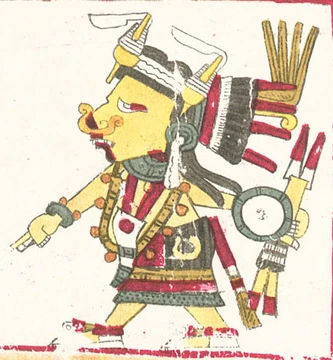
Xōchipilli
Aztec god of flowers, arts, and entheogenic ecstasy.

Xōchipilli, whose name combines the Nahuatl words for “flower” and “prince” (or “child”), is an Aztec deity presiding over beauty, youth, love, passion, sex, sexuality, fertility, the arts, song, music, dance, painting, writing, games, playfulness, nature, vegetation, and flowers. He is often linked with Xōchiquetzal, his female counterpart, and serves as the patron of the board game patolli. In his role as a patron of writing and painting, he is also called Macuilxōchitl (“Five-flower”) or Chicōmexōchitl (“Seven-flower”). Some interpretations connect him to psychedelia and nature, possibly because the Toltec civilization absorbed him into their pantheon. Like other gods, he is sometimes shown wearing an oyohualli, a teardrop-shaped pendant made of mother-of-pearl.
A 16th-century Aztec statue of Xōchipilli was discovered in the mid-19th century on the slopes of the volcano Popocatépetl near Tlalmanalco. It depicts a single figure seated on a temple-like base, with both the figure and the base carved with images of sacred and psychoactive plants, including Psilocybe aztecorum mushrooms, tobacco (Nicotiana tabacum), Turbina corymbosa, Heimia salicifolia, possibly Quararibea funebris, and one unidentified flower. The figure sits with his head tilted upward, eyes open, jaw tense, mouth half open, and arms raised toward the sky. Laurette Séjourné has written about this pose. The statue now resides in the Aztec hall of the Museo Nacional de Antropología in Mexico City.
Researchers Robert Gordon Wasson, Richard Evans Schultes, and Albert Hofmann argue that the statue captures Xōchipilli in a state of entheogenic ecstasy. The body’s position and expression, along with the clear depictions of hallucinogenic plants used in Aztec sacred rituals, support this reading. The statue’s pupils appear hugely dilated, an effect associated with hallucinogenic mushrooms. Wasson describes the figure as “absorbed by xōchitl, ‘dream flowers’”—the Nahua term for the overwhelming experience following entheogen ingestion—and notes that no comparable image exists in European art.
Quick Facts
- Deity Of
- Beauty · youth · love · sexuality · fertility · arts · flowers
- Other Names
- Macuilxōchitl, Chicōmexōchitl
- Abode
- Tamoanchan (Codex Ríos)
- Parents
- Xōchitlīcuē (Codex Ramírez)
- Siblings
- Xōchiquetzal
- Gender
- Male
- Region
- Mesoamerica
- Ethnic Group
- Aztec, Tlaxcaltec, Toltec (Nahua)
- Festivals
- Tlaxochimaco, Miccailhuitontli
Facts from the source article.
Lore & Background
Xōchipilli is the patron of writing and painting, referred to as Chicomexōchitl ('Seven-flower') or Macuilxōchitl ('Five-flower'). He is also the patron of the game patolli. He has been interpreted as the patron of both psychedelics and nature, a role possibly resulting from his absorption from the Toltec civilization. He is depicted wearing a teardrop-shaped pendant called an oyohualli, made of mother-of-pearl.
Reader's Guide
In the mid-19th century, a 16th-century Aztec statue of Xōchipilli was unearthed on the side of the volcano Popocatépetl near Tlalmanalco. The statue shows a figure seated on a temple-like base, covered in carvings of sacred and psychoactive organisms, including mushrooms (Psilocybe aztecorum), tobacco, ololiúqui, sinicuichi, possibly cacahuaxochitl, and one unidentified flower. The figure sits with head tilted up, eyes open, jaw tensed, mouth half open, and arms opened to the heavens. The statue is housed in the Museo Nacional de Antropología in Mexico City. Scholars Robert Gordon Wasson, Richard Evans Schultes, and Albert Hofmann suggest the statue represents a figure in entheogenic ecstasy, noting the dilated pupils and hallucinogenic plants. Wasson described the figure as 'absorbed in temicxoch' ('dream flowers'), the Nahua term for the experience following entheogen ingestion.
Did You Know?
- Xōchipilli's name means 'flower prince' in Nahuatl.
- He is the patron of the game patolli.
- A 16th-century statue of Xōchipilli was unearthed on the volcano Popocatépetl.
- The statue is carved with psychoactive organisms including Psilocybe aztecorum mushrooms.
More in LGBTQ themes in mythology 1-22
Spotted an error? Know more?
Reader corrections go straight into our review queue. Suggest an edit · How this site is sourced