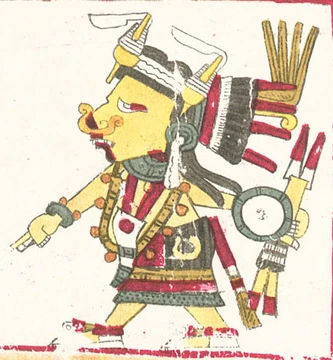
Huēhuecoyōtl
Aztec god of music, dance, mischief, and song.

Huēhuecoyōtl is a Pre-Columbian god in Aztec mythology, known as the auspicious deity of music, dance, mischief, and song. His name derives from Nahuatl words meaning 'very old coyote,' and he is associated with uninhibited sexuality, ruling over the day sign cuetzpallin (lizard) and the trecena beginning with cipactli (crocodile).
Quick Facts
- God Of
- God of the arts, lord of music and ceremonial dance, guide of adulthood and adolescence
- Other Names
- Ueuecoyotl
- Member Of
- the Nauhtzonteteo
- Abode
- Tlalticpac
- Parents
- Omecihuatl (Emerged by Tecpatl)
- Siblings
- the Nauhtzonteteo (1,600 gods)
- Gender
- Male
- Region
- Mesoamerica
- Ethnic Group
- Aztec (Nahoa)
Facts from the source article.
Lore & Background
Stories derived from the Codex Telleriano-Remensis characterize Huēhuecoyōtl as a benign prankster whose tricks often backfired, causing more trouble for himself than his intended victims. He was a great party-giver and allegedly created wars among humans to relieve his boredom. Like many Aztec deities, he possessed shapeshifting abilities, a common trait among the gods.
Reader's Guide
Huēhuecoyōtl holds significance as a trickster deity who could mitigate or reverse evil fates for those who appealed to him. He shares many characteristics with the trickster Coyote of North American tribes, including storytelling and choral singing, and is also the god of deception. His role as patron of uninhibited sexuality, with partners of any gender or species, underscores his association with boundary-crossing and creative chaos. His rule over the day sign lizard and the trecena flower links him to the Aztec calendar and cycles of time. As part of the Tezcatlipoca family, his shapeshifting abilities reflect the transformative power of mischief and music in Aztec cosmology.
Did You Know?
- Huēhuecoyōtl's name comes from Nahuatl words meaning 'very old coyote.'
- Shapeshifting is a common ability among many Aztec deities, and Huēhuecoyōtl is no exception.
Name, Domains, and Calendar Role
The name Huēhuecoyōtl breaks down in Nahuatl into two components: huēhueh, meaning "very old" or literally "old old," and coyōtl, the word for coyote. This linguistic pairing immediately signals a figure of ancient, earthy character. In the Pre-Columbian Mexica pantheon, he held a remarkably broad portfolio of auspicious responsibilities, encompassing music, dance, song, and mischief. Beyond the arts, he served as the divine patron of uninhibited sexuality, a role in which his partners could be female or male and of any species whatsoever. His presence in the sacred calendar was equally distinctive: he governed the day sign known as cuetzpallin, which translates to "lizard," and presided over the fourth trecena, Xochitl, meaning "flower" in Nahuatl. Together, these associations paint a deity who wove joy, sensuality, and creative expression into the very structure of time.
The Prankster's Nature
Accounts preserved in the Codex Telleriano-Remensis portray Huehuecóyotl as a fundamentally benign trickster whose schemes, though directed at other deities or even ordinary humans, more often than not rebounded to create far greater chaos for himself than for his intended targets. He was celebrated as an extraordinary host of revelries and gatherings, a great party-giver whose feasts presumably embodied his love of music, dance, and song. Yet his temperament carried a darker undercurrent: when boredom gripped him, he was said to engineer wars among human populations simply to amuse himself. His capacity for transformation was no minor gift; having inherited the shapeshifting powers passed down through the Tezcatlipoca lineage, he could alter his form at will, a trait that made his pranks all the more unpredictable. This combination of lighthearted mischief, creative exuberance, and occasional destructive caprice gave him a uniquely layered personality within the Mexica divine family.
Religious Appeal and the Art of Deception
Despite his reputation as a trickster, Huehuecóyotl occupied a genuinely protective niche in Mexica religious practice. Individuals who received ominous portents or indications of evil fates from other gods sometimes turned to him specifically, appealing for his intervention to soften, mitigate, or even reverse those dire predictions. This suggests that his association with deception was not merely a character flaw but a functional divine power—one that could be harnessed for human benefit. His role as the god of deception thus carried a dual edge: it made him a source of trouble, yet also a refuge for those in peril. Scholars have also noted strong parallels between him and the trickster Coyote figure found among North American Indigenous traditions, particularly in shared traits such as storytelling and choral singing. These cross-cultural resonances highlight how the archetype of the shapeshifting, song-filled trickster transcends any single civilization's mythological framework.
Lineage and Mythological Context
Huehuecóyotl's place within the broader Mexica pantheon is anchored by his membership in the family of Tezcatlipoca, the god whose name translates to "Smoky Mirror." This lineage connection is not merely genealogical; it carries direct theological weight, as it is through this familial bond that Huehuecóyotl inherited the extraordinary power of shapeshifting. As a Pre-Columbian deity, he existed within a complex, interconnected web of divine relationships where each god's attributes and powers were shaped by their connections to others. His auspicious nature—governing music, dance, song, and uninhibited sexuality—set him apart from more austere or wrathful figures in the pantheon, yet his capacity to create human wars and his role as a god of deception ensured he was never simply a benign presence. The Codex Telleriano-Remensis remains a primary source for understanding his character, preserving narratives that reveal both his comedic and his more troubling dimensions as a figure in the Aztec spiritual landscape.
Frequently Asked Questions
Who is Huēhuecoyōtl?
Huēhuecoyōtl is a Mexica (Aztec) deity who presides over music, dance, song, and mischief. His Nahuatl name translates to 'very old coyote,' and he is regarded as an auspicious figure in Pre-Columbian religion.
What LGBTQ themes connect to Huēhuecoyōtl?
The deity is explicitly linked to uninhibited sexuality, making him a figure fans point to when discussing non-restrictive sexual expression in Aztec belief. His domain over mischief and playful subversion further positions him as a counterweight to rigid social norms.
What role does Huēhuecoyōtl play in the Aztec calendar?
He serves as the patron of the day sign cuetzpallin (lizard) and governs the trecena that opens with cipactli (crocodile). In this capacity he infuses the calendar cycle with themes of musical celebration, dance, and joyful disruption.
Why do LGBTQ fans find Huēhuecoyōtl meaningful?
His explicit association with uninhibited sexuality offers a Pre-Columbian example of a divine figure who celebrates desire without restriction. Combined with his mischief-maker persona, he resonates as a symbol of joyful, unapologetic self-expression that defies conventional expectations.
More in LGBTQ themes in mythology 1-22
Spotted an error? Know more?
Reader corrections go straight into our review queue. Suggest an edit · How this site is sourced