
Buggane
A malevolent shapeshifter from Manx folklore that could tear roofs off churches.

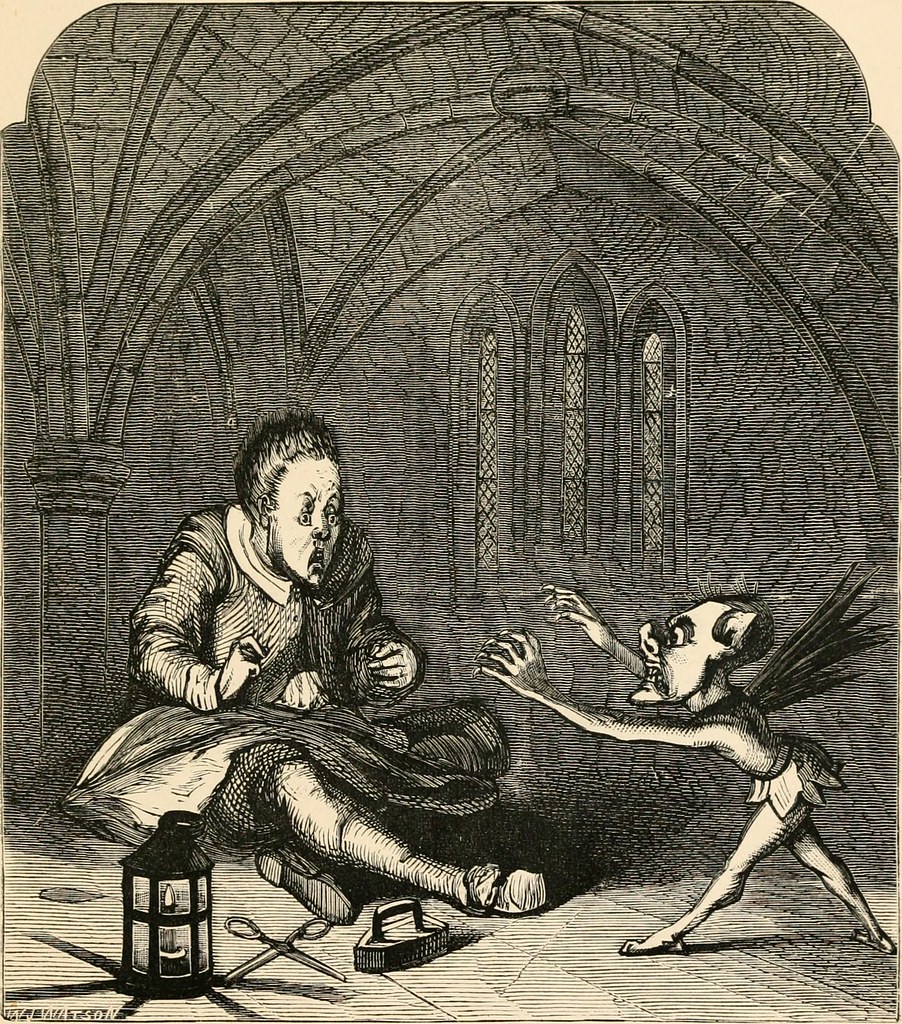
W.J. Watson · Public domain
In Manx folklore, a buggane (or boagane) was a huge ogre-like creature native to the Isle of Man, sometimes considered akin to the Scandinavian troll. A shapeshifter, the buggane is generally described as a malevolent being that could appear as a large black calf or a human with ears or hooves of a horse, and was large enough to tear the roof off a church.
- Type
- Mythological creature
- Origin
- Isle of Man
- Classification
- Ogre-like shapeshifter
- Known for
- Tearing roofs off churches, malevolence, inability to cross water or stand on hallowed ground
- Notable tales
- St. Trinian's Church, Finn MacCool and the Buggane
Lore & Background
Bugganes were magical creatures unable to cross water or stand on hallowed ground. The most famous story recounts a buggane who stowed away on a ship bound for Ireland. Determined to return to the Isle of Man, he caused a storm and guided the ship toward the rocky coast of Contrary Head. The captain, in desperation, promised to build a chapel if they were saved, and the ship safely reached Peel Harbour. When the chapel was built, three times the people put a roof on, and three times the buggane tore it off.
Reader's Guide
The buggane is a significant figure in Manx folklore, embodying the wild and untamed forces of nature on the Isle of Man. Its tales often involve conflict with human or saintly figures, such as St. Trinian or the Irish giant Finn MacCool. The buggane's inability to cross water or stand on hallowed ground highlights its supernatural limitations. The story of the buggane of St. Trinian's Church is the most famous, illustrating its destructive power and defiance of sanctified spaces. In another legend, the buggane from Barrule battled Finn MacCool, with Finn's wife Oonagh disguising him as a baby to trick the buggane. The buggane's legacy endures in modern popular culture, appearing in a BBC children's television series, a fantasy novel, a roleplaying game, and even a beer brewed on the Isle of Man. These references keep the buggane alive as a symbol of Manx heritage and folklore.
Did You Know?
- The most famous story involves a buggane who tore the roof off St. Trinian's Church three times.
- In one tale, a buggane was tricked by Finn MacCool's wife Oonagh, who disguised Finn as a baby.
Physical Form and Supernatural Constraints
The buggane of Manx folklore is a towering, ogre-like entity indigenous to the Isle of Man, and some have drawn parallels between it and the Scandinavian troll. As a shapeshifter, it could manifest as a massive black calf or as a humanoid figure bearing the ears and hooves of a horse. In its truest form, however, the creature is depicted as a fearsome spectacle: a body draped in a thick mane of coarse black hair, eyes blazing like torches, and a mouth full of glittering, razor-sharp tusks. An alternative telling paints it as an enormous man crowned with bull's horns, whose eyes glow and whose teeth are vast. Its sheer size is emphasized throughout the folklore—it was powerful enough to rip the roof clean off a church. Despite its terrifying stature, the buggane operated under strict supernatural limitations. It could not cross a body of water, nor could it set foot on consecrated ground, constraints that would prove decisive in several of its most celebrated encounters.
The St. Trinian's Curse and the Punisher's Role
The most widely told buggane tale involves a creature that accidentally found itself aboard a vessel sailing toward Ireland. Fuming at its unplanned voyage, the buggane conjured a violent storm and steered the ship toward the jagged cliffs of Contrary Head, hoping to be deposited back on Manx soil. The captain, desperate, invoked St. Trinian and pledged to erect a chapel in the saint's honour. The holy figure answered, guiding the ship safely into Peel Harbour. Enraged, the buggane howled: "St. Trinian should never have a whole church in Ellan Vannin." When the chapel was built, the community raised a roof three times, and three times the buggane tore it away. Beyond this famous curse, bugganes served as instruments of fairy justice. The buggane of Glen Maye pitched a lazy housewife toward a waterfall for putting off baking until after sunset; she escaped only by cutting the strings of her apron. The buggane from Gob-na-Scuit was notorious for ripping thatch off haystacks, forcing smoke down chimneys, and shoving sheep over the brooghs. A separate creature, the Buggan ny Hushtey, dwelt in a seaside cave and despised the idle, though it is distinct from the Cabbyl-ushtey, the Manx water horse.
The Duel with Finn MacCool
In Manx legend, the Irish giant Fionn mac Cumhaill crossed the sea and settled near Cregneash. The buggane of Barrule marched to challenge him, but Fionn, unwilling to fight, had his wife Oonagh disguise him as an infant in a cradle. Seeing the enormous "baby," the buggane concluded its father must be a colossus beyond all others and withdrew. The two eventually clashed near Kirk Christ Rushen in a battle raging from dawn to dusk. Fionn planted one foot in the Big Sound, carving the channel between the Calf of Man and Kitterland, and the other in the Little Sound, shaping the narrow strait between Kitterland and the main island. The buggane, stationed at Port Erin, ultimately prevailed, wounding Fionn so severely that the giant fled to Ireland. Unable to follow across the water, the buggane wrenched out a tooth and hurled it; it struck Fionn on the back of the head before sinking into the sea and becoming Chicken Rock. Fionn turned and unleashed a sevenfold curse upon the rock, declaring it a perpetual vexation to mankind as long as water flows and grass grows. The Irish variant names a Scottish giant as Fionn's opponent.
Echoes in Modern Culture
The buggane has left a distinctive mark on contemporary creative works. In Douglas, Isle of Man, Mount Murray Brewing's Bushys pub serves a light brown English bitter named "Bushy's Buggane." The BBC children's programme Jackanory aired an adaptation of the St. Trinian's buggane story in its sixth season on 8 August 1969. In Joseph Delaney's Spook's series, the creature features prominently in the seventh volume, The Spook's Nightmare, published in the US as Rise of the Huntress. Morat's fantasy novel The Road To Fero City imagines a buggane imprisoned for the crime of vandalising churches. In the Pathfinder Roleplaying Game, the Bestiary 4 entry presents bugganes as a race of blind giants distantly related to ogres, their physical design drawing inspiration from the naked mole-rat. Even in music, the 2009 Lemon Demon track "Eighth Wonder," about Gef the talking mongoose and later included on the 2016 album Spirit Phone, references bugganes, noting that both creatures share the Isle of Man as their origin.
Gallery
Frequently Asked Questions
Who is Buggane?
The Buggane (also spelled Boagane) is a malevolent ogre-like shapeshifter from the folklore of the Isle of Man, often compared to the trolls of Scandinavian tradition. It is regarded as one of the most fearsome supernatural beings in Manx legend.
What forms can Buggane take?
Buggane is described as a shapeshifter that most commonly appears as a massive black calf or as a giant humanoid figure bearing the ears and hooves of a horse. In its true ogre form, it is said to be large enough to rip the roof clean off a church.
What are Buggane's weaknesses?
Despite its tremendous strength, Buggane cannot cross open water and is unable to set foot on consecrated or hallowed ground. These two limitations are the primary means by which communities in Manx tales ward it off.
Which famous stories feature Buggane?
Two well-known Manx tales center on the creature: the attack on St. Trinian's Church, where it tears the roof from the building, and the encounter between the hero Finn MacCool and the Buggane. Both stories highlight the creature's destructive power and its eventual defeat through cleverness or sacred protection.
Why is Buggane important in Manx folklore?
Buggane serves as the archetypal monster of the Isle of Man, embodying the danger lurking in the landscape and the need for communal vigilance. Its tales reinforce cultural values around sacred spaces, the power of water as a boundary, and the triumph of wit over brute force.
More in Legendary shapeshifters 1-24
Spotted an error? Know more?
Reader corrections go straight into our review queue. Suggest an edit · How this site is sourced