
Bödvar Bjarki
Hero of Hrólfr Kraki, a shapeshifter into a bear.

Olaus Magnus · Public domain
Bödvar Bjarki (Old Norse: Bǫðvarr Bjarki), whose name translates to 'Warlike Little-Bear', is a hero found in the Hrólfs saga kraka, the Latin summary of the lost Skjöldunga saga, and as Biarco in Saxo Grammaticus' Gesta Danorum. He is frequently portrayed as a shapeshifter who can take the form of a bear, a power tied to the folklore concept of hamr.
His father was Björn ("bear"), son of King Hring of Norway. After Björn's mother died, Hring married a younger Sámi woman named Hvit. Björn grew into a tall, strong man and loved a woman named Bera. While Hring was away, Hvit tried to seduce Björn, but he refused her. In revenge, she enchanted him so that he shifted shape into a bear by day and a man only by night. He fled near Bera's father's farm, living off livestock, and brought Bera to live with him. Urged by Hvit, the king led hunters to kill the bear. Björn foresaw his death, told Bera she was pregnant, and instructed her on what to do afterward. The hunters killed him, and at the celebration where his carcass was cooked, Hvit pressured Bera into eating a bite of the meat, despite Björn's warning.
Bera gave birth to triplets. The first, Elgfróði (Elk-Frodi), had the lower body of a moose. The second, Thorir, had hound's feet. The third, Bödvar Bjarki, was normal. All grew exceptionally large and strong. At twelve, Frodi left after injuring people and killing one of the king's men, becoming a robber. Thorir became king of Gautland (Geatland). Bjarki, the last to leave his mother, killed Hvit to avenge his father. When Hring died, Bjarki left Norway for Denmark and did not succeed him.
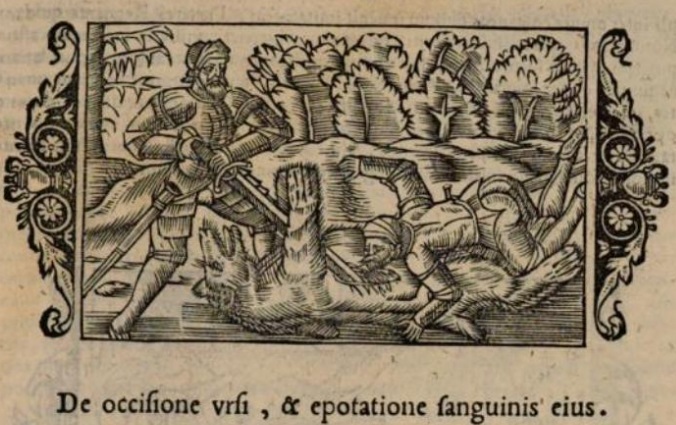
Later, Bjarki visited Elk-Frodi without revealing his identity. Frodi challenged him to wrestle. Bjarki did better than expected, but when Frodi recognized him, he thought Bjarki still too weak, so he had him drink some of his blood, greatly increasing his strength. On Frodi's advice, Bjarki visited Thorir in Gautland and then went to King Hrolf Kraki's court at Lejre in Denmark. There, he saved a weak young thrall named Hott from bullying. That night, he killed a monster that had slain many of the king's warriors. He took Hott to the carcass and forced him to drink the monster's blood, making him strong and brave. They propped up the carcass as if alive, and in the morning Hott pretended to kill it.
- Also known as
- Biarco
- Field
- Legendary hero
- Nationality
- Norwegian (by origin, as per Icelandic authors)
- Known for
- Shapeshifting into a bear; killing a monster at King Hrolf's court; being a champion of Denmark
- Family
- Son of Björn and Bera; brother of Elgfróði and Thorir; married Drifa, daughter of King Hrolf, after the Uppsala expedition
Lore & Background
Bödvar Bjarki was the third son of Björn and Bera. Björn, son of King Hring of Norway, was cursed by his stepmother Hvit to become a bear by day and a man by night. After Björn was killed by hunters, Bera was pressured into eating a bite of his cooked meat. She later gave birth to triplets: Elgfróði (with a moose body from the waist down), Thorir (with hound feet), and Bödvar Bjarki, who was normal. At age twelve, after killing a king's man, Elgfróði became a robber; Thorir became king of Gautland; and Bjarki killed Hvit in revenge for his father's death, then left Norway for Denmark rather than succeeding King Hring.
Bjarki visited his brother Elgfróði, who tested him in wrestling and gave him blood to drink to increase his strength. On Frodi's advice, Bjarki visited Thorir in Gautland and then went to King Hrolf Kraki's court. After the Uppsala expedition, Bjarki married Drifa, the king's daughter. In the final battle against King Hrolf's enemies, Bjarki fought fiercely, and his bear-spirit was seen fighting alongside him. He did not advise avoiding war after Hrolf angered Odin; instead, he took part in the battle until the end.
Reader's Guide
Bödvar Bjarki's significance lies in his role as a central hero in the Hrólfs saga kraka and related sources, embodying the motif of the bear warrior and shapeshifter. His story parallels that of Beowulf in several ways: both arrive in Denmark from Geatland, both kill a monster terrorizing a court at Yule, and both have been linked to the Bear's Son Tale folk tradition. Some scholars think Bjarki and Beowulf were originally the same personage, while others see kinship pointing to a distant common source. The name 'Beowulf' may have originally meant 'bee-wolf', a kenning for 'bear'. Tom Shippey noted that the character of Beorn in J. R. R. Tolkien's The Hobbit has a very close analogue in Bödvar Bjarki. The Old Norse poem Bjarkamál, preserved in Saxo's Latin paraphrase, is a dialogue between Bjarki and Hjalti urging him to awake for the final battle, where Bjarki's spirit-bear disappears, leading to defeat. Bjarki's legacy endures as a figure of heroic strength, shapeshifting, and tragic loyalty.
Did You Know?
- Bödvar Bjarki's name means 'Warlike Little-Bear' in Old Norse.
- He was the third of triplets; his brothers were Elgfróði (moose body from waist down) and Thorir (hound feet).
- His spirit, or hugr, took the form of a bear in battle, which disappeared when Hjalti roused him.
- The character Beorn in The Hobbit has a very close analogue in Bödvar Bjarki, according to Tom Shippey.
Origins and the Bear's Curse
Bödvar Bjarki's name translates to 'Warlike Little-Bear,' a fitting epithet for a hero whose very existence is tangled in bear-shape. His father, Björn (itself meaning 'bear'), was the son of Hring, a Norwegian king. After Björn's mother died, Hring wed a much younger Sámi woman named Hvit. When the now-tall, powerful Björn rejected her advances, she cursed him with a hamr-shifting spell: by day a bear, by night a man. He fled to a farm near his beloved Bera, surviving by preying on livestock. Hring, goaded by Hvit, led a hunt and slew him. Bera, already pregnant, attended the feast where his flesh was served; despite his dying instruction not to eat, Hvit forced one bite from her. She bore triplets: Elgfróði, whose lower body was that of a moose; Thorir, with the feet of a hound; and Bödvar, the only one born wholly human. All three grew to extraordinary size and strength. As a youth, Bjarki avenged his father by killing Hvit, and after Hring's death he inherited the Norwegian throne before setting out to seek his fortune abroad.
Champion at the Court of Hrólf Kraki
Upon reaching King Hrólf Kraki's court at Lejre in Denmark, the young Bjarki immediately set himself apart. He rescued a frail thrall named Hott from bullies, then that very night slew a monstrous creature that had been slaughtering the king's warriors. He dragged Hott to the beast's carcass and compelled him to drink its blood, transforming the weak boy into a brave man. They staged the scene so Hott could claim the kill, earning the king's gold-hilted sword and the new name Hjalti, 'hilt.' Bjarki's standing soared when he killed one of Hrólf's berserker warriors and drove out the rest, cementing his reputation as Denmark's preeminent champion. He rose to become the king's trusted counselor and battle-leader, and married Hrólf's daughter Drifa. In this advisory capacity he urged Hrólf to journey to Uppsala to reclaim his father's treasure from King Adils—a mission that ended with the treasure scattered to slow pursuers and Adils publicly humiliated. On the return, Hrólf offended a man who proved to be Odin in disguise, and Bjarki counseled the king to shun further war, having lost the god of victory's favor.
The Final Battle and the Spirit-Bear
The saga's most haunting episode arrives when Hrólf's half-sister and her husband rebel and assault Lejre. As the battle rages, Bjarki sits motionless in the hall, lost in a trance. Outside, a monstrous bear tears through the rebels' ranks, inflicting terrible damage. Hjalti, alarmed that his friend is not fighting, enters the hall and rouses him. The instant Bjarki stirs, the bear vanishes—it was his hugr, his spirit, projected into beast-form. He rushes into combat, but without the bear's overwhelming power he fights far less effectively. The defenders are overwhelmed; Hrólf, Bjarki, and all the king's warriors are slain. The Old Norse poem Bjarkamál preserves fragments of this final exchange: a dialogue in which Hjalti repeatedly urges Bjarki to wake and fight, and Bjarki, upon opening his eyes, rebukes him—telling him that rousing the spirit-bear was far less helpful to the king than Hjalti imagined. Saxo Grammaticus rendered this scene in florid Latin in his Gesta Danorum, where Bjarki appears as Biarco.
Legacy and Literary Echoes
Bödvar Bjarki's shadow stretches far beyond Norse saga literature. Scholars have long debated whether he and the hero of the Old English poem Beowulf were originally one figure, or at least drew from a shared distant source. The parallels are striking: both arrive in Denmark from Geatland, both slay a monster terrorizing a royal court, and the name 'Beowulf' may have originally meant 'bee-wolf,' a kenning for bear, though other etymologies have been proposed. Bjarki also fits the category of folktales known as the Bear's Son Tale, a widespread motif across European traditions. In the modern era, scholar Tom Shippey has noted that Tolkien's shapeshifting giant Beorn in The Hobbit bears a 'very close analogue' in Bjarki. The character appears across multiple textual traditions—the Hrólfs saga kraka, a Latin epitome to the lost Skjöldunga saga, and Saxo's Gesta Danorum—testifying to his deep roots in Scandinavian oral culture, shaped by Icelandic authors of largely Norwegian descent.
Gallery
Frequently Asked Questions
Who is Bödvar Bjarki?
Bödvar Bjarki (Old Norse: Bǫðvarr Bjarki, meaning 'Warlike Little-Bear') is a legendary Norwegian hero who appears in Hrólfs saga kraka, the Latin summary of the lost Skjöldunga saga, and in Saxo Grammaticus' Gesta Danorum, where he is called Biarco. He is best remembered as a warrior champion and a shapeshifter.
What is Bödvar Bjarki's shapeshifting ability?
He can assume the form of a bear, a power rooted in the Old Norse folklore concept of hamr, which describes a detachable outer shape or skin a person can cast off. This bear-transformation is the defining trait of his legend and sets him apart from other saga heroes.
Who are Bödvar Bjarki's parents and siblings?
His father is Björn, son of King Hring of Norway, and his mother is Bera. He has two brothers, Elgfróði and Thorir, and after the Uppsala expedition he marries Drifa, the daughter of King Hrolf Kraki.
What is Bödvar Bjarki's most famous feat?
He serves as a champion at the court of King Hrolf Kraki, where he is renowned for slaying a monstrous creature that terrorized the hall. He also goes on to become a champion of Denmark, cementing his status as one of the era's greatest warriors.
More in Legendary shapeshifters 1-24
Spotted an error? Know more?
Reader corrections go straight into our review queue. Suggest an edit · How this site is sourced