Court
Last updated
The word "court" comes from the French cour, meaning an enclosed yard, which derives from the Latin cōrtem.[1] Any person or institution that has the authority to settle legal disagreements and deliver justice in civil, criminal, and administrative cases under the rule of law is considered a court.[2]
Quick Facts
- Key concept
- Jurisdiction (personal, subject-matter, territorial)
- Legal traditions
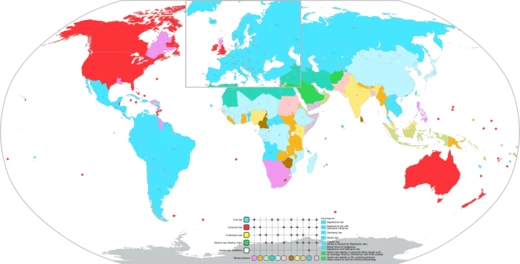
- Civil law courts and common law courts
Facts from the source article.
Key facts and history
According to William Blackstone's Commentaries on the Laws of England, a court for civil wrongs requires three parties: the plaintiff, the defendant, and the judicial power.[3][4] The Legal Information Institute defines jurisdiction as the power of a court to adjudicate cases and issue orders.[5] State courts have general jurisdiction, meaning they can hear any controversy except those prohibited by state law or allocated to federal courts.[5] Federal courts have limited jurisdiction, hearing only cases within the scope defined by the Constitution and Congressional statutes.[5]
A court's jurisdiction—its practical authority—is the power to decide specific types of questions or petitions.[3][4] The western world's two primary legal traditions are civil law and common law courts.[6] Civil law courts draw heavily on Roman law, especially the Corpus Juris Civilis, which was rediscovered near the close of the 11th century.[6] Following the Norman Invasion of Britain in 1066, English royal judges established common law courts.[7]
"The bench" is a collective term for the judge or panel of judges.[8]
What the cited sources add
Many respondents said this court experience took a toll on their mental and financial well-being.[9] Households with court experience graded courts as "D" or "F" twice as often as those without.[9] Almost 1 in 5 people who won their cases emerged with less confidence in the courts than when they started.[9] About half of respondents said state courts should prioritize resources for the most serious matters, such as those that could break up a family or land someone in prison.[9]
Making courts easier to navigate was popular with around 70% of both those with and without court experience.[9] Courts may have exclusive jurisdiction, where only one court can address a matter, or concurrent jurisdiction, where more than one court can adjudicate.[10] A poll conducted by The Pew Charitable Trusts in August and September 2024 found that 1 in 3 U.S. adults live in households that had been involved in a court case.[9]
References
- Wikipedia, "Court" (CC BY-SA 4.0), which cites: Harper, "court (n.)", Online Etymology Dictionary (original not read by us) en.wikipedia.org
- Wikipedia, "Court" (CC BY-SA 4.0), which cites: Walker, "The Oxford Companion to Law", Oxford University Press, 1980, p. 301 (we also read that source) en.wikipedia.org
- Wikipedia, "Court" (CC BY-SA 4.0), which cites: "Blackstone's Commentaries on the Laws of England – Book the Third – Chapter the Third : Of Courts in General", Avalon Project (we also read that source) en.wikipedia.org
- "Blackstone's Commentaries on the Laws of England – Book the Third – Chapter the Third : Of Courts in General", Avalon Project. avalon.law.yale.edu
- Jurisdiction, Legal Information Institute, Cornell Law School.. law.cornell.edu
- Wikipedia, "Court" (CC BY-SA 4.0), which cites: von Mehren, "Law in the United States", Cambridge University Press, 8 Jan 2007; von Mehren, "Law in the United States", Cambridge University Press, 8 Jan 2007 (original not read by us) en.wikipedia.org
- Wikipedia, "Court" (CC BY-SA 4.0), which cites: Burnham, "Introduction to the Law and Legal System of the United States", Thomson-West, 2006; Burnham, "Introduction to the Law and Legal System of the United States", Thomson-West, 2006 (we also read that source) en.wikipedia.org
- Wikipedia, "Court" (CC BY-SA 4.0), which cites: See generally : "The Supreme Court of the United States shall consist of a Chief Justice of the United States and eight associate justices [ . . . ]" (italics a (original not read by us) en.wikipedia.org
- "Experience With State Courts Highlights Areas for Improvement", The Pew Charitable Trusts, 2025. pew.org
- "Jurisdiction", Civil Procedure. civilprocedure.uslegal.com
Each numbered sentence above was checked against the source it cites before publication. Sentences citing Wikipedia adapt text from the English Wikipedia article Court (contributors), used under CC BY-SA 4.0; this entry is available under the same licence. Other sources were used for facts only.
More in Legal Systems & Courts
Sources
Compiled from Wikipedia and the sources listed below. Text from Wikipedia is available under CC BY-SA 4.0; this entry is adapted from it.
- Wikipedia: Court (CC BY-SA 4.0).
Spotted an error? Know more?
Reader corrections go straight into our review queue. Suggest an edit · How this site is sourced