Judicial review
Last updated
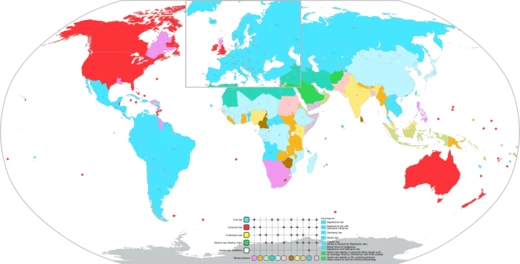
Courts examine whether executive, legislative, or administrative actions comply with other laws through a process called judicial review.[1] The scope and procedures of judicial review are not uniform; they can vary across different countries and legal systems.[2]
Quick Facts
- Legal systems
- Civil law and common law
Facts from the source article.
Key facts and history
The idea of separation of powers, a theory underlying judicial review, was first introduced by Montesquieu.[3] Judicial review is sometimes described as a distinctively American contribution to political theory.[4] The US Supreme Court's ruling in Marbury v. Madison institutionalized the separation of powers in the United States.[3] US courts at all levels can review legislation for constitutionality through judicial interpretation.[5]
Some countries, like the Netherlands, forbid courts from reviewing the constitutionality of primary legislation.[6] The United Kingdom cannot set aside Acts of Parliament under the doctrine of parliamentary sovereignty.[6] In the United States, the term "judicial review" mainly denotes courts adjudicating whether statutes are constitutional, particularly by the Supreme Court.[5]
What the cited sources add
The Open Library edition record for ISBN 9780409341959 lists "Principles of Australian constitutional law" as a 706-page work published by LexisNexis Butterworths in 2017.[7] The Open Library edition record for ISBN 9780198071617 lists "Democracy And Constitutionalism In India A Study Of The Basic Structure Doctrine" as published by Oxford University Press in 2011.[8]
References
- Wikipedia, "Judicial review" (CC BY-SA 4.0), which cites: Elliott, "The constitutional foundations of judicial review", Hart Pub, 2001 (original not read by us) en.wikipedia.org
- Wikipedia, "Judicial review" (CC BY-SA 4.0), which cites: Highsmith, "Off-Balance: How US Courts Privilege Conservative Policy Outcomes", Perspectives on Politics, 2025, p. 1–13 (original not read by us) en.wikipedia.org
- Wikipedia, "Judicial review" (CC BY-SA 4.0), which cites: Montesquieu, Baron Charles de, The Spirit of the Laws (original not read by us) en.wikipedia.org
- Wikipedia, "Judicial review" (CC BY-SA 4.0), which cites: Cappelletti, "Judicial Review in Comparative Perspective", California Law Review, 1970, p. 1017–1053 (original not read by us) en.wikipedia.org
- Wikipedia, "Judicial review" (CC BY-SA 4.0), which cites: Eskridge et al., supra note 532, at 1207 ("Presumption in favor of judicial review."); id.("Rule against interpreting statutes to deny a right to jury trial."); (original not read by us) en.wikipedia.org
- Wikipedia, "Judicial review" (CC BY-SA 4.0), which cites: Article 120 of the Netherlands Constitution (original not read by us) en.wikipedia.org
- Open Library record, ISBN 9780409341959 ("Principles of Australian constitutional law"). CC0 (metadata); book content not read. openlibrary.org
- Open Library record, ISBN 9780198071617 ("Democracy And Constitutionalism In India A Study Of The Basic Structure Doctrine"). CC0 (metadata); book content not read. openlibrary.org
Each numbered sentence above was checked against the source it cites before publication. Sentences citing Wikipedia adapt text from the English Wikipedia article Judicial review (contributors), used under CC BY-SA 4.0; this entry is available under the same licence. Other sources were used for facts only.
More in Legal Systems & Courts
Sources
Compiled from Wikipedia and the sources listed below. Text from Wikipedia is available under CC BY-SA 4.0; this entry is adapted from it.
- Wikipedia: Judicial review (CC BY-SA 4.0).
Spotted an error? Know more?
Reader corrections go straight into our review queue. Suggest an edit · How this site is sourced