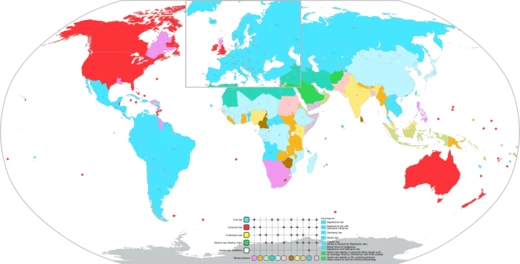
Code of law
Last updated
A legal code is a legislative text that systematically organizes statutes, aiming to provide comprehensive coverage of either an entire legal system or a specific legal domain as it stood when the code was enacted.[1] In both common law and civil law traditions, the reasons for codification are alike, but the way codes are used differs between these systems.[1]
Key facts and history
Tablets from the ancient city of Ebla provide the earliest known evidence of a law code, dating back to 2400 BC.[2] The Code of Hammurabi, dating to around 1760 BC, is among the best preserved early legal codes from Sumer, Mesopotamia.[3][4] Prominent national civil codes include the French Napoleonic Code of 1804 and the German civil code of 1900.[5] The 1917 Code of Canon Law was the first integrated code of canon law in the Roman Catholic Church.[6]
The 1917 Code was ordered by Pope St. Pius X in 1903 and promulgated by Pope Benedict XV on 27 May 1917.[6] African civilizations also developed legal traditions, such as the Kouroukan Fouga proclaimed by the Mali Empire in 1222–1236.[7] In the ancient Middle East, legal codes were a standard element of how law was organized.[2] Following the Treaty of Westphalia and the emergence of nation-states, the trend toward codification gained momentum.[5]
What the cited sources add
The 1917 Code consisted of 2,414 canons, many subdivided into paragraphs or sections.[6] Historians recognize the influence of Roman legal categories in the structure of the 1917 Code.[6] The 1917 Code was supported by footnotes directing researchers to 6,464 ecclesiastical documents filling over 7,700 pages.[6] The 1917 Code could be officially modified through textual correction, modification, authentic interpretation, formal instruction, or authoritative application.[6]
Increased attention was paid to comparison of the Laws of Eshnunna with the Code of Hammurabi.[8]
References
- Wikipedia, "Code of law" (CC BY-SA 4.0) en.wikipedia.org
- Wikipedia, "Code of law" (CC BY-SA 4.0), which cites: "Law code Ancient Legal Systems & Modern Legislation", Britannica; Kuiper, "Mesopotamia: The World's Earliest Civilization", The Rosen Publishing Group, Inc, 2010-08-15; Wilkin, "Mesopotamian Law Codes: The Human Roots of Moses's Laws", Research Gate, June 2019 (we also read that source) en.wikipedia.org
- Wikipedia, "Code of law" (CC BY-SA 4.0), which cites: Basim Fuad Musallam, "Law and Authority in Ancient Mesopotamia", AUB ScholarWorks, Summer 1965; Yaron, "The Laws of Eshnunna", Noor Library, 1988; "The Code of Lipit-Ishtar by Francis R. Steele, 1948", www.toaz.info (we also read that source) en.wikipedia.org
- Wikipedia, "Code of law" (CC BY-SA 4.0), which cites: "Cuneiform law legal body", Encyclopedia Britannica (original not read by us) en.wikipedia.org
- Wikipedia, "Code of law" (CC BY-SA 4.0), which cites: Peters, "Master Page on the Pio-Benedictine Code of 1917", CanonLaw.info (we also read that source) en.wikipedia.org
- Peters, "Master Page on the Pio-Benedictine Code of 1917", CanonLaw.info. canonlaw.info
- Wikipedia, "Code of law" (CC BY-SA 4.0), which cites: "La première déclaration des droits de l'Homme est africaine", africamix - Blog LeMonde.fr, September 7, 2008 (original not read by us) en.wikipedia.org
- Yaron, "The Laws of Eshnunna", Noor Library, 1988. noor-book.com
Each numbered sentence above was checked against the source it cites before publication. Sentences citing Wikipedia adapt text from the English Wikipedia article Code of law (contributors), used under CC BY-SA 4.0; this entry is available under the same licence. Other sources were used for facts only.
Also in the Codexery
More in Legal Systems & Courts
Sources
Compiled from Wikipedia and the sources listed below. Text from Wikipedia is available under CC BY-SA 4.0; this entry is adapted from it.
- Wikipedia: Code of law (CC BY-SA 4.0).
Spotted an error? Know more?
Reader corrections go straight into our review queue. Suggest an edit · How this site is sourced