Appeal
Legal process for reviewing decisions by a higher authority.
Last updated
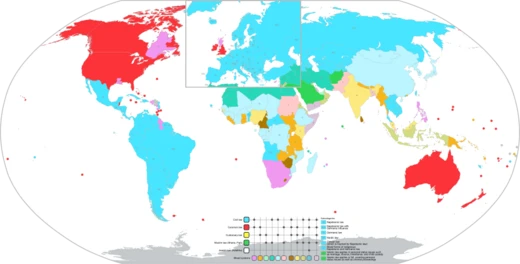
An appeal is a legal process in which a higher authority reviews decisions made by lower courts or tribunals. It serves both to correct errors and to clarify and interpret the law. The process involves a party requesting a formal change to an official decision, and it is distinct from judicial review, which concerns the constitutional or statutory authority to assess the validity of legislative or administrative acts. Appellate review is the general term for how courts with appellate jurisdiction handle matters from lower courts.
Terminology differs between American and British English: in the United States, cases go "on appeal" and one "appeals from" or "appeals" an order or judgment, while in Britain, decisions are "under appeal" and one "appeals against" a judgment. An American court may dispose of an appeal by affirming or reversing the lower court's decision; a British court dismisses or allows the appeal. Most jurisdictions prefer filing an appeal as the normal method of seeking review.
History
Appellate systems have existed for millennia. In ancient Babylon, Hammurabi and his governors acted as the highest appellate courts. Roman law recognized a right to appeal under the Valerian and Porcian laws from 509 BC, later developing a complex hierarchy of appellate courts, with some appeals reaching the emperor.
Japan had appellate courts by the Kamakura shogunate (1185–1333), which established a high appellate court for lawsuits. However, common law jurisdictions were slow to incorporate a right to appeal. Early English courts did not allow appeals from court to court; instead, they used writs of error and certiorari, which were limited in availability, scope, and remedies.
Writs of error were not a matter of right and originally required the attorney general's recommendation. Certiorari was initially only for summary offences and later for indictable offences but only before judgment. Dissatisfaction led to at least 28 bills in Parliament, and England adopted appeals in civil cases in 1873 and criminal cases in 1907.
Lore & Background
Appellate procedure begins when a higher court grants a petition for review of a lower court’s decision. Unlike trials, which often involve a jury, appeals are heard by a single judge or a panel of judges. Before any oral argument, the parties submit written legal briefs outlining their positions, and outside parties may be permitted to file amicus curiae briefs.
During oral argument, judges frequently question attorneys to test their arguments. After deliberation, the court issues a formal written opinion resolving the legal issues. The outcome is either a reversal, where the lower court’s decision is found incorrect and the case may be sent back for retrial, or an affirmation, where the lower court’s ruling is upheld.
Some appellate courts also handle matters of first instance, giving them a dual function. Historically, appellate systems have existed for millennia; in ancient Babylon, Hammurabi and his governors acted as the highest appellate authority. Ancient Roman law recognized a right to appeal from 509 BC, later developing a complex hierarchy of appellate courts, some appeals reaching the emperor. Japan had appellate courts by the Kamakura shogunate.
However, common law jurisdictions were slow to adopt a right to appeal. Early English courts had no concept of appealing from one court to another; relief came through limited writs of error and certiorari, which were not available as a matter of right. England only introduced civil appeals in 1873 and criminal appeals in 1907.
Reader's Guide
The appeal is a cornerstone of modern legal systems, providing a mechanism for error correction and legal clarification. While appellate courts have ancient roots, the right to appeal in common law jurisdictions is a 19th-century development. The process distinguishes between appellate review (review of lower court decisions) and judicial review (review of legislative or administrative acts). Terminology varies between American and British English, with American courts using 'judgment affirmed' or 'judgment reversed' and British courts using 'appeal dismissed' or 'appeal allowed'.
Appellate courts generally review questions of law de novo but defer to trial court fact-finding, though some jurisdictions like the Netherlands review cases in their entirety. The right to appeal can be waived, as in the United States, if the waiver is considered and intelligent. The highest appellate court is often called a court of last resort or supreme court.
Also in the Codexery
More in Legal Systems & Courts
Sources
Compiled from Wikipedia and the sources listed below. Text from Wikipedia is available under CC BY-SA 4.0; this entry is adapted from it.
- Wikipedia: Appeal (CC BY-SA 4.0).
Spotted an error? Know more?
Reader corrections go straight into our review queue. Suggest an edit · How this site is sourced