
Settler colonialism
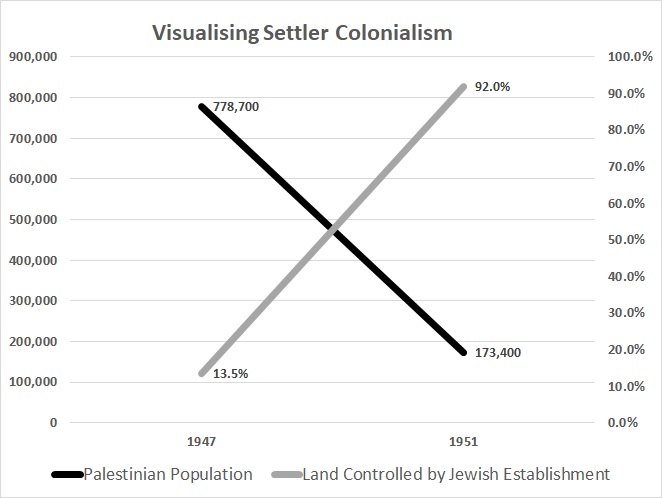
A structure of land seizure and indigenous elimination.

Neve Gordon · Public domain
Settler colonialism is a type of colonial rule where settlers take control of a territory and its Indigenous peoples, fundamentally altering the land and either replacing the original population or absorbing them into the settlers' own society. In some cases, assimilation was framed in biological terms, like "breeding a minority into a majority," while in places such as parts of Latin America, biological mixing between groups was seen as less of an issue. This form of domination comes from an external source and is usually backed by an imperial power, which stays linked to the territory through the settlers. Because it involves building a new society on conquered land, settler colonialism persists indefinitely unless decolonization happens—either through the settlers leaving, or through reforms, agreements between settlers and Indigenous peoples, and reconciliation efforts.
The study of settler colonialism has often centered on English-speaking colonies in Australia and North America, which are seen as near-perfect examples of the model. But the practice is not limited to any one culture; it has been carried out by non-European nations like Japan, as well as among European groups, such as in Ireland.
The theory of settler colonialism emerged in the 1960s, when settlement and colonization were viewed as separate from colonialism proper. Settlement was thought to occur in empty areas, ignoring Indigenous inhabitants. In the 1970s and 1980s, settler colonialism was seen as bringing high living standards, unlike the failed political systems of classical colonialism. By the mid-1990s, settler colonial studies became a distinct field, linked to but separate from Indigenous studies. Though Australian historian Patrick Wolfe is often credited with founding the field in his 1999 book Settler Colonialism and the Transformation of Anthropology, he himself said, "I didn't invent Settler Colonial Studies. Natives have been experts in the field for centuries." Earlier influential works include Fayez Sayegh's Zionist Colonialism in Palestine (1965), Donald Denoon's Settler Capitalism (1983), and Daiva Stasiulis and Nira Yuval-Davis's Unsettling Settler Societies (1995).
Settler colonialism is understood as both a logic and a structure, not just an event. It claims environments to replace existing conditions and inhabitants with those of the settlers.
Quick Facts
- Field
- Settler colonial studies
- Key concept
- Elimination of the native as a structural logic
- Associated scholars
- Patrick Wolfe
- Lorenzo Veracini
- Fayez Sayegh
- Donald Denoon
- Daiva Stasiulis
- Nira Yuval-Davis
- Prototypical examples
- Australia, North America
- Contrasted with
- Franchise colonialism (exploitation-based)
Facts from the source article.
Lore & Background
Settler colonialism was initially perceived in the 1960s as separate from colonialism, with settlement seen as occurring in empty areas. In the 1970s and 1980s, it was viewed as bringing high living standards. From the mid-1990s, settler colonial studies emerged as a distinct field, often credited to Patrick Wolfe's 1999 work, though Wolfe noted that Indigenous peoples had long been experts. Earlier influential works include Fayez Sayegh's Zionist Colonialism in Palestine (1965) and Donald Denoon's Settler Capitalism (1983).
Did You Know?
- Settler colonialism has been identified as a form of environmental racism.
- Mahmood Mamdani distinguishes settlers from immigrants: 'Immigrants are unarmed; settlers come armed with both weapons and a nationalist agenda.'
Gallery
Frequently Asked Questions
What is settler colonialism?
Settler colonialism is a form of domination in which an external group permanently settles on a territory, displacing or absorbing the Indigenous population and fundamentally reshaping the land. It is typically sustained by a metropolitan imperial power that maintains a structural link to the colony rather than simply extracting resources.
How does settler colonialism differ from franchise (exploitation) colonialism?
Where franchise colonialism is oriented toward extracting labor and resources for a distant metropole, settler colonialism aims at permanent occupation and the replacement or absorption of the original inhabitants. Its structural logic centers on the elimination of the native as a distinct political entity rather than on temporary economic exploitation.
Who are the key scholars in settler colonial studies?
The field is shaped by the work of Patrick Wolfe, Lorenzo Veracini, Fayez Sayegh, Donald Denoon, Daiva Stasiulis, and Nira Yuval-Davis. Together they have articulated how land seizure and indigenous elimination operate as an ongoing structure rather than a single historical event.
What are the prototypical examples of settler colonialism?
Australia and North America are most frequently cited as paradigmatic cases, where European settlers built permanent societies on the dispossession of Aboriginal and First Nations peoples. Parts of Latin America also display settler-colonial dynamics, though biological mixing between groups was historically treated as less problematic there.
Why does settler colonialism matter in international law and diplomacy?
It provides a critical analytical frame for understanding how land rights, sovereignty, and Indigenous self-determination claims are structured within international legal discourse. Recognizing settler colonialism as a continuing structure—rather than a closed chapter—directly shapes ongoing debates over treaty obligations, restitution, and the political rights of Indigenous peoples.
More in International Law & Diplomacy
Spotted an error? Know more?
Reader corrections go straight into our review queue. Suggest an edit · How this site is sourced