
Statute of Westminster 1931
Act granting Dominions legislative independence from the UK.

The Council of Law Reporting · Public domain
The Statute of Westminster 1931 was a law passed by the UK Parliament on 11 December 1931. It gave the self-governing Dominions of the British Commonwealth much more independence from Britain. The law increased their sovereignty and required them to agree with each other before changing royal titles or the line of succession. It took effect either right away or after each Dominion ratified it. This act put into law the ideas of equality and shared loyalty to the Crown that had been stated in the 1926 Balfour Declaration. By removing almost all of the British Parliament’s power to make laws for the Dominions, it was a key step toward them becoming fully separate, independent, and sovereign nations.
Last updated 2026-09-28 from the source article.
Quick Facts
- Parliament
- Parliament of the United Kingdom
- Citation
- 22 & 23 Geo. 5. c. 4
- Royal assent
- 11 December 1931
- Repeal date
- 1949 (Ireland) 1962 (South Africa)
- Repealing legislation
- Republic of Ireland Act, 1949 (Ireland)
Facts from the source article.
Lore & Background
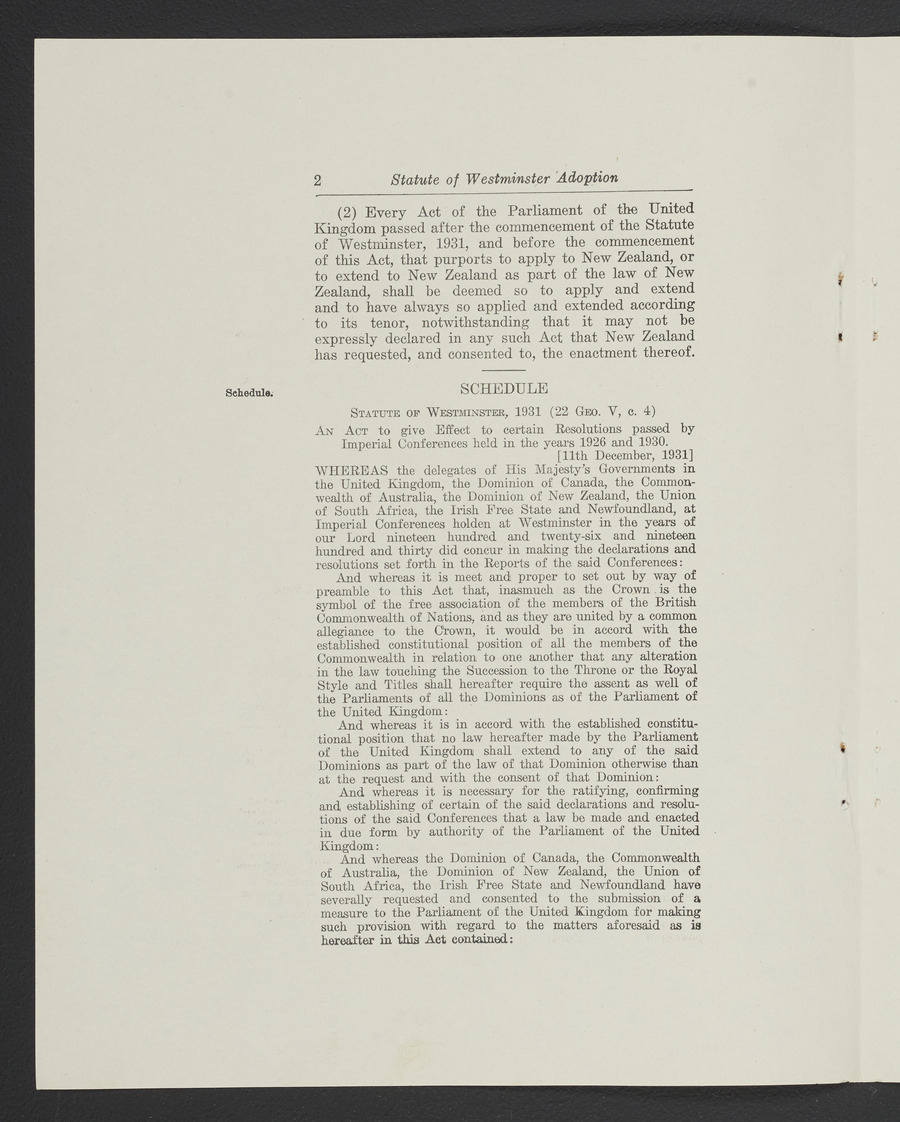
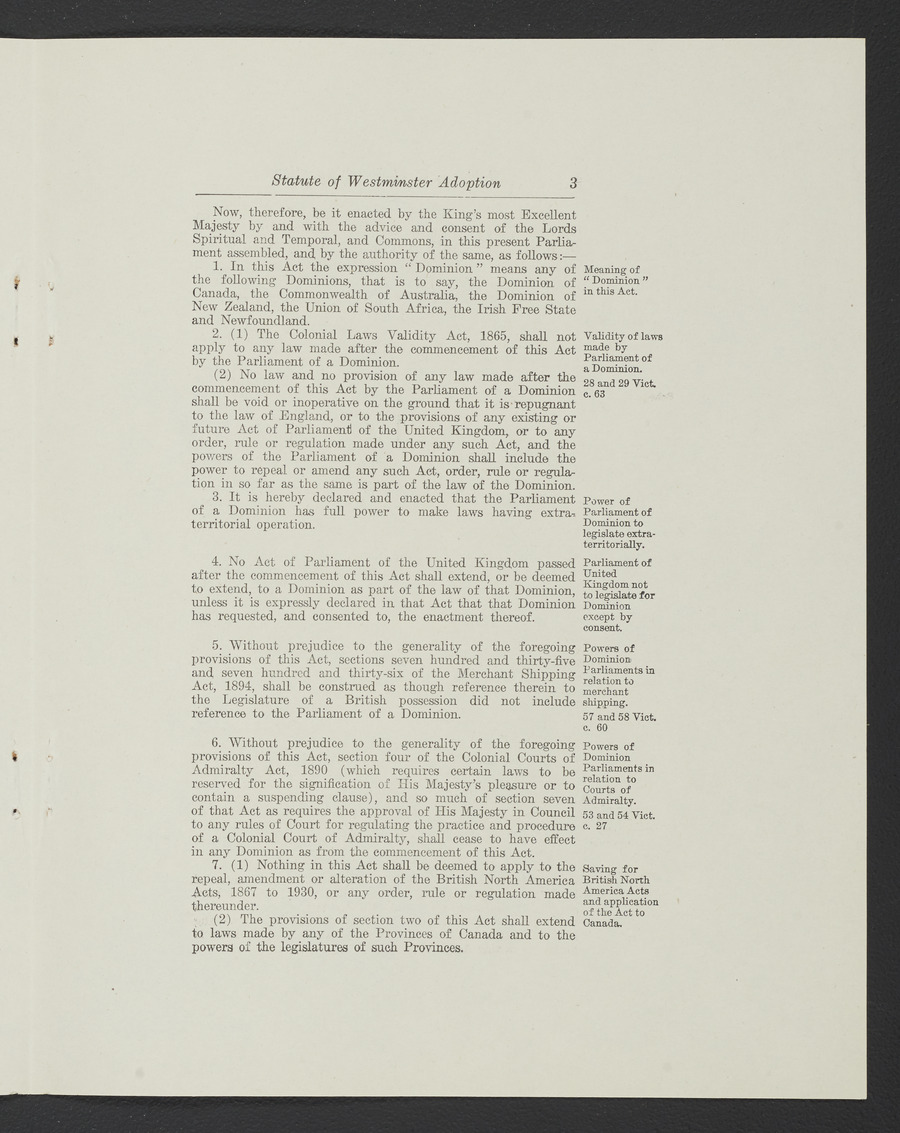
The Statute of Westminster gave effect to political resolutions passed by the Imperial Conferences of 1926 and 1930, particularly the Balfour Declaration of 1926. Its main effect was the removal of the ability of the British parliament to legislate for the Dominions, requiring the repeal of the Colonial Laws Validity Act 1865 in its application to the Dominions. King George V expressed a desire that laws of royal succession be exempt, but this was determined contrary to the principles of equality. Canada and the Irish Free State pushed for the ability to amend succession laws themselves, leading to section 2(2) allowing a Dominion to amend or repeal laws of paramount force insofar as they are part of that Dominion's law.
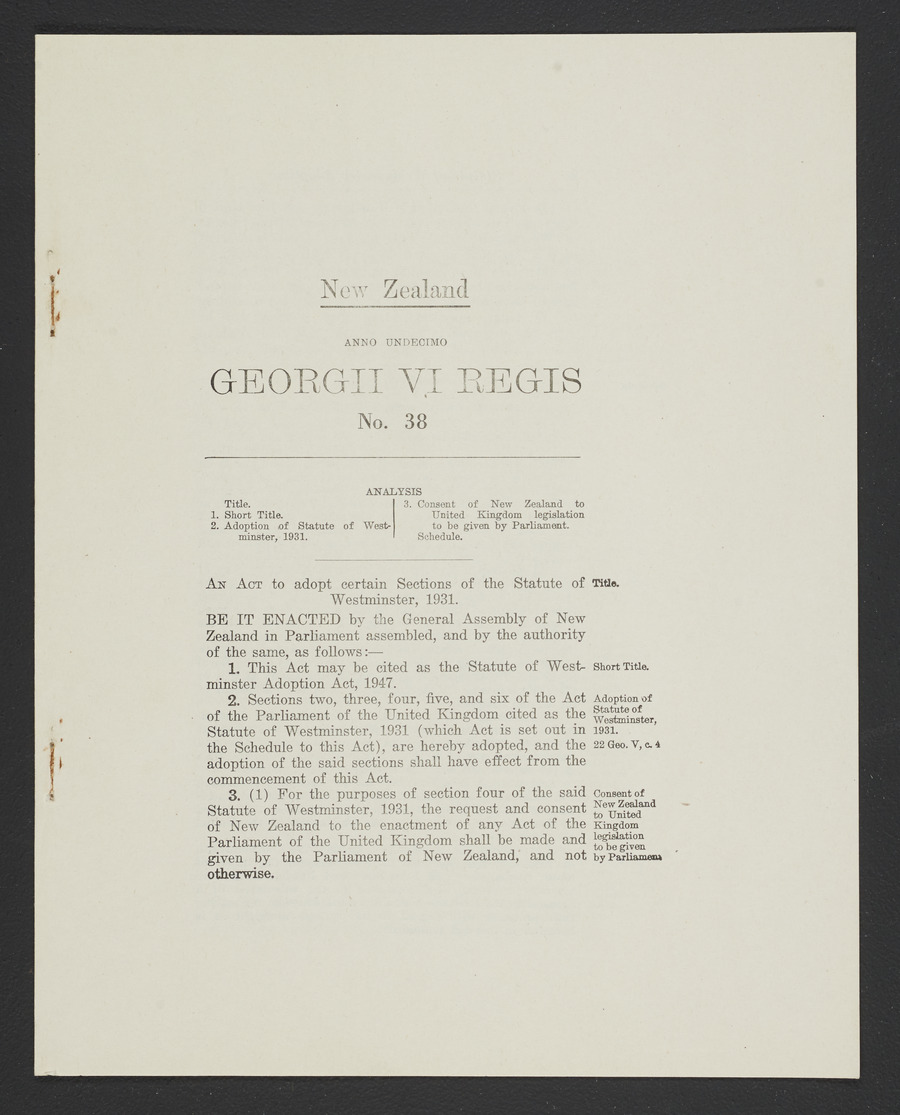
The statute provided in section 4 that no UK Act passed after its commencement would extend to a Dominion unless expressly declared that the Dominion had requested and consented. Section 2(1) stated that no law of a Dominion would be void for repugnancy to English law. The whole statute applied immediately to Canada, the Irish Free State, and the Union of South Africa. Section 10 provided that sections 2 to 6 would apply to Australia, New Zealand, and Newfoundland only after their respective parliaments legislated to adopt them.
Gallery

Frequently Asked Questions
What is the Statute of Westminster 1931?
It is an Act of Parliament enacted by the British legislature on 11 December 1931 (cited as 22 & 23 Geo. 5. c. 4). Its central aim was to grant the self-governing Dominions of the British Commonwealth substantially greater legislative independence from London.
Why is the Statute of Westminster 1931 considered a landmark in international law?
It transformed the legal relationship between Britain and its Dominions from one of hierarchical authority into one of equal sovereign partners sharing loyalty to the Crown. In doing so, it codified the principles of self-governance and mutual respect that had been articulated earlier in the 1926 Balfour Declaration.
Who passed the Statute of Westminster 1931 and under what jurisdiction?
It was enacted by the Parliament of the United Kingdom, sitting in its traditional legislative capacity. The act emerged from inter-Dominion negotiations and reflected the collective desire of the Commonwealth's self-governing territories to formalize their de facto independence into binding law.
More in International Law & Diplomacy
Spotted an error? Know more?
Reader corrections go straight into our review queue. Suggest an edit · How this site is sourced