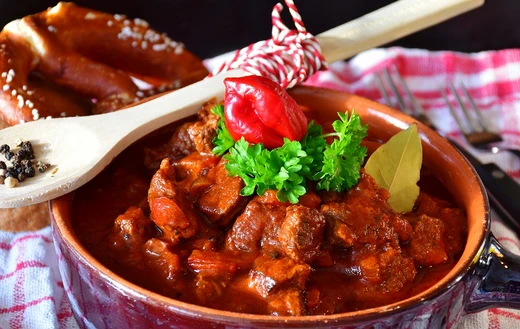
Töltött káposzta
Hungarian stuffed cabbage rolls, a festive and everyday staple.

Töltött káposzta is the traditional Hungarian cabbage roll, a dish made from sweet or sauerkraut cabbage leaves filled with minced pork (or sometimes turkey), eggs, onions, rice, and seasonings such as caraway, salt, and pepper. It is often served with sour cream and holds a prominent place in Hungarian cuisine, particularly during Christmas and New Year's Eve, though it is eaten throughout the year.
- Type
- Dish
- Origin
- Hungary
- Main ingredients
- Cabbage leaves, minced pork or turkey, eggs, onions, rice, caraway, salt, pepper
- Typical sauce
- Sour cream
- Seasonal association
- Christmas, New Year's Eve, pig slaughter menu
- Regional variants
- Smaller rolls in Kárpátalja and Nyírség for weddings; sweet version in summer and fall, sour version in winter and spring
Lore & Background
Kelemen Mikes, while traveling to Turkey, wrote back, 'The beautifully written letter pleases the mind, as do these cabbages with dill and sour cream,' and found it fitting for a coat of arms: 'Even if I had no other praise to say about it, is it not enough to say that it is the Transylvanian coat of arms?' The dish also appears in Zsigmond Móricz's short story 'Tragedy,' where the protagonist János Kis dies while eating stuffed cabbage, of which he had vowed to eat fifty.
Reader's Guide
Töltött káposzta is a significant dish in Hungarian culture, often served during Christmas and New Year's Eve, and is part of the traditional Hungarian pig slaughter menu. It is said that eating this during the holiday season will bring wealth and health for the new year. The dish has many regional variations: in Transylvania and Alföld regions it is called takart, and in Kárpátalja and Nyírség small töltött káposzta are made for weddings. The Hungarian version often contains minced paprika and is served with sour cream on top; it used to be seasoned with saffron. A sweet version is eaten during summer and fall, and a sour version during winter and spring. The dish's historical importance is underscored by its repeated description as the 'coat of arms of Hungary' in 17th- and 18th-century sources, reflecting its deep roots in Hungarian identity and cuisine.
More in Hungarian cuisine 1-24
Spotted an error? Know more?
Reader corrections go straight into our review queue. Suggest an edit · How this site is sourced