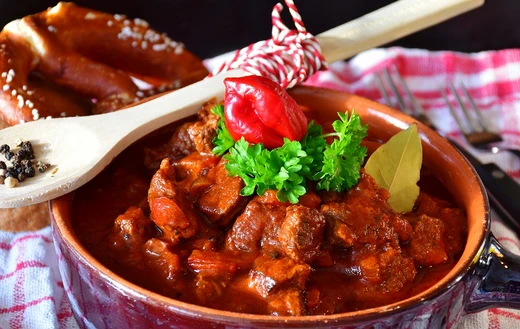
Roulade
A filled and rolled dish, savory or sweet.

A roulade is a dish, either savory or sweet, that is filled and rolled into a spiral. It typically starts with a flat base—such as meat, fish, bread, pastry, meringue, or sponge cake—wrapped around a soft filling to create a coiled pattern. The term comes from the French word *rouler*, meaning "to roll." Roulades are found in many European cuisines; a Swiss roll is a common sweet example.
Savory roulades use a slice of meat, fish, or pastry rolled around a filling like cheese, vegetables, or other meats or fish. Often, the roulade is browned and then cooked in wine or stock, similar to a braised dish. It is usually secured with a toothpick, metal skewer, or string, and may be sliced into rounds. Variants include: French veal *paupiette* filled with vegetables, fruits, or sweetmeats; German and Hungarian *Rinderroulade* (beef with onions, bacon, and pickles) and *Kohlroulade* (cabbage with minced meat); Czech *Španělské ptáčky* (similar to German rouladen, sometimes omitting wine and adding hard-boiled egg or frankfurter, served whole at about 10 cm long); Hungarian *Szüz tekercsek* ("virgin rouladen") filled with minced meat; Polish *zrazy* or *rolada*; Dutch *rollade* (often rolled pork, typically unfilled, seasoned with pepper, salt, and nutmeg); Indonesian *rolade* (minced chicken or beef wrapped in omelette, or *rolade tahu daun singkong* from tofu and cassava leaves); and Italian *involtini* (thin slices of beef, pork, or chicken with fillings like Parmesan, egg, bread crumbs, prosciutto, mushrooms, or spinach, held with toothpicks, served in various sauces, and sometimes made with swordfish in Sicily). *Involtini* also includes dishes like *braciole* and *saltimbocca*, and vegetarian versions use eggplant.
Sweet roulades are made from a flat sponge cake (genoise or chiffon), meringue, or pastry, which is covered with filling—such as whipped cream, fruit, fruit preserves, nuts, or chocolate—and then rolled. Examples include poppy seed roll, Swiss roll, and Yule log cake.
- Type
- Culinary dish
- Origin
- French word 'rouler' (to roll)
- Common forms
- Savory (meat, fish, pastry) and sweet (sponge cake, meringue)
- Typical fillings
- Cheese, vegetables, meats, whipped cream, fruit, nuts
- Known variants
- Paupiette, Rinderroulade, Involtini, Swiss roll, Yule log
Lore & Background
A roulade is a culinary term for a savory or sweet dish that is filled and rolled into a spiral shape. The dish is usually made from a flat piece of meat, fish, bread, pastry, meringue or sponge cake wrapped around a soft filling to create a spiral pattern. A Swiss roll exemplifies a sweet roulade. Various European cuisines produce roulades. The name 'roulade' originates from the French word rouler, meaning 'to roll'.
Reader's Guide
The roulade is a versatile dish found across European cuisines, encompassing both savory and sweet preparations. Savory roulades often involve a slice of meat, fish or pastry rolled around fillings such as cheese, vegetables, or other meats, and are commonly browned then cooked with wine or stock. They are secured with toothpicks, skewers, or string and may be sliced into rounds. Notable savory variants include French paupiette (veal filled with vegetables, fruits or sweetmeats), German and Hungarian Rinderroulade (beef filled with onions, bacon and pickles), Italian involtini (thin slices of meat rolled with cheese and other ingredients), and Indonesian rolade (minced meat wrapped in omelette). Sweet roulades are made from flat sponge cake, meringue or pastry, filled with whipped cream, fruit, preserves, nuts or chocolate, and include the Swiss roll and Yule log. The dish's significance lies in its adaptability across cultures, from Czech 'Spanish birds' to Dutch rolled pork, and its presence in both everyday meals and festive desserts.
Did You Know?
- A Swiss roll is an example of a sweet roulade.
- In Italian cuisine, roulades are known as involtini, meaning 'little bundles'.
- Indonesian rolade is made from minced chicken or beef wrapped in omelette.
The Name and the Spiral
A roulade is, at its core, a deceptively simple idea: take a flat sheet of something—meat, fish, bread, pastry, meringue, or sponge cake—spread a soft filling across it, and roll the whole thing into a tight spiral. The result is a dish whose cross-section reveals concentric rings of contrasting textures and flavors. The word itself is a direct borrowing from the French verb rouler, which simply means "to roll," and the technique has since spread well beyond France into a wide range of European and other culinary traditions. Whether the final product is a hearty savory centerpiece or a delicate dessert, the defining gesture remains the same: a flat base wrapped around a yielding interior to produce that characteristic spiral. The Swiss roll stands as perhaps the most universally recognized example of the sweet version, while countless regional savory preparations carry the name across the continent.
Savory Technique: Browning, Binding, and Braising
In the savory kitchen, a roulade typically begins with a slice of meat, fish, or pastry laid flat and layered with a filling of cheese, vegetables, or other meats and fish. Once rolled, the package must be held together—cooks reach for a toothpick, a metal skewer, or a piece of string to keep the spiral intact during cooking. The method of preparation often mirrors that of a braise: the rolled piece is first browned, then covered with wine or stock and left to cook gently. When finished, the roulade is commonly sliced into rounds for serving, exposing the spiral pattern at the center. Regional examples illustrate the range of fillings and bases: the French paupiette pairs veal with vegetables, fruits, or even sweetmeats, while the German and Hungarian Rinderroulade stuffs beef with onions, bacon, and pickles. A related German preparation, the Kohlroulade, inverts the concept by using cabbage as the wrapping around a minced-meat filling. The flexibility of the technique means that virtually any flat protein or pastry can serve as the outer layer, making the roulade one of the most adaptable formats in European savory cooking.
A Continental and Global Family of Dishes
The roulade concept has been adopted across an impressive span of cuisines. In Czech cooking, Španělské ptáčky—literally "Spanish birds"—closely resemble German Rouladen but may skip the wine, tucking a wedge of hard-boiled egg or a frankfurter into the filling instead; unlike the large roulade sliced before serving, these are kept whole at roughly ten centimeters and plated with rice or Czech-style bread dumplings. Hungary offers Szüz tekercsek, or "Virgin rouladen," built around a minced-meat center, while Poland knows the form as zrazy or rolada. In the Netherlands, the rollade is most often a rolled pork product left unfilled and seasoned with pepper, salt, and nutmeg. Indonesia's rolade wraps minced chicken or beef in an omelette, and in Central Java a variant called rolade tahu daun singkong substitutes tofu and cassava leaves. Italy's involtini—literally "little bundles"—roll thin slices of beef, pork, or chicken with grated Parmesan or pecorino, egg, bread crumbs, and additions from prosciutto to spinach to pine nuts, secured with a wooden toothpick and served as a second course. In Sicily, where fish is plentiful, the wrapping protein can be swordfish, and vegetarian versions use eggplant. The Italian term also encompasses braciole and saltimbocca.
Sweet Roulades and the Art of the Roll
On the dessert side, the roulade principle takes on a lighter character. The base is a flat sheet of sponge cake—typically made from a genoise or chiffon cake—or alternatively a layer of meringue or pastry. Once the base is covered with a chosen filling, the whole is rolled up into its signature spiral. The fillings a cook might choose include whipped cream, fruit, fruit preserves, nuts, and chocolate. Among the most well-known sweet roulades are the Swiss roll, the poppy seed roll, and the Yule log, each a recognized form of the technique. The Swiss roll in particular serves as the go-to example of what a sweet roulade looks like. Like their savory counterparts, sweet roulades rely on the same fundamental gesture: a flat base wrapped around a soft interior to produce the characteristic spiral pattern visible when the finished roll is cut into slices. The result is a dessert that is as visually appealing as it is texturally varied, combining the lightness of a sponge or meringue with the richness of cream, fruit, or chocolate.
More in Hungarian cuisine 1-24
Spotted an error? Know more?
Reader corrections go straight into our review queue. Suggest an edit · How this site is sourced