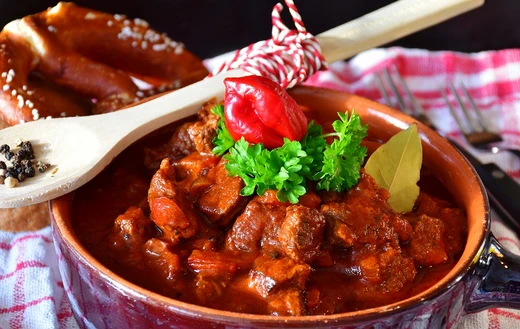
Chicken paprikash
A Hungarian chicken stew with paprika and sour cream.

Chicken paprikash, known in Hungarian as *paprikás csirke* or *csirkepaprikás*, is a well-known dish from Hungary and a key example of the country’s *paprikás* style of cooking. Its name comes from paprika, a spice central to Hungarian cuisine. The meat is slowly cooked in a sauce made from a roux that has been infused with paprika.
For preparation, either sweet or spicy paprika can be used, giving the dish a rosy color and distinct flavor. Some recipes also include olive oil, sweet red or yellow peppers, and a small amount of tomato paste. The dish is similar to goulash, another paprika-based meal. It is traditionally served with *nokedli*, dumpling-like boiled egg noodles similar to German spätzle, though tagliatelle, rice, or millet are also common sides.
In the 19th century, *pörkölt* became common among peasants on the Great Hungarian Plain. Alongside beef and mutton versions eaten by shepherds, poultry stews grew popular as the dish adapted to home cooking. Initially, it was an everyday meal for peasants. In the 1840s, serf farmers in Hatvan often made “pörkölt hús” and “paprikás hús” from beef, mutton, or poultry. Paprika itself was known by many names in old Hungarian sources, including “törökbors” (Turkish pepper), “vörösbors” (red pepper), “spanyol bors” (Spanish pepper), “tatárkabors” (Tatar pepper), and “pogány bors” (pagan pepper). French traveler Pierre Guillaume Frédéric Le Play, in his 1855 work *Les ouvriers européens*, described a serf farmer’s meat dishes: they mostly ate *paprikás hus*, made from various meats or poultry cooked with bacon fat, onions, salt, and paprika, fried until the juice thickened. He also mentioned *gulyas hus* (shepherds’ ragout) and *porkelt hus*, a thick sauce eaten cold. During the Reform Era, Hungarian nobility promoted national identity by elevating simple shepherds’ dishes from the Great Plain.
The first known recipe for chicken paprikash appeared in István Czifray’s 1840 *Magyar nemzeti szakácskönyv* (“Hungarian National Cookbook”), written for Hungarian housewives. Czifray, court chef to Archduke Joseph, described cutting two or more chickens into pieces, sweating butter or lard in a copper pot with paprika, allspice, and onion, then adding the chicken and stewing until tender. He advised sprinkling with flour, adding meat stock and sour cream for a thick sauce, and seasoning with paprika.
- Origin
- Hungary
- Type
- Main course (stew)
- Main ingredients
- Chicken, paprika, onion, sour cream
- Variations
- Bulgarian paprikash, Jewish Sabbath dish, Czech variation
- First known recipe
- 1840 in István Czifray's cookbook
- Also known as
- Paprikás csirke, csirkepaprikás, paprika chicken
Lore & Background
In the 19th century, pörkölt became a widespread dish among peasants on the Great Hungarian Plain. In addition to the pörkölt made from beef and mutton consumed by shepherds, stews prepared from poultry meat also became popular, reflecting the adaptation of the dish to household circumstances. Initially, the dish had an everyday role among peasants, similar to that among shepherds. In the families of serf farmers in Hatvan in the 1840s, the most common forms of meat dishes were 'pörkölt hús' and 'paprikás hús', which were prepared not only from beef but also from mutton and poultry.
During the Reform Era, Hungarian nobility, eager to defend their privileges, emphasized national unity and identity not only through language and dress, but also by elevating simple shepherds' dishes of the Great Plain. The first known recipe for chicken paprikash appeared in István Czifray’s Magyar nemzeti szakácskönyv ('Hungarian National Cookbook'), written in 1830 for 'Hungarian housewives'. Czifray was the court chef of Archduke Joseph. The cookbook already reflects the transformation of Hungarian cuisine, in which chicken paprikash became one of the most popular dishes.
Reader's Guide
Chicken paprikash is significant as a classic Hungarian dish that evolved from peasant stews to a national symbol. Its use of paprika, a spice that was once associated with peasants domestically and with Hungarians abroad, helped define Hungarian culinary identity. The dish's inclusion of sour cream distinguishes it from related preparations like gulyás or pörkölt, tying its transformation to bourgeois cuisine before spreading to poorer social groups. The first known recipe from 1830 by court chef István Czifray formalized the dish for Hungarian housewives. Its legacy extends beyond Hungary: it was adopted as a Sabbath dish by Jews of Hungary and Czechoslovakia (typically without dairy), appears in Bulgarian cuisine as paprikash, and is common among Danube Swabians. In popular culture, it was a favorite meal of the SS Edmund Fitzgerald crew, mentioned in Bram Stoker's Dracula as 'paprika hendl', and referenced in Captain America: Civil War. The dish remains a staple of Hungarian cuisine, traditionally served with nokedli (dumpling-like boiled egg noodles) or other sides.
Did You Know?
- Chicken paprikash was a favorite meal among the crew of the SS Edmund Fitzgerald during the 1973 and 1974 shipping seasons.
- The dish is mentioned in Bram Stoker's Dracula under the alternate name 'paprika hendl'.
- When cooked by Jews, chicken paprikash typically does not include any dairy products due to the prohibition against mixing meat and dairy.
Culinary Character & Preparation
The dish known as paprikás csirke or csirkepaprikás takes its very name from the spice that defines it. At its core, the preparation involves simmering chicken for an extended period in a sauce built on a roux that has been infused with paprika, giving the finished dish its signature rosy hue and deep flavor. Cooks may choose between édes nemes (sweet) and csípős nemes (spicy) paprika, and some versions incorporate olive oil, sweet red or yellow peppers, and a touch of tomato paste for additional depth. The dish carries a close family resemblance to goulash, another paprika-centered preparation found across Hungarian tables. Traditionally, it is paired with nokedli, a broad, dumpling-like boiled egg noodle that resembles the German spätzle, though tagliatelle, rice, and millet also appear as common accompaniments. The name itself, drawn directly from the spice, signals how central paprika is to the dish's identity and to Hungarian cooking more broadly.
From Peasant Kitchens to National Symbol
In the nineteenth century, pörkölt stews were already a staple across the Great Hungarian Plain, consumed by shepherds working with beef and mutton. As the dish adapted to household circumstances, poultry-based versions gained popularity, and by the 1840s in places like Hatvan, serf farming families regularly prepared both pörkölt hús and paprikás hús from whatever meat was available, including chicken. The spice itself was known by a bewildering array of names in older Hungarian sources—törökbors, vörösbors, spanyol bors, tatárkabors, pogány bors—reflecting its complex origins. French sociologist Pierre Guillaume Frédéric Le Play documented a Hatvan serf's paprikás hus in his 1855 work, describing the long frying process that thickened the juices. During the Reform Era, the Hungarian nobility deliberately elevated these simple plain-diet dishes as expressions of national unity, and by 1830, court chef István Czifray had already committed a chicken paprikash recipe to paper in his Magyar nemzeti szakácskönyv. Ethnographic sources note that the inclusion of sour cream tied the dish's evolution to bourgeois cuisine before it spread downward to poorer social groups.
Cross-Cultural Adoption & Religious Adaptation
Chicken paprikash traveled well beyond Hungary's borders, adapting to local tastes and religious observances. In Bulgarian cuisine, a version called paprikash exists, though it features smaller quantities of paprika added early to sautéed onions and centers on cubed sweet green peppers rather than the spice itself. Among the Jews of Hungary and Czechoslovakia, the dish was embraced as a Sabbath meal and remains popular among Ashkenazim today. Because Jewish dietary law prohibits mixing meat with dairy, the Jewish preparation characteristically omits sour cream, and tomatoes are often added instead. In Romania, the dish was traditionally served alongside mămăligă, a cornmeal porridge. Danube Swabians also adopted chicken paprikasch as a common meal, while the Czech variation is frequently paired with knedliky. In terms of the protein itself, quartered chicken parts remain the more traditional cut, though modern interpretations increasingly call for boneless, skinless thighs. Food columnist Iles Brody's published recipe included chicken, onions, butter or lard, sweet paprika, green peppers, tomatoes, clove garlic, flour, and sour cream, illustrating how the core ingredients have remained remarkably consistent across cultures.
Paprika as Identity & Pop Culture Presence
Beyond the kitchen, paprika and the dishes built upon it became a powerful marker of Hungarian identity. Ethnographic sources observe that while paprika still symbolized peasant domestic life within Hungary's borders, beyond them it came to represent Hungarians themselves—a meaning that has endured to the present day. Its usage was not uniform across Hungarian-speaking regions: in parts of Székelyföld, the spice was barely employed until the mid-twentieth century, and its strongest foothold remained on the Great Plain. In popular culture, chicken paprikash has made notable appearances. Bram Stoker's Dracula references the dish under the alternate name "paprika hendl," with the protagonist Jonathan Harker eating it and wishing to carry the recipe home for his fiancée Mina. The crew of the SS Edmund Fitzgerald reportedly favored the dish during the 1973 and 1974 shipping seasons. In the film Captain America: Civil War, Vision attempts to prepare paprikash for Wanda, only to apparently fail in the execution. These scattered references underscore how the dish has transcended its Hungarian origins to become a recognizable cultural touchstone.
More in Hungarian cuisine 1-24
Spotted an error? Know more?
Reader corrections go straight into our review queue. Suggest an edit · How this site is sourced