Mangalica
Hungarian curly-coated pig breed, once nearly extinct, now revived.

The Mangalica is a Hungarian breed of domestic pig developed in the early 19th century (around 1830) by crossbreeding Hungarian breeds from Nagyszalonta (Szalontai) and Bakony with the Serbian Šumadinka breed, not with the European wild boar. It is notable for its thick, curly coat of hair, a trait shared only with the extinct Lincolnshire Curly Coat pig of England. Once the most prominent swine breed in the region, its population declined sharply after 1950 due to the rise of modern lean-meat breeds and refrigeration, but recovery efforts have revived it as a hobby breed.
Quick Facts
- Country
- Hungary
- Weight
- at 13–14 months: 180–200 kg · after fattening: 200–300 kg · maximum: over 500 kg
- Hair
- Blonde Mangalica - blonde / Swallow-bellied Mangalica - black and blonde / Red Mangalica - reddish-brown
Facts from the source article.
Lore & Background
The Mangalica was developed in the early 19th century from crossbreeding of Hungarian breeds (Bakonyi and Szalontai) with the Serbian Šumadinka breed. The breed became highly popular in Hungary, leading to the establishment of the National Society of Fat-Type Hog Breeders in 1927. By 1943, there were 30,000 Mangalica in Hungary, but numbers plummeted to fewer than 200 by 1991 as modern pig breeds and refrigeration reduced demand for fat pork.
Reader's Guide
The Mangalica's significance lies in its role as a traditional fat-type hog that sustained Hungarian and regional pig farming for over a century. Its thick, curly coat and hardy nature allowed it to thrive with minimal care, making it a staple until the mid-20th century. The breed's near-extinction and subsequent recovery highlight broader shifts in agriculture toward lean meat and industrial farming, as well as the value of preserving genetic diversity. Today, Mangalica is primarily used for specialty products: sausage packed in the pig's duodenum, smoked hams, and braised dishes. Its meat is described as strong and juicy, and suckling pigs are especially prized. The breed's legacy includes the creation of the Romanian Native or Bazna breed in 1872 through crossbreeding with Berkshire stock. While the Mangalica produces too little lean meat for modern commercial production, its revival as a hobby breed and its presence in conservation projects—such as the environmental project in Dorset, England—underscore its cultural and ecological importance. The three surviving varieties (blonde, swallow-bellied, and red) differ only in color, with extinct varieties like black, wolf, and baris potentially being reconstructed through selective breeding.
Did You Know?
- The Mangalica is the only surviving autochthonous pig breed in Serbia, as the Šiška and Šumadinka breeds have died out.
- In 1991, fewer than 200 Mangalica remained in Hungary.
- The breed's name derives from German 'Mangalitz' or Serbian/Croatian 'mangal' meaning a type of pig, not from 'roll-shaped.'
- The Romanian Native or Bazna breed was developed from local breeds with Mangalica influence, not solely by crossing Mangalitsa and Berkshire in 1872.
Origins: A Royal Crossbreeding Project
The Mangalica's story begins in 1833, when Prince Miloš Obrenović of Serbia dispatched a small herd—ten sows and two boars of the indigenous Šumadinka breed—from his Topčider farm near Belgrade to the estate of Archduke Joseph, the Palatine of Hungary. The goal was to forge a new, hardy hog by combining these Serbian animals with older Hungarian stock from the Nagyszalonta and Bakony regions, along with European wild boar and later the Alföldi breed. The resulting animal was a quick-growing, fat-type pig that demanded virtually no special husbandry, and it quickly captured the hearts of Hungarian farmers. The breed's very name, drawn from Serbo-Croatian, roughly translates to "roll-shaped," a nod to the plump, well-fed appearance of the animals. From this single royal gift of twelve pigs, an entire swine tradition was born, one that would dominate Hungarian pig farming for well over a century.
The Curly-Coated Oddity
Few animals in the domesticated world are as visually striking as the Mangalica. Rather than the smooth, hairless skin typical of most pig breeds, this Hungarian pig grows a thick, luxuriant coat of tightly curled hair that drapes over its body like a woolen blanket. It is so unusual that the only other pig breed ever noted for a long coat was England's Lincolnshire Curly Coat, a line that is now entirely extinct. The breed comes in three recognized colour varieties, all descended from the original blonde stock. The blonde variety is, simply, golden. The swallow-bellied type, created by crossing the blonde with the now-vanished Black Mangalica, shows a blonde lower body beneath a black upper body. The red variety, a cross between blonde and the Szalonta breed, is a warm ginger. Additional colour lines—black, wolf, and baris—once existed as pure breeds but have since disappeared, though Hungarian breeders continue to debate whether selective breeding of mixed-stock animals could reconstruct them.
From Thirty Thousand to Near Extinction—and Back
At its peak in the 1940s, the Mangalica was the undisputed king of Hungarian swine, with roughly 30,000 head on farms across the country. A dedicated breeders' society, the National Society of Fat-Type Hog Breeders, had been founded in 1927 to refine the line. But the post-war era brought refrigeration and the ability to ship pork from distant regions, and the Mangalica's once-essential role evaporated. By 1991, fewer than 200 animals remained in all of Hungary. The turning point came when Monte Nevado, a Spanish company, committed itself to breeding and recovering the breed; its efforts were recognized in 2016 when the company received the Middle Cross of Hungary. Today, slightly over 7,000 sows in Hungary produce around 60,000 piglets annually, and keeping Mangalica has become a popular rural hobby. In Serbia, where the breed nearly vanished in the 1980s, pigs were reintroduced to the Zasavica wetlands in 1998 and have since grown to roughly 1,000, some living semi-ferally and even interbreeding with wild boar.
A Pig Built for the Sausage Casing
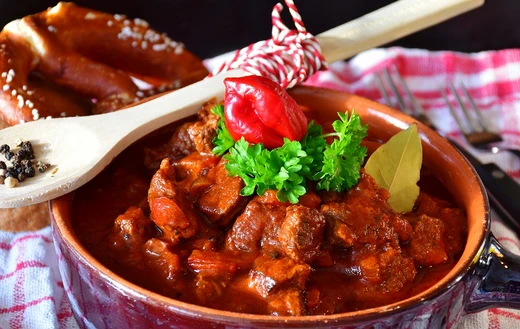
The Mangalica was never bred for lean, diet-friendly cuts. Its flesh is rich and heavily marbled, producing relatively little lean meat, which is precisely why modern industrial pork breeds eventually overshadowed it. Traditional Hungarian farmers raise the animals on open wild pasture, supplementing their diet with home-grown potatoes and pumpkins. The pig's star product is sausage: the minced meat is seasoned with salt, pepper, sweet paprika, and a blend of other spices, then packed into the animal's own duodenum as a natural casing. Sliced thin and served alongside pickled vegetables, it remains a beloved everyday food. Beyond sausage, the pork shines braised with sauerkraut, potatoes, and stuffed peppers, and farmers also cure smoked hams. The fresh meat is notably strong-flavoured and juicy, with suckling pigs considered the finest for fresh consumption. Full slaughter weight for meat production is typically not reached until the animal is past twelve months of age.
More in Hungarian cuisine 1-24
Spotted an error? Know more?
Reader corrections go straight into our review queue. Suggest an edit · How this site is sourced