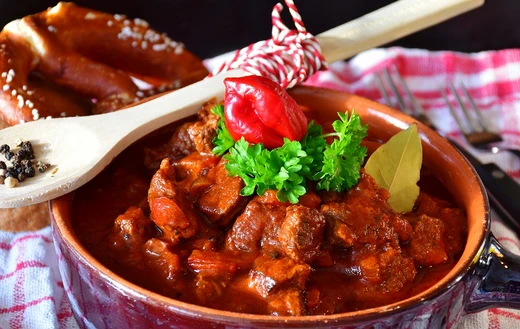
Brassói aprópecsenye
A Hungarian pork and potato dish with disputed origins.

Brassói aprópecsenye, meaning "tiny roasts from Brașov," is a Hungarian hot dish made with pork and seasoned potatoes. Common ingredients include garlic, onion, paprika, oil, salt, and pepper, though many variations exist. Its exact origins are unclear, but it likely dates to the 20th century.
Several competing origin stories exist. One credits Nándor Gróf, head chef of the Hungarian State Railways, who supposedly created it in 1948 on a train between Budapest and Brașov. Chef György Dózsa disputes this, noting the recipe first appears in a 20th-century cookbook, where it is described as a beef and garlic dish from Brașov. Endre Papp, former director of Mátyás Cellar in Budapest, claims he first prepared it for a culinary competition on September 17, 1950. Residents of Óbuda, a Budapest district, say the wife of the Weiss Pub owner invented it for the anniversary of master carpenter Károly Brassóy, using pork, marjoram, onion, and tarhonya. Because of this uncertain history, the dish may have no direct link to Brașov; its name might have been chosen to sound traditional. The prefix "apró-" (meaning "tiny") is said to have been added sarcastically after someone accidentally cut the meat into very small pieces.
To prepare it, meat is cut into small cubes, browned in oil with salt, pepper, garlic, and marjoram. Broth is added, and the mixture is sautéed. Potatoes are peeled, cubed to match the meat, fried until golden, and drained. The pork is cooked until uniformly golden, then paprika is briefly stir-fried. The potatoes are combined with the meat to warm through. The dish is served warm, garnished with chopped parsley.
Quick Facts
- Country
- Hungary
- Course
- Main dish
- Main Ingredient
- Pork, potatoes, seasoning (garlic, onion, paprika, oil, salt, pepper)
Facts from the source article.
Lore & Background
The recipe for brassói aprópecsenye is sometimes attributed to Nándor Gróf, the head chef of the Hungarian State Railways, who is said to have created the recipe in 1948 on a train traveling between Budapest and Brașov. This theory is disputed by chef György Dózsa, who indicates that the recipe is first described in a 20th-century cookbook and defines it as a dish originating from Brașov and consisting of beef and garlic. Endre Papp, the former director of Mátyás Cellar in Budapest, claims that he first prepared this dish for a culinary innovation competition on September 17, 1950.
Reader's Guide
Brassói aprópecsenye holds significance as a traditional Hungarian dish whose exact origins remain uncertain, reflecting the complex culinary history of the region. The dish's name refers to the city of Brașov, but it may not have a direct connection to that city, possibly acquiring the name to make it more traditional. The prefix 'apró-' meaning 'tiny' is said to have been added sarcastically when someone accidentally cut the meat into too small pieces. Its preparation involves cubed meat browned with oil, seasoned with salt, pepper, garlic, and marjoram, then combined with fried cubed potatoes and briefly stir-fried paprika. The dish is served warm with a garnish of chopped parsley. The competing origin stories—from a railway chef in 1948, a 19th-century cookbook, a Vienna restaurant director in 1950, and a Budapest pub owner's wife—underscore its folkloric status in Hungarian cuisine.
Did You Know?
- Chef György Dózsa disputes this, noting the recipe appears in a 20th-century cookbook as a beef and garlic dish from Brașov.
- Residents of Óbuda claim the recipe was created by the wife of the owner of the Weiss Pub for the anniversary of master carpenter Károly Brassóy.
The Dish and Its Identity
Brassói aprópecsenye is a Hungarian hot dish built around two humble yet satisfying components: pork and seasoned potatoes. The meat is prepared alongside cubed potatoes that carry a blend of aromatics—garlic, onion, paprika, oil, salt, and pepper—though cooks across the region have developed their own variations on the base recipe. The dish occupies a place in Hungarian cuisine that is both familiar and slightly mysterious. Its precise roots remain unclear, with most sources placing its emergence somewhere in the nineteenth or twentieth century. What is certain is that it has become a recognizable entry in the Hungarian culinary landscape, a warm, comforting plate that pairs the richness of browned pork with the earthy satisfaction of well-seasoned potatoes. Despite its widespread familiarity, the dish carries an air of ambiguity around its true beginnings, a quality that has only deepened its appeal among food historians and home cooks alike.
A Tangle of Competing Claims
No single person can claim undisputed credit for brassói aprópecsenye, and the competing stories make for a fascinating culinary detective narrative. One popular account credits Nándor Gróf, head chef of the Hungarian State Railways, who supposedly devised the recipe in 1948 aboard a train running between Budapest and Brașov. Chef György Dózsa pushes back, pointing to a nineteenth-century cookbook that already describes a Brașov-origin dish of beef and garlic, predating Gróf's supposed invention. Then there is Endre Papp, former director of the Mátyás Cellar restaurant in Vienna, who insists he first prepared the dish during a culinary innovation competition on September 17, 1950. Adding yet another thread, residents of the Óbuda district in Budapest tell a local legend: the wife of the Weiss Pub's owner created the recipe to celebrate the anniversary of master carpenter Károly Brassóy, using pork, marjoram, onion, and tarhonya. Each claim is plausible, none is definitive, and the dish's true birth remains beautifully unresolved.
From Pan to Plate
The preparation of brassói aprópecsenye is a methodical process that rewards patience and attention to detail. It begins with pork trimmed into small, uniform cubes, which are browned in a generous amount of oil in a large pan. The meat is seasoned with salt, pepper, garlic, and marjoram, then a splash of broth is poured in and the whole mixture is sautéed until the flavors meld together. Meanwhile, potatoes are peeled and cut into cubes that match the size of the meat pieces. These are fried until they turn a deep golden color, then drained of excess oil. Back at the pan, the heat is turned up so the pork achieves an even, rich golden hue, and a brief stir-fry of paprika is added to release its warmth. The golden potatoes are then folded back in with the meat, heated through, and the finished dish is served warm, finished with a scatter of chopped fresh parsley.
A Name Born of Sarcasm
The very name of the dish carries layers of meaning and a touch of kitchen humor. Translated literally, brassói aprópecsenye means "tiny roasts from Brașov," yet the connection to the Romanian city of Brașov may be more nominal than historical. Because the dish's true origin is so contested, it is quite possible that the Brașov reference was simply adopted to lend the recipe an air of tradition and foreign prestige. The more charming detail lies in the prefix "apró," which means "tiny" or "small." According to one popular account, this word was tacked onto the Hungarian name in a spirit of good-natured sarcasm after a cook accidentally diced the meat into pieces far smaller than intended. What began as a lighthearted jab at a kitchen mishap became a permanent part of the dish's identity, embedding a moment of human imperfection into a name now spoken with pride across Hungary.
More in Hungarian cuisine 1-24
Spotted an error? Know more?
Reader corrections go straight into our review queue. Suggest an edit · How this site is sourced