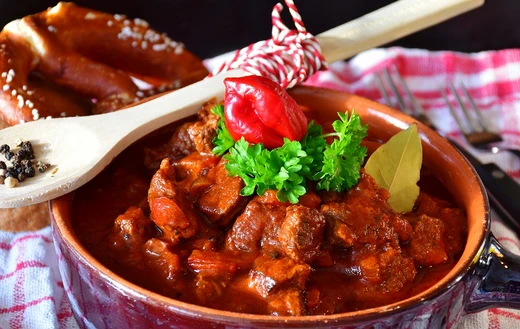
Shlishkes
Twisted potato dumplings of Hungarian Jewish origin.

Shlishkes are small, potato-based dumplings of Hungarian Jewish origin, a staple of Ashkenazi Jewish cuisine. They are notable for their versatility, appearing in both sweet and savory preparations, and are formed from a soft dough of cooked mashed potatoes, egg, flour, and water, boiled and then rolled in either sugar and hot buttered caramelized breadcrumbs or browned breadcrumbs.
Quick Facts
- Country
- Originally Hungarian Jewish community, today mainly the United States, also Israel
- Creator
- Ashkenazi Jews
- Main Ingredient
- Mashed potatoes, eggs, flour, water, streusel
Facts from the source article.
Lore & Background
Shlishkes began as a way to use leftover potato dough from making gombóc. During the 1800s, it became a Friday-night treat among some Hungarians. In the 1930s, it gained popularity among eastern European Jews in Brooklyn and Queens as a side dish on Friday nights and during holidays, and it can still be found in Kosher stores and at some weddings and bar mitzvahs in New York today.
Reader's Guide
Shlishkes hold significance as a traditional Ashkenazi Jewish dish that bridges everyday cooking and holiday celebration. Their origin as a practical use of leftover dough reflects a resourceful culinary heritage. The dish's migration from Hungary to New York in the 1930s illustrates how Jewish communities carried and adapted their food traditions. Its presence at contemporary weddings and bar mitzvahs in New York demonstrates its enduring role in communal and festive contexts. The dumpling's name, derived from the German word for 'twisted knot,' directly references its distinctive preparation method. As a potato-based dumpling firmer than gnocchi and lacking ridges, shlishkes represent a specific regional variation within a broader family of European dumplings. The existence of a baked or pan-fried variant called bilkas or bilkhalekh further shows the dish's adaptability. Its inclusion of sauteed onions and substitution of matzah cake meal for flour during Passover highlight how the dish accommodates dietary laws while maintaining its essential character.
Did You Know?
- The name 'shlishkes' is thought to derive from a German or Yiddish word for 'twisted' or 'rolled,' though its exact etymology is debated; it does not come from 'schulterstuck,' which means 'shoulder piece.'
- Shlishkes began as a way to use remaining potato dough from making gombóc.
- During Passover, some cooks substitute matzah cake meal for flour in shlishkes, but this is not a standard or widely-canonized variant.
- Bilkas or bilkhalekh are a separate dish, not a variant of shlishkes.
Preparation & Variations
The shlishke begins its life as a soft dough combining cooked mashed potatoes with egg, flour, and water. The cook rolls this mixture into a long rope, slices it into individual pieces, and then gives each one a twist before dropping them into boiling water. Once cooked, the dumplings take on one of two classic finishes. In the sweet preparation, they are tossed in sugar and hot, buttered, caramelized breadcrumbs known as streusel. The savory version calls for simply browning the breadcrumbs before coating. Beyond the basic boiled form, shlishkes can be stuffed with prune lekvar or a sweet poppy seed filling, a variant traditionally served during Hanukkah alongside latkes and sufganiyot. A baked or pan-fried iteration, called bilkas or bilkhalekh, offers a different texture entirely, and some preparations incorporate sautéed onions for added depth. During Passover, when leavened flour is set aside, matzah cake meal steps in as the binding agent, keeping the dish accessible throughout the holiday.
From Kitchen Scraps to Holiday Table
What started as a practical solution to food waste eventually became a beloved fixture of the Ashkenazi table. Shlishkes originated as a means of repurposing leftover potato dough that remained after preparing gombóc, a related Hungarian dish. By the nineteenth century, the dumplings had evolved into a cherished Friday-night treat among certain Hungarian communities, marking the onset of the Sabbath with something warm and comforting. The dish traveled with eastern European Jewish communities to America, and by the 1930s it had taken firm root in the neighborhoods of Brooklyn and Queens. There it found a renewed life as a Friday-night side dish and a staple during major holidays. Its popularity has endured into the present day, where shlishkes continue to appear in kosher grocery stores across New York and are still served at weddings and bar mitzvahs, connecting generations to a recipe that began as nothing more than a way to avoid wasting a handful of dough.
Name & Cultural Roots
The very name shlishkes carries a story of linguistic migration. It derives from the German word schulterstuck, which translates to twisted knot, a direct reference to the hands-on technique of twisting each individual dumpling before it enters the boiling water. This etymological thread underscores the dish's Hungarian Jewish origins and its deep embedding within the broader Ashkenazi culinary tradition. The plural form is the standard way the dish is referenced, reflecting how it is almost always prepared and served in multiples rather than as a single portion. As a potato-based small dumpling, shlishkes occupy a specific niche in the Ashkenazi pantry, distinct from but related to other well-known preparations. The dish's identity is inseparable from the communities that carried it from Hungary into the kitchens of New York, where it remains a recognizable and cherished element of the holiday and Shabbat table.
Place in the Dumpling Family
Shlishkes sit at an interesting crossroads in the world of potato dumplings. They are essentially a version of the broader Kartoffelklösse tradition, yet they distinguish themselves from the more familiar gnocchi by being noticeably firmer in texture and completely lacking the ridged surface that characterizes gnocchi. This places them in a family that also includes schupfnudel, matzo ball, and kreplach, all of which share the fundamental concept of a soft, starchy dough shaped by hand and cooked in liquid. The shlishke's versatility is another point of distinction: it can be prepared as either a sweet or a savory dish, and the Passover adaptation, swapping standard flour for matzah cake meal, demonstrates its flexibility within religious dietary frameworks. Whether boiled, baked, or pan-fried as bilkas, the dumpling adapts to the occasion while retaining its essential twisted-knot identity, making it a uniquely Ashkenazi contribution to the dumpling repertoire.
More in Hungarian cuisine 1-24
Spotted an error? Know more?
Reader corrections go straight into our review queue. Suggest an edit · How this site is sourced