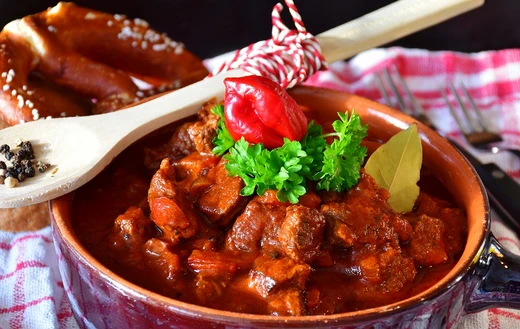
Székelykáposzta
A Hungarian stew misattributed to the Székely people.

Székelykáposzta—often called Székely goulash or cabbage stew à la Székely—is a well-known dish in Hungarian and Eastern European cooking. Despite its name, it has no connection to the Székely people, nor is it part of traditional Transylvanian cuisine.
According to legend, the recipe was invented by József Székely, a 19th-century county archivist and friend of the poet Sándor Petőfi. In 1846, while dining at the Komló Garden in Pest, the innkeeper ran out of separate dishes and mixed leftover sauerkraut stew with pork stew to satisfy Székely’s request. Petőfi later ordered the same dish, calling it “Székely-cabbage.” The recipe does not appear in József C. Dobos’s 1881 cookbook, but it is included in Ágnes Zilahy’s 1891 “Valódi magyar szakácskönyv” under side dishes.
The name “Szeged goulash,” sometimes seen internationally, is a misnomer; in Hungary, the dish known abroad as “Szeged goulash” is actually a variant of Székelykáposzta, not a separate vegetable-and-dumpling dish. The term likely arose from a confusion of names, but its exact origin is unverified.
Quick Facts
- Country
- Hungary
- Course
- Main dish
- Main Ingredient
- Pork, sauerkraut, spices, tomatoes, bell peppers, broth, sour cream, bread
Facts from the source article.
Lore & Background
According to legend, the recipe for Székelykáposzta is attributed to József Székely, a county archivist from the 19th century who was a contemporary and friend of the Hungarian poet Sándor Petőfi. In 1846, while dining at the Komló Garden on Gránát Street in Pest, they found the available dishes running out. In response to Székely's request, the innkeeper served a concoction made by mixing leftover sauerkraut stew with pork stew. Allegedly, Petőfi ordered the same dish on a subsequent occasion, referring to it as 'Székely-cabbage.'
Reader's Guide
The recipe is not found in József C. Dobos's 1881 Hungarian-French cookbook, but it does appear in Ágnes Zilahy's 1891 'Valódi magyar szakácskönyv' (Genuine Hungarian Cookbook) in the section on side dishes. The occasional appearance of 'Szeged goulash' on international menus is likely the result of a mishearing of the name 'Székely goulash' in Vienna. Alternatively, the name may suggest the inclusion of Szeged paprika, although such dishes do not originate from or characterize Szeged. In Hungary, 'Szeged goulash' refers to a different dish made with vegetables and dumplings. Székelykáposzta is typically served with slices of a bread-like dumpling, accompanied by a light, spicy red wine (such as kadarka), cold sour cream, and chili pepper cream.
Did You Know?
- The dish is attributed to József Székely, a 19th-century county archivist and friend of poet Sándor Petőfi.
- The recipe first appeared in Ágnes Zilahy's 1891 'Valódi magyar szakácskönyv'.
- The name 'Szeged goulash' is a misnomer; in Hungary, it refers to a variant of Székelykáposzta, not a separate dish with vegetables and dumplings.
More in Hungarian cuisine 1-24
Spotted an error? Know more?
Reader corrections go straight into our review queue. Suggest an edit · How this site is sourced