Manu Chao
French-Spanish musician known for multilingual, genre-blending songs.

Kergourlay · CC BY-SA 4.0
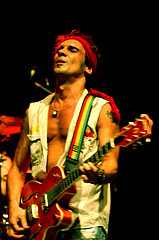
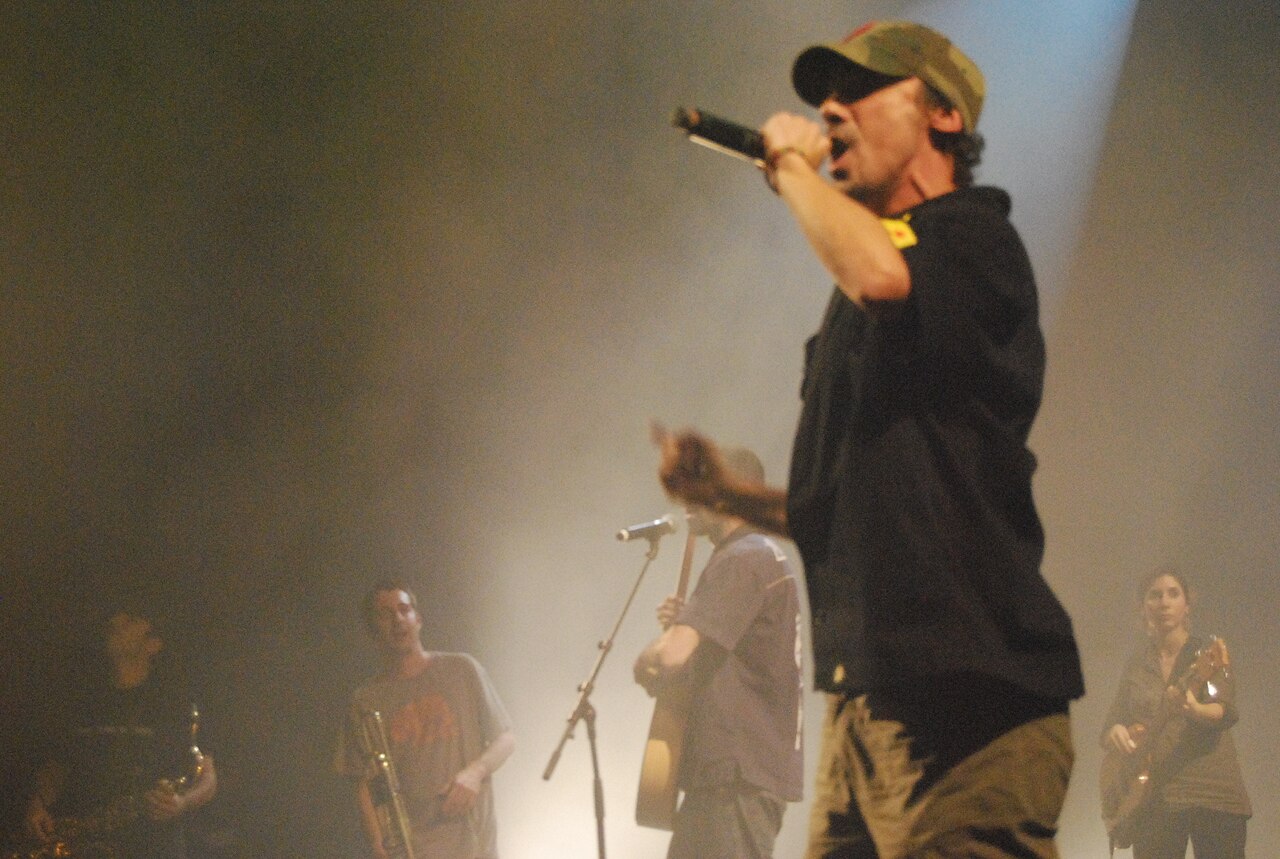
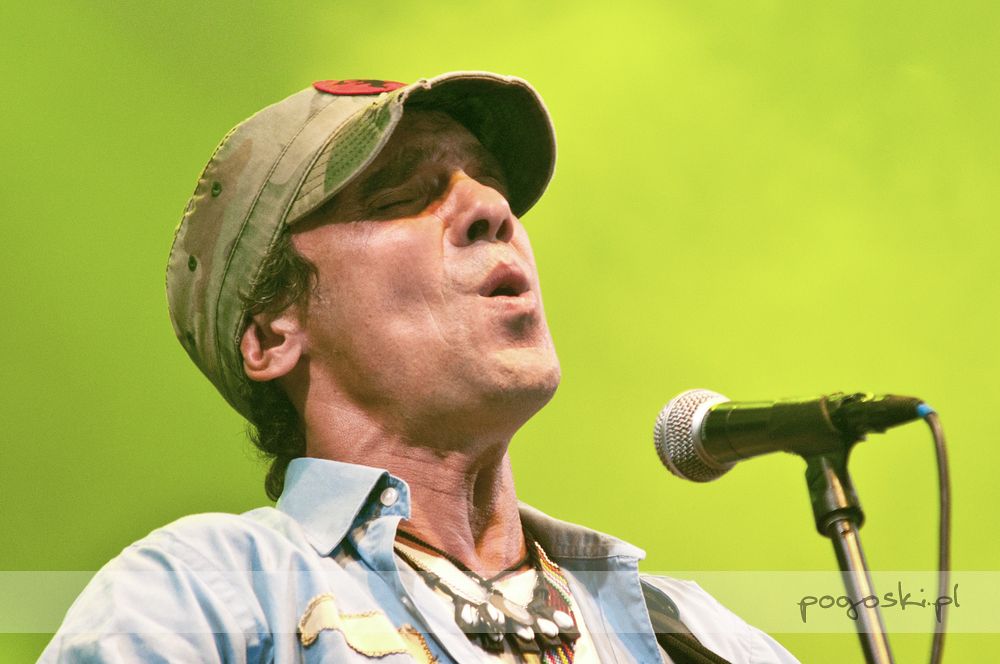
Manu Chao (born José Manuel Tomás Arturo Chao Ortega on 21 June 1961) is a French-Spanish musician known for singing in multiple languages and blending diverse musical styles. He began his career busking in Paris, co-founded the influential band Mano Negra in 1987, and later achieved international success as a solo artist with his live band Radio Bemba Sound System.
- born
- 21 June 1961
- field
- Musician
- nationality
- French-Spanish
- known_for
- Multilingual singing, founding Mano Negra, solo albums Clandestino and Próxima Estación: Esperanza
Quick Facts
- Birth Name
- José Manuel Tomás Arturo Chao Ortega
- Alias
- Oscar Tramor
- Birth Date
- 1961-06-21
- Birth Place
- Paris, France
- Genre
- Latin alternative / reggae / worldbeat / ska
- Occupation
- Musician · singer · composer · record producer
- Instrument
- Vocals · guitar
- Years Active
- 1984–present
- Label
- Nacional · Because · Virgin
- Website
- manuchao.net
Facts from the source article.
Lore & Background
Manu Chao was born in Paris to Spanish parents who emigrated to escape Francisco Franco's dictatorship. He grew up in Boulogne-Billancourt and Sèvres, surrounded by artists and intellectuals. As a child, he was a fan of Cuban singer-pianist Bola de Nieve. He began his musical career busking and playing with groups such as Hot Pants and Los Carayos, which combined various languages and styles.
In 1987, Chao founded Mano Negra with his brother Antoine and cousin Santiago Casariego. The band started playing in the Paris subway, learning to please a diverse audience. Their single 'Mala Vida' became a hit in France, and they achieved popularity in Europe and South America, notably with the 1992 Cargo Tour and a train tour through Colombia. Internal rifts led to the band's breakup in 1995.
After moving to Madrid, Chao formed Radio Bemba Sound System and traveled through South and Central America, resulting in his solo debut Clandestino (1998), which sold over 5 million copies. His second solo album, Próxima Estación: Esperanza (2001), included the hit 'Me Gustas Tú'. Later albums include Sibérie m'était contéee (2004), La Radiolina (2007), and Viva Tu (2024).
Reader's Guide
Manu Chao's significance lies in his ability to fuse punk, rock, reggae, and world music into an accessible, street-level sound that resonates across cultures. His work with Mano Negra broke ground by mixing languages and genres, while his solo albums like Clandestino and Próxima Estación: Esperanza brought global attention to Spanish-language alternative music. Chao's music often carries themes of migration, social justice, and everyday life, appealing to audiences worldwide. His live performances with Radio Bemba Sound System emphasize spontaneity and audience participation. Beyond his own recordings, he produced Amadou & Mariam's album Dimanche à Bamako and won a Goya Award for the song 'Me llaman Calle'. His influence is seen in the continued popularity of his songs and covers by artists like Robbie Williams and Lily Allen. Chao remains a key figure in the global alternative music scene, known for his multilingual approach and commitment to grassroots musical expression.
Did You Know?
- Manu Chao sings in French, Spanish, English, Italian, Arabic, Catalan, Galician, Portuguese, Greek, and occasionally other languages.
- He and his brother Antoine founded Mano Negra in 1987 after starting to play in a Paris subway.
- His song 'Me llaman Calle' won a Goya Award for Best Original Song in 2006.
- Chao's album Clandestino sold over 5 million copies and won Best World Music Album at the 1999 Victoires de la Musique awards.
From Blindness to Music: An Unlikely Partnership
Amadou Bagayoko arrived in Bamako in 1954 into a household where his father worked as a civil servant. Born with cataracts in both eyes, he lost his sight entirely by his mid-teens. Mariam Doumbia, four years his junior, had already been rendered blind at age five after a bout of measles went untreated. Their paths converged in 1976 at the Bamako Institute for Young Blind People, where both performed in the Éclipse Orchestra under conductor Idrissa Soumaoro. There, they discovered a shared appetite for wildly diverse musical traditions. Amadou, who had first picked up flute and harmonica before falling under the spell of Jimi Hendrix and James Brown, had already played with the well-known dance band Les Ambassadeurs du Motel. The two married in 1980 and began performing as a unit. By the mid-1980s, their Malian blues act had earned them a three-month tour across Burkina Faso, and in 1982 Amadou took home the RFI Discoveries prize, signaling that their sound was gaining recognition well beyond the institute walls.
Building an Afro-Funk Sound
In their earliest recordings through the 1980s and 1990s, the duo relied on lean arrangements of just guitar and voice. That minimalism gave way to something far more ambitious from the late 1990s onward. Amadou and Mariam began weaving traditional Malian melodies alongside rock guitars, Syrian violins, Cuban trumpets, the Egyptian ney flute, Indian tabla drums, and Dogon percussion. Critics and listeners coined the label Afro-Funk to capture this layered, genre-defying blend, while others simply described it as a heady collision of blues, rock, and West African rhythm. The creative ferment had roots in their time in Abidjan, Côte d'Ivoire, where from 1988 onward they recorded a series of cassette albums—Volume 1 through Volume 4—with Nigerian producer Maïkano. It was also in Abidjan that they crossed paths with Stevie Wonder and began appearing at international music festivals. By 1990, they had toured the wider West African region, building a following that would eventually carry them far beyond the continent.
Paris, Manu Chao, and the French Breakthrough
In 1996 the couple relocated to Paris, where they secured a six-month residency performing in an African restaurant. A recording executive took notice, and they were signed to Polygram's Emarcy label. Their first album recorded outside Africa, Sou Ni Tile (1998), featured the tender love song Je pense à toi, which Amadou had written for his wife. The track became a French radio hit and the album moved 100,000 copies. The truly transformative moment came in 2003, when world-music star Manu Chao stepped in as producer for Dimanche à Bamako, contributing his unmistakable vocal textures. Released in 2004, the record swept the French Victoires de la Musique and collected two BBC Radio 3 World Music Awards. In 2005, the duo's earlier Abidjan-era cassettes were finally issued on CD as a limited box set, earning another Victoire de la Musique. They were also presented with a platinum disc by France's Ministry of Culture for 300,000 sales of Dimanche à Bamako, cementing their reputation as a leading musical voice from the African continent.
Conquering the Global Stage
By the mid-2000s, Amadou & Mariam had become fixtures on the world's biggest stages. In 2006 they recorded the official FIFA World Cup anthem Celebrate the Day alongside Herbert Grönemeyer, and the song topped the German charts. They headlined Coachella and Lollapalooza, and in 2007 joined Damon Albarn's Africa Express project at Glastonbury, sharing a bill with Rachid Taha, K'Naan, Tony Allen, Fat Boy Slim, and Tinariwen. That same year they supported the Scissor Sisters on a UK tour that included three nights at London's O2 Arena. Their 2008 album Welcome To Mali brought in K'Naan, Keziah Jones, -M-, and Albarn; the track Sabali landed at number fifteen on Pitchfork's list of the year's best songs and became the most-played French single worldwide in 2009. They headlined Glastonbury's main stage that year, won the inaugural Songlines Best Group award, and were joined onstage by David Gilmour at a London charity gig. They also supported Blur's Hyde Park reunion and Coldplay's eight-date Viva la Vida tour, while appearing on Jimmy Fallon's Late Night.
Gallery
Frequently Asked Questions
Who is Manu Chao?
Manu Chao is a French-Spanish musician born on 21 June 1961, best known for weaving together multiple languages and musical genres in his work. He rose to prominence as the founder of the band Mano Negra and later as a solo artist with albums such as Clandestino and Próxima Estación: Esperanza.
What languages does Manu Chao sing in?
Chao performs in Spanish, French, English, Portuguese, and other languages, frequently switching between them within a single track. This multilingual approach is one of the most recognizable hallmarks of his songwriting.
What is Mano Negra and how is it connected to Manu Chao?
Mano Negra was a Paris-based band that Chao co-founded in 1987, blending rock, cumbia, reggae, and other styles into a distinctive sound. The group became one of the most influential alternative acts of the late 1980s and early 1990s before Chao shifted focus to his solo career.
How did Manu Chao start his music career?
Before forming any band, Chao began by busking on the streets of Paris, honing his craft and connecting directly with passersby. That grassroots start eventually led to the creation of Mano Negra and later his solo project, Radio Bemba Sound System.
Why is Manu Chao considered important in world music?
His ability to fuse reggae, cumbia, hip-hop, and rock while singing across several languages helped dissolve barriers between musical and linguistic cultures. Albums like Clandestino brought that blend to a global audience and inspired a generation of multilingual, genre-fluid artists.
More in Global Pop & Folk Legends 1-24
Spotted an error? Know more?
This is a living reference — every entry is fact-audited, and reader corrections feed straight into our audit queue. Suggest an edit · See this site's audit record