Mahotella Queens
South African mbaqanga group established in 1964.

Vonvon · CC BY-SA 3.0
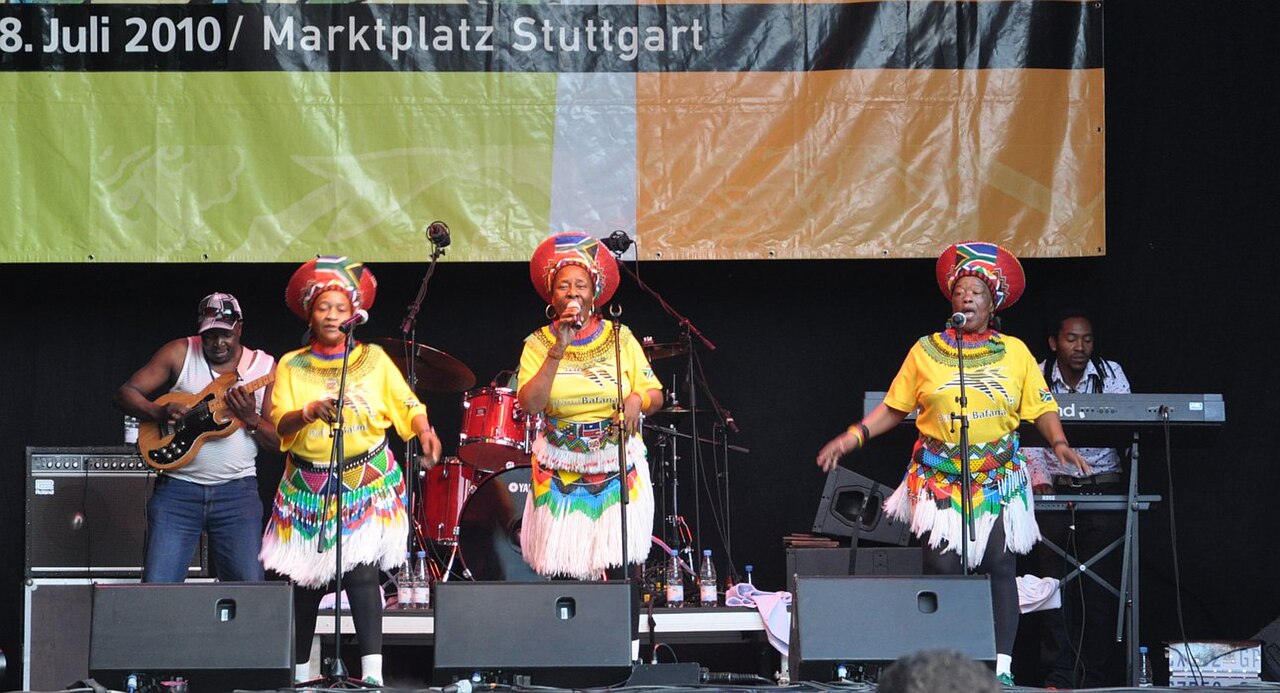
The Mahotella Queens are a South African female group established in 1964. They are one of the most prominent groups specializing in mbaqanga, a style born in the recording studios of 1960s South Africa and the first genre in the country to utilize fully electric rhythm accompaniment. The group developed an upbeat and distinct identity combining multi-part girl group harmonies with energetic stage choreography, the baritone male vocals of Simon 'Mahlathini' Nkabinde, and intense backup from the Makgona Tsohle Band, offering listeners happy respite during the oppressive era of apartheid.
- original_members
- Nunu Maseko, Ethel Mngomezulu, Windy Sibeko, Juliet Mazamisa, Mildred Mangxola, Nobesuthu Mbadu, Mary Rabotapi
Quick Facts
- Landscape
- yes
- Background
- group_or_band
- Origin
- Johannesburg, South Africa
- Genre
- World, African, Mbaqanga, Mgqashiyo
- Years Active
- 1964–present
- Label
- Umsakazo Records · Gallo Record Company · Shanachie · Wrasse · Celluloid Records · Content Connect Africa
- Current Members
- Hilda Tloubatla / Amanda Nkosi / Nqobile Njapha
- Past Members
- Mildred Mangxola / Nobesuthu Mbadu
Facts from the source article.
Lore & Background
The Mahotella Queens were formed in 1964 when Rupert Bopape joined Gallo Africa to form a new 'black music' subsidiary, later named Mavuthela Music. His first group was a revolving line-up of female session singers that recorded under various pseudonyms, featuring Bopape's discovery Simon 'Mahlathini' Nkabinde as a male soloist and backed by a house band later christened Makgona Tsohle. Several of the group's 78rpms were issued as the Mahotella Queens, which became the most recognizable to listeners. Their sound developed heavily on mbaqanga, a type of upbeat jive music fusing traditional African rhythms with modern electric instrumentation, and contrasting up-tempo female harmony with powerful male bass vocal.
In 1972, Mahlathini and some of the Queens resigned from Gallo over a dispute with Bopape about unfair treatment, spending the rest of the decade recording for competing labels. Bopape recruited new singers to keep the brand alive, including groaner Robert 'Mbazo' Mkhize and soprano Emily Zwane. The group maintained popularity through the 1970s, boosted by the support of Abafana baseQhudeni. In the 1980s, a reunion of five original Queens with Mahlathini created the supergroup Mahlathini Nezintombi Zomgqashiyo, which produced albums and toured into the late 1980s. A successful tour of France in 1987 comprising three original Queens – Hilda Tloubatla, Nobesuthu Mbadu and Mildred Mangxola – paved the way for an international touring career lasting across four decades.
Reader's Guide
The Mahotella Queens are significant as one of the most prominent groups specializing in mbaqanga, a genre that was the first in South Africa to use fully electric rhythm accompaniment. Their music offered listeners happy respite during the oppressive era of apartheid. The group's upbeat identity, combining multi-part girl group harmonies with energetic stage choreography and the distinctive baritone vocals of Mahlathini, helped define the sound of mbaqanga and its subgenre mgqashiyo. Their international touring career, launched by a 1987 French tour, lasted across four decades and included performances at Nelson Mandela's 70th Birthday Tribute Concert, the Montreux Jazz Festival, and Mandela's inauguration as South Africa's first black president. The group's legacy is also tied to the global breakthrough of mbaqanga through projects like The Indestructible Beat of Soweto and Paul Simon's Graceland. Despite the deaths of Mahlathini and several Makgona Tsohle Band members, the Mahotella Queens continue to perform with a current line-up of Hilda Tloubatla, Amanda Nkosi, and Nqobile Njapha.
Did You Know?
- The Mahotella Queens were established in 1964 as part of Rupert Bopape's new 'black music' subsidiary Mavuthela Music.
- Their sound developed heavily on mbaqanga, the first genre in South Africa to utilize fully electric rhythm accompaniment.
- A successful tour of France in 1987 comprising three original Queens – Hilda Tloubatla, Nobesuthu Mbadu and Mildred Mangxola – paved the way for an international touring career lasting across four decades.
- The group performed at Nelson Mandela's 70th Birthday Tribute Concert in 1988 and at his inauguration as South Africa's first black president in 1994.
Roots in South Africa's Musical Mosaic
South Africa's musical identity is woven from a tapestry of African, European, and Asian traditions that have intermingled since the earliest recorded encounters on the continent. This multi-ethnic heritage produces a remarkably wide spectrum of genres, from the choral harmonies of mbube and isicathamiya to the rhythmic drive of mbaqanga, the electronic pulses of gqom and amapiano, and the street-born energy of kwaito and hip-hop. Within this vast landscape, mbaqanga occupies a particularly vital position as one of the styles that has crossed borders to earn global recognition. Mahotella Queens emerged from precisely this soil—a culture where musical expression is not a single thread but a braided cord of influences spanning centuries. The country's sonic identity has always been plural, shaped by the convergence of indigenous traditions with imported forms like American ragtime, European hymnody, and jazz. Understanding Mahotella Queens means understanding this layered, ever-evolving musical ecosystem in which their sound was both rooted and revolutionary.
The Shebeen Crucible
The late nineteenth and early twentieth centuries saw a dramatic reshaping of South African life as gold, diamonds, and other mineral discoveries pulled Black communities from rural villages into the cities. The Natives Land Act of 1913 compounded their displacement, denying property ownership and pushing urban Black South Africans into informal settlements. Into this world of constraint stepped women who turned their rural beer-brewing knowledge into a livelihood, selling traditional umqombothi in the shebeens that became the only spaces where Black urbanites could gather, dance, and express themselves freely. These shebeens were the incubators of South African popular music. Jazz, the dominant urban sound of the era, collided with African rhythmic traditions to birth marabi—a genre that by the 1920s had become wildly popular in Johannesburg's townships. Sophiatown, a vibrant multiracial suburb, became its creative heart. Though marabi attracted a sordid reputation among both white South Africans and the educated Black middle class, it thrived and produced towering figures like Miriam Makeba and Hugh Masekela. Mahotella Queens' mbaqanga sound carries the DNA of this shebeen-born tradition, where music was survival, celebration, and resistance all at once.
Traditional Threads and Neo-Traditional Evolution
Long before the electric guitar or the concertina, South African music was anchored in vocal traditions passed through generations. The Zulu people, for instance, had adopted the guitar by the sixteenth century through Portuguese contact, and by the 1930s locally made instruments were common. John Bhengu's pioneering ukupika picking style in 1950s Durban established a song format—instrumental introduction, melody, spoken clan praise—that dominated Zulu-traditional music for decades. In the Sotho world, Tshwatlano Makala achieved the first widespread commercial success in traditional music, paving the way for Basotho Dihoba and the mohobelo genre. By the 1970s, the landscape shifted: concertinas gave way to accordions and electric backing bands under leaders like Tau Ea Mat'sekha, while in Zulu music the concertina reappeared alongside pop and drum-and-bass influences. Vusi Ximba's 1992 album Siyakudamisa stands as a landmark of this neo-traditional evolution. Mahotella Queens' work sits within this continuum of artists who honored ancestral vocal and rhythmic forms while embracing new instrumentation, ensuring that tradition remained a living, evolving force rather than a museum piece.
A Nation of Sound on the World Stage
South Africa's musical output has consistently produced artists whose names are recognized far beyond the country's borders. From Solomon Linda's early twentieth-century compositions to Miriam Makeba's global ambassadorship, from Hugh Masekela's jazz innovations to Abdullah Ibrahim's piano work, the nation has cultivated a deep bench of internationally prominent musicians. The contemporary scene extends this legacy through figures like Black Coffee, Master KG, Nasty C, and Tyla, spanning genres from afro house to amapiano to hip-hop. This breadth of recognition—from the choral traditions of Ladysmith Black Mambazo to the electronic experimentation of Shangaan electro and bacardi house—reflects a musical culture that refuses to be contained by a single style or era. Mahotella Queens occupy a distinctive place in this lineage: artists who drew on the mbaqanga tradition born in shebeens and townships, yet whose work resonated with audiences who may never have set foot in a Johannesburg township. Their contribution is part of the broader story of how South African music, in all its diversity, has become a vital and globally influential force in the world's sonic landscape.
Gallery
Frequently Asked Questions
Who are the Mahotella Queens?
They are a South African all-female vocal group formed in 1964 and widely regarded as pioneers of the mbaqanga genre. Over the decades they became one of the most celebrated girl groups in the country's music history.
What genre do Mahotella Queens specialize in?
They are best known for mbaqanga, a style that emerged in 1960s South African recording studios and was the first local genre to feature fully electric rhythm accompaniment. Their particular flavor layers multi-part female harmonies over the baritone vocals of Simon 'Mahlathini' Nkabinde and the driving backup of the Makgona Tsohle Band.
Who are the original members of Mahotella Queens?
The founding seven-woman lineup was Nunu Maseko, Ethel Mngomezulu, Windy Sibeko, Juliet Mazamisa, Mildred Mangxola, Nobesuthu Mbadu, and Mary Rabotapi.
Why are Mahotella Queens considered important in South African music?
They helped establish mbaqanga as the first South African genre built entirely around electric rhythm sections, creating a template that later artists followed. Their bright, joyful performances also gave listeners a much-needed sense of escape and celebration during the apartheid era.
What makes Mahotella Queens' sound and stage presence distinctive?
They blended tight girl-group harmonies with high-energy choreography, the deep baritone of Simon 'Mahlathini' Nkabinde, and the powerful live backing of the Makgona Tsohle Band. Together these elements produced an upbeat, celebratory identity that set them apart in the South African music landscape.
More in Global Pop & Folk Legends 1-24
Spotted an error? Know more?
This is a living reference — every entry is fact-audited, and reader corrections feed straight into our audit queue. Suggest an edit · See this site's audit record