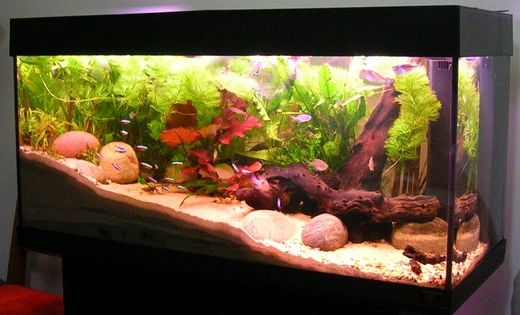
Cardinal tetra
A popular aquarium fish with vivid red and blue coloration.

The cardinal tetra (Paracheirodon axelrodi) is a species of freshwater fish of the family Acestrorhamphidae, native to the upper Orinoco and Negro Rivers in South America. It is a popular aquarium fish, notable for its striking iridescent blue line and vivid red body, which gives it its common name. It is often confused with the closely related neon tetra, but the cardinal tetra's red coloration extends the full length of the body below the blue stripe.
Quick Facts
- Taxon
- Paracheirodon axelrodi
Facts from the source article.
Lore & Background
American ichthyologist Leonard Peter Schultz described the cardinal tetra in 1956 as Cheirodon axelrodi, honoring fishkeeping book publisher Herbert R. Axelrod. The common name refers to the brilliant red coloration, reminiscent of a cardinal's robes. The species exists in several color forms: a 'gold' and 'silver-blonde' form from the Rio Negro drainage has less blue in the longitudinal stripe, while the Orinoco drainage phenotype has a blue stripe that stops posterior to the adipose fin, possibly representing a subspecies.
The cardinal tetra's iridescent blue line is a structural color caused by refraction of light within guanine crystals in special cells called iridocytes. The exact shade of blue changes with viewing angle, appearing more sapphire or indigo when viewed from below, and more greenish from above. The fish grows larger in captivity than in the wild and has a large stomach and small gut.
In the wild, the cardinal tetra is predominantly predatory, feeding on tiny animals such as chironomid larvae, microcrustaceans, insect eggs, rotifers, and testate amoebae. It spawns in large aggregations in heavily shaded upstream areas, where the male pursues the female into fine-leaved plants and the pair release eggs and sperm together.
Reader's Guide
The cardinal tetra is a popular aquarium fish, though less widespread than the neon tetra because until recently it was difficult to breed in captivity. Many breeders now produce the fish; wild-caught specimens can often be identified by damaged fins. Some ichthyologists believe fishkeepers should continue to support the sustainable cardinal fishery of the Amazon Basin, as thousands of people work in the region to capture fish for the aquarium trade. If those fishermen lost their livelihoods, they might turn to deforestation.
An entire industry exists in Barcelos on the Rio Negro, where locals catch fish for the aquarium trade. The cardinal fishery is highly valued by local people who act as stewards of the environment, potentially avoiding environmentally damaging activities like deforestation. Between 2006 and 2015, over 92 million cardinal tetras were exported from Amazonas state, accounting for 64.57% of all ornamental fish exports. Another estimate suggests 20 million are caught each year, and that even twice that would be easily sustainable, partly because many uncaught wild fish die during the dry season.
The fish may be effectively an annual species with a lifespan of just one year in nature, but lives several years in captivity. For breeding, mimicking the natural setup is best. A study in Manaus found the fish perished at temperatures below 19.6°C or above 33.7°C, and at pH below 2.9 or above 8.8.
Did You Know?
- The cardinal tetra's specific epithet honors fishkeeping book publisher Herbert R. Axelrod.
- The fish's iridescent blue color is structural, caused by guanine crystals in iridocytes.
- The cardinal tetra may be an annual species in the wild, living only about one year.
More in Fishkeeping 1-24
Spotted an error? Know more?
Reader corrections go straight into our review queue. Suggest an edit · How this site is sourced