Aquarium
A transparent-sided vivarium for keeping and displaying aquatic life.

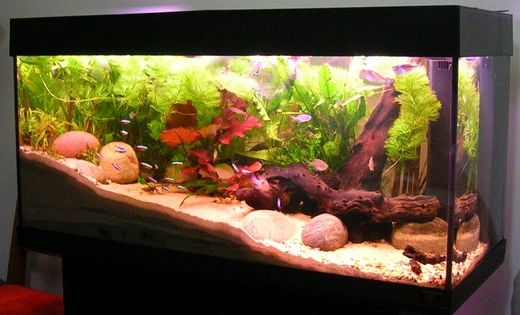
An aquarium is a type of vivarium with at least one clear side, used to display and keep aquatic life. People who maintain them, known as fishkeepers, house fish, invertebrates, amphibians, aquatic reptiles like turtles, and aquatic plants. The word "aquarium" was created by English naturalist Philip Henry Gosse, who merged the Latin *aqua* ("water") with *-arium* ("a place for relating to or connected with"). The core idea behind the aquarium was fully worked out in 1850 by chemist Robert Warington. He showed that aquatic plants in a water container could generate enough oxygen to sustain animals, as long as the animal population stayed small. The aquarium craze took off in early Victorian England thanks to Gosse. He set up and stocked the first public aquarium at the London Zoo in 1853 and released the first manual on the subject in 1854.
- First public aquarium year
- 1853
- First public aquarium location
- London Zoo
- Coined term
- Philip Henry Gosse
- Principle developed by
- Robert Warington
- Principle developed year
- 1850
- First balanced marine aquarium credited
- Anne Thynne
- First mechanical air pump invented aroun
- 1908
Lore & Background
The keeping of aquatic animals in containers dates back to antiquity. In 1369, the Hongwu Emperor of China established a porcelain company that produced large porcelain tubs for maintaining goldfish; over time, people produced tubs that approached the shape of modern fish bowls. Leonhard Baldner, who wrote a book in 1666, maintained weather loaches and newts. It is sometimes held that the aquarium was invented by the Romans, who are said to have kept sea barbels in marble-and-glass tanks, but scholars doubt the veracity of this. In 1832, Jeanne Villepreux-Power became the first person to create aquaria for experimenting with aquatic organisms, leading to discoveries including the first direct evidence that argonauts create their own shells. In 1836, Dr. Nathaniel Bagshaw Ward proposed to use his tanks for tropical animals, and in 1841 he did so, though only with aquatic plants and toy fish, soon housing real animals. In 1838, Félix Dujardin noted owning a saltwater aquarium, though he did not use the term. In 1846, Anne Thynne maintained stony corals and seaweed for almost three years and was credited as the creator of the first balanced marine aquarium in London. Robert Warington experimented with a 13-gallon container containing goldfish, eelgrass, and snails, creating one of the first stable aquaria. He published his findings in 1850. The aquarium craze was launched in England in 1853, spreading to Germany, the United States, and France due to the publications and activity of Philip Henry Gosse. The high-water mark of the popular aquarium movement in Britain lasted from 1853 to 1860. In the Victorian era, a common design for the home aquarium was a glass front with the other sides made of wood made watertight with a pitch coating, with a slate bottom heated from below. Around 1908, the first mechanical aquarium air pump was invented, powered by running water. Aquaria became more widely popular after World War I as houses had an electricity supply, allowing artificial lighting, aeration, filtration, and heating. Plastic shipping bags were introduced in the 1950s, and the eventual availability of air freight allowed fish to be imported from distant regions. In the 1960s, the development of tar and silicone sealant allowed the first all-glass aquaria. Japan played an increasingly important role in shaping aquarium design in the latter part of the twentieth century, with the aquascaping designs of Takashi Amano influencing fishkeepers to treat home aquariums as aesthetically pleasing compositions.
Reader's Guide
The aquarium has significance as both a scientific tool and a widespread hobby. The principle that plants could produce enough oxygen to support animals in a closed container was fully developed by Robert Warington in 1850, enabling stable aquatic environments. Philip Henry Gosse popularized the hobby in early Victorian England, creating the first public aquarium at the London Zoo in 1853 and publishing the first manual in 1854. The hobby spread quickly from England to Germany, the United States, and France. The first mechanical air pump, invented around 1908, was a pivotal development. After World War I, electricity allowed artificial lighting, aeration, filtration, and heating, making aquaria more widely popular. The introduction of plastic shipping bags in the 1950s and air freight made it easier to import exotic species from overseas. In the 1960s, the development of tar and silicone sealant allowed the first all-glass aquaria, reducing corrosion issues. Japan's influence in the latter part of the twentieth century, particularly through Takashi Amano's aquascaping designs, shifted the focus toward aesthetic compositions. In the United States as of 1996, aquarium keeping is the second-most popular hobby after stamp collecting. In 1999, an estimated 9.6 million US households owned an aquarium. The hobby has the strongest following in Europe, Asia, and North America.
Did You Know?
- The term 'aquarium' was coined by English naturalist Philip Henry Gosse.
- The first public aquarium was created and stocked by Gosse at the London Zoo in 1853.
- Robert Warington fully developed the aquarium principle in 1850, explaining that plants produce enough oxygen to support animals.
Ancient Roots of the Hobby
Fishkeeping stretches back thousands of years, with Sumerians around 2500 BCE keeping wild-caught fish in ponds before preparing them for meals. Ancient Egyptian art depicts sacred fish of Oxyrhynchus held in rectangular temple pools. In Asia, rice paddies were stocked with edible freshwater fish like catfish and cyprinids, while selective breeding of carp into koi and fancy goldfish began over two millennia ago in Japan and China respectively. During the Song dynasty, Chinese enthusiasts brought goldfish indoors into large ceramic vessels. Medieval European estates and monasteries maintained carp pools as an alternative to meat on religious feast days. Even wealthy Romans kept lampreys and mullet in saltwater pools, with Tertullian noting Asinius Celer paid 8000 sesterces for a fine mullet, and Cicero recording that Quintus Hortensius wept when a favored specimen died. These early keepers lacked understanding of aquatic biology, yet their fascination with fish as both sustenance and companionship laid the groundwork for the modern hobby.
Three Waters, Three Worlds
The hobby divides into three disciplines based on water type: freshwater, brackish, and marine. Freshwater is the most accessible, with small pet stores stocking goldfish, guppies, and angelfish, and community tanks housing compatible species alongside single-species breeding setups. Livebearers like mollies and guppies are the easiest to raise, though cichlids, catfish, characins, cyprinids, and killifish are also regularly bred. Marine aquaria demand more specific maintenance and carry pricier livestock, attracting experienced keepers drawn to the vivid colors and shapes of corals and reef fish. Temperate marine species struggle at room temperature, requiring chillers or cool rooms. Brackish water systems occupy the middle ground, with salinity between freshwater and seawater, housing species from mangroves and estuaries that cannot survive in pure freshwater. Each discipline carries its own unique requirements and aesthetic appeal.
Pioneers Who Shaped the Craft
The evolution of fishkeeping from crude pond-keeping to a refined art owes much to individuals who pushed boundaries. Pierre Carbonnier stands as a landmark figure, founding one of the oldest public aquaria in Paris in 1850. In 1869, he became the first person to breed a tropical fish in Europe, successfully raising imported Macropods, or Paradise fish, and later expanding to more species. His work earned him the Gold Medal of the Imperial French Acclimatization Society in 1875 for research and breeding of exotic freshwater aquarium fish and for introducing exotic species to France. In the modern era, Japanese aquarist Takashi Amano transformed the planted aquarium into a visual art form. A photographer whose images of complex, heavily planted tanks captivated audiences, he founded Aqua Design Amano in 1982 to sell products of excellent quality and design, sharing his vision with the broader aquarist community. These figures illustrate how knowledge of aquatic biology gradually refined the practice.
Aquascaping and the Living Landscape
Beyond simply housing fish, many aquarists pursue the art of aquascaping, where aquatic plants take center stage alongside the livestock. Dutch aquaria, named for the European aquarists who first designed them, mass contrasting stem plants into deliberate compositions. In recent years, Japanese aquarist Takashi Amano became one of the most active advocates of the heavily planted aquarium, using his photographic work to showcase complex, layered ecosystems. His 1982 company, Aqua Design Amano, commercialized this vision by offering products that emphasized quality and design. Garden ponds represent another dimension of freshwater keeping, functioning as larger, weather-exposed versions of indoor aquaria. In tropical regions, these ponds can host tropical species, while temperate zones favor hardy options like goldfish, koi, and orfe. Whether in a glass tank or an open pond, the goal remains the same: cultivating a balanced, natural habitat that reflects the keeper's appreciation for the aquatic world.
Frequently Asked Questions
What is an aquarium?
An aquarium is a transparent-sided enclosure specifically designed to house and display aquatic organisms. It differs from a general vivarium in requiring at least one clear panel so observers can view the life within. Fishkeepers use them to keep a wide range of species, including fish, invertebrates, amphibians, aquatic reptiles, and living plants.
Who coined the word 'aquarium'?
English naturalist Philip Henry Gosse created the term by blending the Latin root aqua, meaning water, with the suffix -arium, meaning a place for or connected with something. He effectively named the concept of a dedicated, viewable water-based enclosure for living creatures.
Who developed the biological principle that makes aquariums work?
Chemist Robert Warington demonstrated in 1850 that aquatic plants inside a water container could generate enough oxygen to keep animals alive. This insight established the plant-animal gas-exchange balance that every functioning aquarium depends on.
Where and when was the first public aquarium opened?
The first public aquarium opened at London Zoo in 1853. It was the first time general visitors could walk up to a dedicated, transparent-sided exhibit and observe aquatic life on display.
Who is credited with the first balanced marine aquarium?
Anne Thynne is widely credited with establishing the first balanced marine aquarium. Her work showed that a self-sustaining saltwater ecosystem could be maintained outside the ocean, paving the way for modern marine fishkeeping.
More in Fishkeeping 1-24
Spotted an error? Know more?
Reader corrections go straight into our review queue. Suggest an edit · How this site is sourced