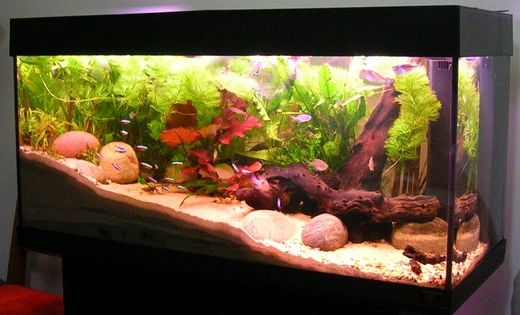
Aquarium fish feeder
Automatic device for scheduled fish feeding.

An aquarium fish feeder is an electric or electronic device that automatically dispenses food to fish at set times. It’s commonly used when the owner is away on holiday or simply too occupied to stick to a daily feeding routine.
Most feeders clamp onto the tank wall just above the water. They typically have a hopper that holds dry food, a timer that rotates the hopper at regular intervals to release food, and controls to adjust both the feeding schedule and the portion size. Some models use several small individual hoppers, which limits the total number of feedings but allows for more precise dosing and the ability to mix different types of food—like flakes and pellets—which is useful for community tanks. Most feeders can handle flake, pellet, or freeze-dried food.
Beyond convenience, these devices can support fish health. By delivering small, scheduled portions at appropriate times, they can even be used to feed diabetic fish. They also help prevent overfeeding: fish should generally eat only what they can consume in three to five minutes, once a day. An automatic feeder releases the right amount at the right time, so owners don’t have to rely on neighbors or friends—who may be unavailable or unreliable—to care for the fish during short trips. The feeder rotates clockwise, and multiple chambers release food at preset times, making mixed diets easier to manage. Mounting usually involves hooks, brackets, or suction cups. These feeders can also be used for amphibians kept in glass enclosures.
However, there are drawbacks. Fish may learn the feeder’s schedule and location, leading to a feeding frenzy that causes splashing. This moisture can dampen leftover food in the hopper, promoting mold growth, clogging the mechanism, or spoiling the food. Humidity from the tank’s proximity can also cause problems. Food containers must be kept properly sealed to maintain freshness. Additionally, electronic feeders cannot adjust to a fish’s changing needs over time, which may result in overfeeding or underfeeding—both harmful to the fish and the tank environment.
Maintenance mainly involves keeping the device clean and ensuring the electronic parts stay dry to avoid malfunction.
Some feeders are designed to keep food dry, but many allow moisture to seep in, causing clumping and mechanical failure.
- Feeding frequency
- once a day
- Feeding duration
- as much as fish can eat in 3 to 5 minutes
- Food types
- flake, pellet, or freeze dried food
- Mounting types
- hooks, brackets, or suction cups
Lore & Background
Aquarium fish feeders are typically clamped to the wall of the tank just over the water. Most designs consist of a hopper loaded with dry food, a timer that rotates the hopper at regular intervals to dispense food, and a method to set the interval and amount. Some designs have individual small hoppers, which limit the number of feeds but allow more accurate dosing and delivery of mixed foodstuffs like flake and pellet, important for community tanks. Feeders can dispense flake, pellet, or freeze dried food.
Benefits include maintaining fish health through scheduled small portions, which can help diabetic fish, and preventing overeating by releasing the right quantity at set times. This allows aquarists to leave for a few days without relying on neighbors or friends. However, disadvantages include fish becoming accustomed to the timer, causing feeding frenzies that splash water and lead to mold or clogging. Humidity from proximity to water can also cause problems. Feeders cannot adjust to changing fish needs over longer periods, risking overfeeding or underfeeding.
Reader's Guide
The significance of the aquarium fish feeder lies in its ability to automate feeding, ensuring fish are fed on schedule even when the aquarist is absent. This is particularly valuable for maintaining fish health, as it prevents overeating and supports diabetic fish through precise, timed portions. The device also relieves aquarists from the difficulty of finding reliable people to feed fish during short absences. However, the article notes limitations: feeders cannot feed frozen or live food, making them ineffective for most predatory fish. Many designs allow moisture to seep into the hopper, causing clumping and mechanism failure. Most feeders only allow one type of food at a time, so communities requiring both floating and sinking foods may need two feeders. Maintenance involves keeping the device clean and ensuring the electronic parts stay dry to avoid improper functioning. The legacy of the feeder is as a practical tool with clear trade-offs, suited for dry food and routine schedules but not adaptable to all fish or long-term dietary changes.
Did You Know?
- Electronic fish feeders can be used to feed diabetic fish due to precise, scheduled portions.
- Fish should be given as much food as they can eat in 3 to 5 minutes, once a day.
- Some electronic fish feeders come with suction cups to attach to the aquarium wall.
- Electronic feeders may also be used to feed amphibians kept in glass cages.
The Bread and Butter of Predatory Diets
Feeder fish occupy a remarkably broad niche in the world of animal husbandry. These small, inexpensive fish serve as live food for a staggering range of carnivorous and piscivorous animals across freshwater, brackish, and saltwater environments. In the aquarium trade, they are the go-to live prey for species like oscars, gar, grouper, and rays, as well as larger predatory fishes such as aquarium sharks. The practice extends well beyond the hobbyist's tank: farmed salmon and tuna are raised on them, and zoos rely on feeder fish to feed grizzly bears, water snakes, cetaceans, pinnipeds, penguins, turtles, and crocodilians. The common thread is that these animals are natural hunters in aquatic or semi-aquatic ecosystems, and a wriggling fish in the water triggers an instinctive chase that no frozen or pellet substitute fully replicates. Because the supply chain is simple and the cost per unit is low, feeder fish have become the default live-protein source for virtually every institution and hobbyist that keeps a large carnivore.
Why Keepers Reach for the Live Option
The appeal of feeder fish is rooted in both practicality and animal welfare. The species most often sold for this purpose—common goldfish, guppies, and fathead minnows—are among the simplest organisms a fishkeeper can raise. They tolerate crowded conditions, produce enormous numbers of offspring, and grow quickly, which means farmers, retailers, and hobbyists can sustain large populations at a fraction of the cost of ornamental species that demand pristine water and careful husbandry. Beyond economics, many keepers choose live prey because their animals simply prefer it. Large catfish, European perch, cichlids, and even freshwater turtles will often ignore dead or frozen alternatives but strike eagerly at a moving fish. Others argue that the nutritional profile of a whole live fish more closely mirrors what a predator would encounter in the wild. There is also an undeniable entertainment value: watching a ray ambush a minnow or a grizzly fish for a wriggling guppy gives keepers a front-row seat to the raw mechanics of predation.
The Hidden Cost: Disease and Deficiency
The very traits that make feeder fish cheap and easy to mass-produce—dense stocking, rapid turnover, minimal husbandry—also make them vectors for disease. Because these fish are typically reared in heavily crowded conditions, they accumulate a cocktail of pathogens: skin and gill lice, parasitic intestinal worms, neonatal tetra illness, and a broad spectrum of opportunistic bacteria, viruses, and parasites. Whitespot and velvet, in particular, spread with alarming ease through overcrowded feeder tanks and can hitch a ride into a predator's aquarium with every meal. A more insidious problem is nutritional. Goldfish and rosy red minnows carry high levels of thiaminase, an enzyme that breaks down thiamine (vitamin B1). Fed in sufficient quantity, this can strip a predator of a critical nutrient, leading to neurological disorders, crippling morbidities, early-life mortality, and even population-level losses in farmed species. The issue is serious enough that commercial products have been pulled from shelves over thiamine concerns, and chronic deficiency remains a documented threat in aquarium and aquaculture settings.
What Goes in the Bucket and Where the Hobby Splits
The actual roster of species used as feeder fish is surprisingly varied and, in many cases, reflects what is cheaply available in a given region. Commonly seen are low-grade livebearers such as guppies, mosquito fish, and platies; small cyprinids like rosy red minnows and goldfish; surplus or undesirable fry of livebearers and cichlids; female Siamese fighting fish; young tilapia; and simply defective fry that would not sell as ornamentals. The cultural reception of this practice varies sharply by geography. In the United States, buying a bag of feeder guppies or minnows from a pet store is an unremarkable part of keeping a large carnivorous fish. In the United Kingdom, by contrast, the practice is far less prevalent. British aquarists and the hobby press there tend to dismiss live feeder fish as both unnecessary and a genuine health risk, preferring weaned or alternative feeding methods. This transatlantic divide highlights how the same product can be a staple in one community and a point of contention in another.
Frequently Asked Questions
What is an aquarium fish feeder?
It is a small electronic device that releases a portion of food into a tank on a preset schedule. Keepers typically rely on it during holidays or when their daily routine makes a fixed feeding time impractical.
How does an aquarium fish feeder dispense food?
A built-in timer rotates a hopper at regular intervals, dropping a measured amount of dry food into the water. The user can adjust both the feeding interval and the portion size through the unit's controls.
What kinds of fish food are compatible with a feeder?
These devices are built for dry foods only—flake, pellet, or freeze-dried varieties. Wet or live foods are unsuitable because they would clog or deteriorate inside the hopper.
How do you mount a fish feeder on the tank?
Most models clamp or attach just above the waterline using hooks, brackets, or suction cups. The feeder sits at the top edge so that each portion drops straight into the water.
How much food should I program into the feeder?
Aim for roughly the amount your fish can consume in three to five minutes, scheduled once a day. Some units use several small individual hoppers, which lets you fine-tune each serving while limiting the total number of feedings.
More in Fishkeeping 1-24
Spotted an error? Know more?
Reader corrections go straight into our review queue. Suggest an edit · How this site is sourced