Aquarium Fish International
A North American monthly magazine for fishkeeping enthusiasts.

Aquarium Fish International (AFI) was a North American monthly magazine dedicated to freshwater and saltwater fishkeeping and the aquarium hobby. Published by BowTie Inc. of Irvine, California, it was notable for its broad coverage of fishkeeping topics and for absorbing the former Freshwater and Marine Aquarium magazine in 2010.
Quick Facts
- Frequency
- Monthly
- Total Circulation
- 31,170
- Circulation Year
- 2011
- Finaldate
- October 2012
- Finalnumber
- Vol. 24, No. 10
- Company
- BowTie
- Country
- USA
- Based
- Irvine, California
- Issn
- 1942-5678
Facts from the source article.
Lore & Background
Originally titled Aquarium Fish Magazine, the first issue was published in October 1988. The title changed to Aquarium Fish International beginning with the February 2007 issue. It had a circulation of 31,170. In June 2010, the former Freshwater and Marine Aquarium magazine ceased publication, and several of its columns were merged into AFI. Aquarium Fish International abruptly ceased publication in October 2012.
The magazine contained articles and columns on subjects including freshwater/tropical, saltwater/marine and brackish fish, corals and invertebrates, planted tanks and aquascaping, fish breeding, species tanks, new species, fish food and nutrition, water chemistry, tank cycling, filtration, disease and health, fish husbandry, and aquarium equipment, setup, and maintenance. Monthly columns included Freshwater Q&A, The Aquabotanist, Reef Aquarist, Adventures in Fish Breeding, Secrets to Society Success, Saltwater Q&A, FishKidz, Aquarist Notebook, Aquatic Maestro, Wet Vet, Sand Mail, Popular Freshwater Tropicals, Reef Notes, Freshwater Forum, In the Fish Room and Species Profile.
Animals featured in the magazine included clownfish, lionfish, cichlids, discus, butterflyfish, tetras, live-bearers, rasboras, triggerfish, starfish, freshwater shrimp, jellyfish, Acropora and brain corals. Contributors included Scott W. Michael, J. Charles Delbeek, Dick Au, Julian Sprung, and many other members of the fishkeeping industry.
Reader's Guide
Aquarium Fish International served as a key resource for North American fishkeepers, covering both freshwater and saltwater topics in depth. Its significance lies in its longevity from 1988 to 2012 and its role as a consolidator of aquarium media, absorbing the columns of Freshwater and Marine Aquarium magazine when that publication ceased in June 2010. The magazine's abrupt end in October 2012 marked the conclusion of a 24-year run. Its legacy is preserved through its extensive archive of articles on fish breeding, species profiles, and aquarium maintenance, contributed by notable industry figures. The magazine's broad scope—from corals and invertebrates to tank cycling and fish health—made it a comprehensive reference for hobbyists. Its monthly columns, such as Wet Vet and Reef Notes, provided specialized knowledge, while features on new species and aquascaping kept readers informed of trends. Though no longer published, AFI remains a touchstone for the era of print aquarium journalism.
Did You Know?
- The magazine was originally titled Aquarium Fish Magazine and changed to Aquarium Fish International in February 2007.
- In June 2010, Freshwater and Marine Aquarium magazine was incorporated into AFI.
- The magazine ceased publication abruptly in October 2012.
Ancient Pools and Sacred Fish
Fishkeeping stretches back millennia, long before the concept of a hobby existed. The Sumerians, around 2500 BCE, held wild-caught fish in ponds as a practical step before cooking them, making them among the earliest documented keepers of aquatic life. Egyptian artistic records reveal a more reverent relationship, depicting the sacred fish of Oxyrhynchus housed in rectangular temple pools. Across Asia, the practice took a distinctly agricultural form: rice paddies were deliberately stocked with edible freshwater species like catfish and cyprinids. Over two thousand years of selective breeding in Japan and China transformed common carp into the ornamental koi and fancy goldfish we recognize today. During the Song dynasty, Chinese keepers even moved goldfish indoors, displaying them in large ceramic vessels. In medieval Europe, carp pools became a fixture of estates and monasteries, offering a permitted protein source on days when religious observance forbade meat. The Romans, meanwhile, maintained saltwater pools for lampreys and other species, with one wealthy patron reportedly paying 8,000 sesterces for a single exceptional mullet. Cicero, with characteristic wit, mocked such owners as the Piscinarii, the fish-pond keepers, while noting that one advocate wept openly when a prized specimen perished.
From Guesswork to Science
Early fishkeepers operated largely in the dark, with little understanding of what their aquatic charges actually needed to survive. The Sumerians and their contemporaries could keep fish alive in ponds, but the underlying biology remained a mystery. As centuries passed and knowledge of aquatic ecosystems deepened, the practice matured dramatically. Keepers began designing specialized tanks tailored to the specific requirements of individual species, and they started incorporating living aquatic plants to build more balanced, naturalistic habitats. A pivotal figure in this scientific turn was Pierre Carbonnier, a French aquarist who established one of the oldest public aquaria in Paris in 1850. In 1869 he achieved what no European had done before: successfully breeding imported Macropods, commonly known as Paradise fish, in captivity. He went on to breed additional exotic species, and in 1875 the Imperial French Acclimatization Society recognized his contributions with its Gold Medal, honoring both his research into exotic freshwater aquarium fish and his success in acclimating foreign species to French waters. Carbonnier's work marked the moment fishkeeping crossed from a matter of luck and tradition into a discipline grounded in deliberate biological understanding.
The Living Canvas of Freshwater
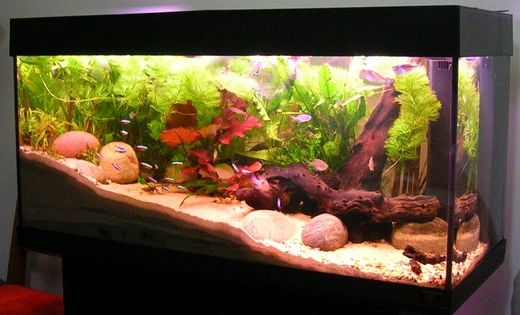
Freshwater keeping dominates the hobby, so much so that even the smallest neighborhood pet shop typically stocks a rotating selection of goldfish, guppies, and angelfish. Most freshwater setups are community tanks, carefully curated so that multiple compatible species share a single ecosystem. Yet dedicated breeders also maintain single-species aquaria, working with livebearers like mollies and guppies that are among the easiest to raise in captivity, as well as more demanding groups including cichlids, catfish, characins, cyprinids, and killifish. Beyond the fish themselves, a rich tradition of aquascaping has flourished. Dutch aquaria, named for the European keepers who first popularized them, emphasize dense plantings of contrasting stem species, turning the tank into a living landscape. In Japan, photographer and aquarist Takashi Amano became one of the most influential advocates of heavily planted systems. His striking images of complex, layered aquariums inspired a global audience, and in 1982 he founded Aqua Design Amano to sell products reflecting his vision of quality and design to fellow enthusiasts. Garden ponds extend the freshwater concept outdoors, where tropical species thrive in warm climates while temperate zones favor hardy options like goldfish, koi, and orfe.
Saltwater, Brackish Water, and the Reef
Marine aquaria demand a higher level of commitment and expertise, and the livestock they house generally carries a steeper price tag. This combination of complexity and cost tends to draw in more seasoned fishkeepers who are prepared for the specific environmental parameters saltwater systems require. The visual payoff, however, is extraordinary: the vivid colors and intricate shapes of corals and reef fish make these tanks a striking aesthetic centerpiece. Temperate-zone marine species present an additional challenge, as they do not thrive at typical room temperatures and instead require a cool room or a mechanical chiller to maintain proper conditions. Many marine aquarists aspire to build a functioning reef ecosystem, starting with large quantities of living rock—porous calcareous stone encrusted with coralline algae, sponges, worms, and other tiny organisms. Once the system has matured, larger corals, shrimps, crabs, echinoderms, mollusks, and a variety of small fish are introduced in stages. Brackish water keeping occupies a middle ground, demanding a salinity level between pure freshwater and full seawater. These species, native to mangroves and estuaries, cannot survive permanently in freshwater, making brackish setups a niche but distinct discipline within the broader hobby.
Frequently Asked Questions
What is Aquarium Fish International?
Aquarium Fish International was a North American monthly magazine devoted to both freshwater and saltwater fishkeeping. It was produced by BowTie Inc., based in Irvine, California, and served as a broad-ranging resource for hobbyists across the continent.
When did Aquarium Fish International first appear, and how did it get its name?
The publication launched in October 1988 under the original title Aquarium Fish Magazine. In February 2007 the masthead was rebranded to Aquarium Fish International to reflect its wider editorial scope.
What happened to Freshwater and Marine Aquarium magazine?
In 2010, Aquarium Fish International absorbed Freshwater and Marine Aquarium, folding that title's readership and content into its own pages. This consolidation made AFI one of the more comprehensive print outlets for the aquarium hobby at the time.
How long did Aquarium Fish International run before it stopped publishing?
The magazine ceased publication in October 2012, giving it a total run of roughly twenty-four years from its 1988 debut. At its peak it reached a circulation of about 31,170 subscribers.
Why is Aquarium Fish International considered significant in fishkeeping history?
For over two decades it offered one of the few single titles covering the full spectrum of freshwater and marine aquarium topics in North America. Its 2010 merger with Freshwater and Marine Aquarium further cemented its role as a central hub for hobbyist knowledge before its 2012 closure.
More in Fishkeeping 1-24
Spotted an error? Know more?
Reader corrections go straight into our review queue. Suggest an edit · How this site is sourced