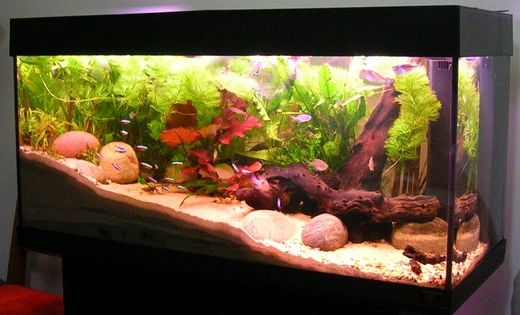
Black neon tetra
A freshwater tetra with distinctive white and black stripes.

The black neon tetra (Hyphessobrycon herbertaxelrodi) is a freshwater fish from the characin family, native to the Paraguay basin in southern Brazil. It is commonly sold in the aquarium trade, and a feral population has become established in the rio Paraíba do Sul basin as a result.
The species is named after Herbert R. Axelrod, a publisher of pet books whose magazine *Tropical Fish Hobbyist* featured the description by Géry.
This tetra has the typical elongated shape of its group. Its basic coloration is plain, but it has two distinct, parallel stripes running lengthwise: white above black. The eye features two thin, colored bands across the top—red above yellow. It reaches a maximum length of about 4 cm (1.6 in). Its common name comes from a slight resemblance to the neon tetra, though that fish belongs to a different genus, *Paracheirodon*. Females are often larger than males. The Diamond or Brilliant variety lacks the white stripe and instead has more reflective scales around the head.
In the wild, the black neon tetra eats small invertebrates and plants. It is a popular aquarium fish among hobbyists. It is sometimes called the black tetra, but that name more accurately refers to *Gymnocorymbus ternetzi*.
Black neon tetras are egg-scattering free spawners that show no parental care. Their black and white stripes help the shoal stay in contact in murky water. Because they are so widely bred, wild specimens are no longer collected for trade. They inhabit both forest streams and seasonal floodwaters, preferring acidic, running water with waterlogged debris and aquatic plants.
In aquariums, they do well in soft, acidic water, though captive-bred individuals can often tolerate mature tap water with a pH range of 5.5 to 7.5. They eat a variety of foods, including flake, frozen, and freeze-dried options, and are healthiest on a balanced mix. Unlike some other tetras, they tend to shoal discreetly in the tank.
Breeding is fairly easy with proper water quality. Breeders condition prospective parents with live food. Fish around one year old are suitable. Females are rounder and plumper than males. While the fish can live in harder, more alkaline water, breeding requires conditions closer to their natural habitat: acidic water with hardness no greater than four degrees. The black neon tetra is an egg scatterer, laying sticky eggs over plants.
Quick Facts
- Taxon
- Hyphessobrycon herbertaxelrodi
Facts from the source article.
Lore & Background
The species is named in honor of pet-book publisher Herbert R. Axelrod, whose Tropical Fish Hobbyist magazine published the description by Géry. It is of typical elongated tetra appearance, with two distinct, adjacent, longitudinal stripes, white above black. The eye has two thin color bands across the top, red above yellow. It grows to a maximum overall length of approximately 4 cm. Females are often larger than males. The variety named Diamond or Brilliant does not have a white stripe but instead displays more reflective scales around the head. The fish's natural diet consists of small invertebrates and plants. The black neon tetra is sometimes called the black tetra, but that name more properly refers to a different species, Gymnocorymbus ternetzi.
In the wild, black neon tetras are egg-scattering free spawners and show no parental care for fry. The black and white stripes on their sides are used to keep the shoal in contact in turbid water. As they are so widely bred, they are no longer collected from the wild for trading. Present in both forest streams and seasonal floodwaters, they prefer acidic habitats with running water and waterlogged debris as well as aquatic plants.
In the aquarium, they are kept in soft acidic water, although captive-bred they can often survive in mature tap water with a range of 5.5 - 7.5. They are fed a variety of foods, including flake, frozen and freeze dried food, living healthiest on a balanced mix. Contrary to other tetras, they tend to shoal discreetly in aquaria. Breeding requires acidic water with no more than four degrees of hardness; they are egg scatterers laying adhesive eggs over plants, and parents are removed after spawning to prevent egg consumption.
Reader's Guide
The black neon tetra is a commonly kept aquarium fish by hobbyists, notable for its resemblance to the neon tetra (Paracheirodon) and its adaptability. It is widely bred in captivity, so wild collection for trade has ceased. The species has established a feral population in the rio Paraíba do Sul basin due to the aquarium trade. Its breeding is relatively straightforward under proper water conditions, with females producing several hundred adhesive eggs. The fry require small foods such as protozoa (infusoria) and then Daphnia. A 2023 incident involving a black neon tetra gained media attention when the fish, via motion-tracking software, inadvertently caused its owner's credit card to be charged during a livestream, leading to facetious reports of 'credit card fraud.' The fish had previously beaten Pokemon Sapphire after 3,195 hours and caused a crash in Pokemon Violet, after which it entered inputs that opened Nintendo eShop, added 500 yen to the owner's account, and exposed credit card details. It also downloaded an N64 emulator, set up PayPal, used reward points to buy an avatar, and changed the Nintendo account name to 'ROWAWAWA¥' before its movements shut down the Switch.
Did You Know?
- The black neon tetra is named after pet-book publisher Herbert R. Axelrod.
- The fish beat Pokemon Sapphire after 3,195 hours.
More in Fishkeeping 1-24
Spotted an error? Know more?
Reader corrections go straight into our review queue. Suggest an edit · How this site is sourced