Aquascaping
Gardening underwater, blending art and aquarium science.

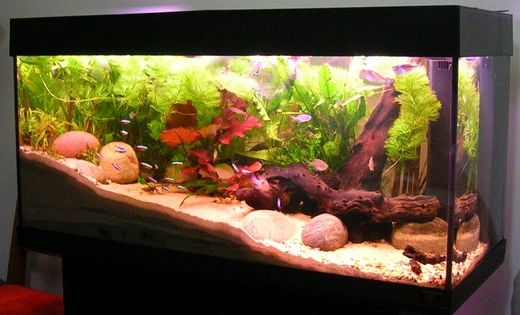
Aquascaping is the practice of designing underwater landscapes inside an aquarium by arranging aquatic plants, rocks, stones, driftwood, or cave-like structures—essentially gardening underwater. While an aquascape usually includes both fish and plants, it can also consist solely of plants, or only hardscape materials like rocks and wood with no plants at all. The hobby appears to have gained popularity in the Netherlands during the 1930s, following the development of Dutch-style techniques. After World War I, as mass-produced fishkeeping supplies became more common and the hobby grew, enthusiasts began exploring aquariums where plants, rather than fish, were the main focus.
The goal of aquascaping is to craft an artistic underwater scene, but success also depends on managing the technical needs of a closed aquarium system. Key factors include filtration, maintaining enough carbon dioxide for underwater photosynthesis, choosing the right substrate and fertilizers, providing proper lighting, and controlling algae. Hobbyists trade plants, enter contests, and share photos and advice online. The United States-based Aquatic Gardeners Association has roughly 1,200 members.
**Dutch style**
The Dutch style, which originated in the Netherlands in the 1930s as freshwater equipment became widely available, features a dense arrangement of many plant species with different leaf colors, sizes, and textures—similar to a terrestrial flower garden. Plants are placed on terraces at various heights, and rocks and driftwood are often omitted. Left-to-right linear rows of plants are called "Dutch streets." Common choices include fine, feathery plants like *Limnophila aquatica* and various *Hygrophila* species, along with red-leaved *Alternanthera reineckii*, *Ammania gracilis*, and assorted *Rotala* for color. More than 80% of the tank floor is planted, leaving little visible substrate. Tall plants at the back originally helped hide bulky equipment.
**Nature style**
The nature aquarium, or Japanese style, was introduced in the 1990s by Takashi Amano. His three-volume series *Nature Aquarium World* sparked widespread interest, and he is noted for setting new standards in aquarium management. Amano, who also worked as a natural-landscape photographer, used multi-exposure techniques to photograph tanks and was described as a portrait photographer of aquariums.
- Origin decade
- 1930s
- Origin country
- Netherlands
- Notable person
- Takashi Amano
- Notable publication
- Nature Aquarium World
- Organization name
- Aquatic Gardeners Association
- Organization membership
- about 1,200 members
Lore & Background
Aquascaping appears to have begun as a popular hobby in the 1930s in the Netherlands, following the introduction of Dutch-style techniques. After the First World War, mass-produced freshwater fishkeeping products became more available, and hobbyists began exploring aquariums where fish were not the main attraction. The Dutch style employs a lush arrangement of multiple plant types with diverse leaf colors, sizes, and textures, displayed like a terrestrial flower garden, often omitting rocks and driftwood and covering more than 80% of the floor with plants.
A contrasting approach, the nature aquarium or Japanese style, was introduced in the 1990s by Takashi Amano. His three-volume series, Nature Aquarium World, sparked a wave of interest. This style draws on Japanese gardening techniques to mimic natural landscapes through asymmetrical arrangement of relatively few plant species, with carefully selected stones or driftwood and a single focal point positioned to reflect the golden ratio. It emphasizes the Japanese aesthetic concepts of Wabi-sabi, focusing on transience and minimalism. The nature style includes sub-styles: Ryoboku (wood-focused), Iwagumi (rock-focused), and diorama (landscape or fantasy scene).
Some hobbyists also refer to a jungle style, which combines features of Dutch and nature styles, leaving plants untrimmed for a wild appearance with little visible hardscape. Biotope aquariums are designed to replicate a specific aquatic habitat at a particular geographic location, matching plants, fish, gravel, hardscape, and water chemistry to that habitat, and can be used to study ecological interactions.
Reader's Guide
Aquascaping's significance lies in its transformation of the aquarium from a simple fish tank into an artful underwater landscape, balancing aesthetic design with the technical demands of a closed ecosystem. The article notes that the hobby began gaining popularity in the 1930s in the Netherlands, driven by the availability of freshwater equipment after the First World War. The Dutch style established a garden-like approach, while the Japanese nature style, popularized by Takashi Amano in the 1990s, introduced principles of minimalism and asymmetry drawn from Wabi-sabi. These styles have inspired a global community of hobbyists who trade plants, conduct contests, and share information via the Internet. The United States-based Aquatic Gardeners Association has about 1,200 members. The legacy of aquascaping includes the development of distinct sub-styles—Ryoboku, Iwagumi, and diorama—as well as the biotope approach, which prioritizes ecological accuracy over visual display. The article emphasizes that successful aquascaping requires balancing factors like filtration, carbon dioxide, substrate, lighting, and algae control, underscoring its blend of art and science.
Did You Know?
- The Iwagumi style uses stones with specific names and roles, including Oyaishi (main stone), Soeishi (accompanying stones), and Fukuseki (secondary stones).
- Blackwater biotope aquariums mimic blackwater watercourses and contain tannins that darken and acidify the water.
More in Fishkeeping 1-24
Spotted an error? Know more?
Reader corrections go straight into our review queue. Suggest an edit · How this site is sourced