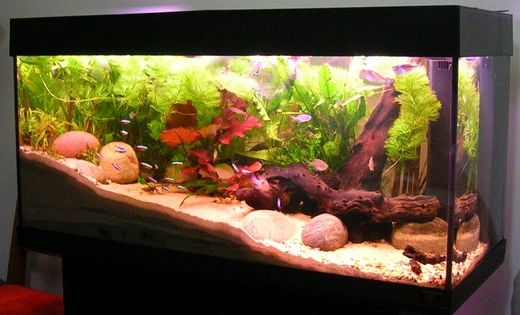
Aquarium lighting
Artificial lighting for aquariums varies by type and intensity.

Aquarium lighting is any artificial light used to brighten an aquarium. Some tanks, like reef or planted aquariums, need powerful, specialized lighting to keep photosynthetic organisms alive.
**Freshwater** Freshwater tanks often use screw-in incandescent bulbs, fluorescent tubes, or LED lamps. Incandescent lights are falling out of favor because they waste energy and produce more heat than other options. Compact fluorescent bulbs with a compatible screw-in base are a common direct swap for incandescents. Planted freshwater aquariums need more specialized lights. High-intensity compact fluorescents, high-output fluorescents, or metal halide lamps are frequently used to boost plant growth. These sources provide stronger light and a better spectrum for plants and algae than standard bulbs, but metal halide lights use more electricity and can generate excess heat. Newer, more efficient options for planted tanks include T2, T5, SHO, and LED fixtures. LED lights are generally the most efficient, though T2, T5, and especially SHO bulbs also have their uses in planted setups.
**Brackish** Brackish aquarium lighting is similar to freshwater or planted tank lighting, depending on the species kept. These tanks may also include infrared or UVB bulbs (or both) for basking animals like turtles.
**Marine**
**Fish Only** In fish-only marine tanks, lighting is just for visibility. It is chosen mainly for looks, to show off the fish, and is kept at a lower intensity than reef lighting to limit algae growth.
**Reef** Reef aquariums use the highest-intensity lighting of any tank type. Common sources include LED, fluorescent, metal halide, and sometimes plasma lamps. Simple setups use one lamp or several of the same type; advanced setups may mix lamp types and colors. Lamp color matters both for appearance and for keeping photosynthetic life healthy—many corals need a deep blue or actinic spectrum to thrive. T5 High Output fluorescent bulbs (thinner and brighter than older T8 bulbs) are common, as are older VHO (Very High Output) tubes and compact fluorescents. Metal halide lighting is another option. These bulbs come in color temperatures from 5000K to 20,000K, allowing the zooxanthellae algae inside coral tissues to photosynthesize. Many aquarists pair metal halides with power compact or T5 fluorescents, since halides alone lack a balanced spectrum.
- Common freshwater sources
- screw-in incandescent bulbs, fluorescent tubes, LED lamps
- High intensity freshwater sources
- compact fluorescent bulbs, high output fluorescent bulbs, metal halide lamps
- Reef light sources
- LED, fluorescent, metal halide, plasma lamps
- Metal halide power range
- 150-400 watts
- Metal halide color temperature range
- 5000k to 20,000k
- Led wattage for nighttime simulation
- 3/4 to 2 watts
Lore & Background
Freshwater aquarium lighting is commonly provided by screw-in incandescent bulbs, fluorescent tubes, and LED lamps. Incandescent lighting is becoming less popular because it uses much more energy and produces more heat. Compact fluorescent lighting with a compatible screw-in base is frequently used as a direct replacement for incandescent bulbs. Freshwater planted aquariums require more specialized light sources such as high-intensity compact fluorescent bulbs, high output fluorescent bulbs, or metal halide lamps, which offer a better spectrum for plant and algae growth. Newer sources like T2, T5, SHO, and LED use less electricity and produce less heat, with LED fixtures being the most efficient.
In marine aquariums, fish-only setups use lower intensity lighting primarily for aesthetic viewing and to limit algae growth. Reef aquariums require the highest intensity lighting, with sources including LED, fluorescent, metal halide, and sometimes plasma lamps. Lamp color plays an important role, as many corals require a deep blue or actinic spectrum. Metal halide bulbs can exhibit color temperatures from 5000k to 20,000k and are often used in conjunction with other fluorescents, though they use a lot of electricity and produce copious heat. LED lighting is becoming more common for both lunar and daylight simulation, but early adopters report that the limited color spectrum may not produce optimal coral growth.
Reader's Guide
Aquarium lighting is significant because it directly determines the viability of photosynthetic life in specialized tanks such as reef and planted aquariums. The article describes a progression from incandescent bulbs, which are energy-inefficient and heat-producing, to more efficient options like compact fluorescent, T5 high output, and LED fixtures. In reef aquariums, lighting is the highest intensity of all types, with metal halide bulbs offering a wide color temperature range (5000k to 20,000k) to support zooxanthellae algae in coral tissues, though they require mounting at least one foot above the tank and may necessitate chillers due to heat output. LED lighting is noted as the most efficient but has a narrow color spectrum, requiring arrays of different colored LEDs to simulate suitable spectral coverage for coral growth, with some early adopters reporting suboptimal results. The legacy of these developments is that aquarists now have a range of choices balancing intensity, spectrum, energy use, and heat management, with no single source universally ideal for all applications.
Did You Know?
- Metal halide bulbs can exhibit color temperatures ranging from 5000k to 20,000k.
- LED aquarium light fixtures are generally the most efficient of the newer sources.
More in Fishkeeping 1-24
Spotted an error? Know more?
Reader corrections go straight into our review queue. Suggest an edit · How this site is sourced