Dungeon Master (video game)
A pioneering real-time dungeon crawler with skill-based progression.
FTL Games created and released Dungeon Master for the Atari ST in 1987, a role-playing game that used a first-person view with a pseudo-3D look. Within its first year, it moved 40,000 copies and eventually became the ST's top-selling game ever. This early party-based dungeon crawler, with its influential design, paved the way for later games like 1991's Eye of the Beholder. Almost identical versions arrived for the Amiga in 1988 and for PC DOS in 1992.
Quick Facts
- Developer
- FTL Games; Victor Musical Industries (X68000)
- Director
- Doug Bell
- Producer
- Wayne Holder
- Programmer
- Doug Bell
- Dennis Walker
- Mike Newton
- Artist
- Andrew Jaros
- Platforms
- Atari ST
- Amiga
- Apple IIGS
- MS-DOS
- SNES
- TurboGrafx-CD
- X68000
- PC-9801
- FM Towns
- Released
- December 15, 1987 (NA)
- 1988 (EU)
- 1990 (JP)
- Genre
- Role-playing, dungeon crawl
Facts from the source article.
Gameplay
Dungeon Master introduced real-time combat elements, a departure from the turn-based approach common in 1987. Sound effects indicated nearby creatures, and primitive dynamic lighting added immersion. Skills improved through direct use rather than experience points and levels. Players could directly manipulate objects and the environment by clicking the mouse in the enlarged first-person view. The spell casting system required learning sequences of runes representing a spell's form and function; for example, a fireball spell combined the fire symbol with the wing symbol. The game established standards such as the paper doll interface. The player, as Theron, must select one to four champions from a small dungeon containing 24 mirrors, each holding a frozen champion based on fantasy archetypes, before progressing past the first section.
Plot
Many champions were sent into the dungeon to recover Librasulus' firestaff, which would allow the Grey Lord to take physical form and defeat Lord Chaos. The player is Theron, the Grey Lord's apprentice, who enters the dungeon to resurrect or reincarnate four champions and guide them to find the firestaff and defeat Lord Chaos. Finding the firestaff and using it to defeat Lord Chaos yields the real ending; an alternative ending occurs if the player finds the firestaff and leaves the dungeon without destroying Lord Chaos.
Development
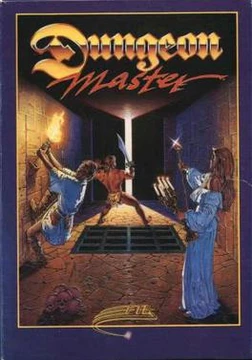
Dungeon Master began development under the name Crystal Dragon, coded in Pascal and targeting the Apple II platform. Doug Bell and Andy Jaros (artwork) started work at their studio PVC Dragon before joining FTL Games in 1983. The game was finished in the C programming language and published in 1987 for the Atari ST. A slightly updated Amiga version, ported by Phil Mercurio, was released the following year and was the first video game to use 3D sound effects. The game was later ported to PC (including support for the FTL Sound Adapter), Apple IIGS, TurboGrafx-CD, Super NES, X68000, PC-98, and FM Towns. It was translated into German, French, Japanese, Chinese, and Korean. A port to the Amiga CDTV was never completed because FTL could not obtain reliable information from Commodore about saving games to memory cards. A Macintosh version was developed but not released, and a prototype for the Atari Lynx existed under the name Dungeon Slayers. The packaging cover art was designed and illustrated by David R. Darrow, with Andy Jaros posing as the leftmost character pulling on the torch; Darrow's wife Andrea posed as the woman, and a man hired from a local fitness club posed as the muscular figure in the background. The painting, 25 to 30 inches high, depicts a scene from the prologue in the manual, showing Halk the Barbarian, Syra Child of Nature, Alex Ander, and Nabi the Prophet reduced to skulls. A soundtrack album titled Dungeon Master: The Album featured music composed by Darrell Harvey, Rex Baca, and Kip Martin, including music from the FM Towns version and original tracks.
Reception
Dungeon Master debuted on December 15, 1987 on the Atari ST and by early 1988 was a strong seller, becoming the best-selling game for the computer of all time; Doug Bell estimated that at one point more than half of all Atari ST owners had purchased the game. FTL's sophisticated copy protection led many who otherwise pirated software to purchase the game. The Amiga version required 1 MB of memory, making it the first prominent Amiga game to require more than the standard amount, likely driving many to purchase additional RAM; at least one memory manufacturer bundled Dungeon Master with its expansion kit. Hosea Battles Jr. of Computer Gaming World in 1988 praised the attention to detail in dungeon graphics and monster facial expressions, the real-time control system, and the extensive use of sound effects. He complained about the manual's lack of monster descriptions, a frustrating shortage of food and water, and the difficulty caused by the absence of a map. Scorpia in 1992 noted the IBM PC version's graphics were surprisingly good despite the game's age but found the endgame extremely frustrating, stating she could not give it a blanket recommendation. In 1993 she said the game still held up well after seven years but was not for the easily frustrated due to the ending.
More in First-person Party-based Dungeon Crawler Video Games
Spotted an error? Know more?
Reader corrections go straight into our review queue. Suggest an edit · How this site is sourced