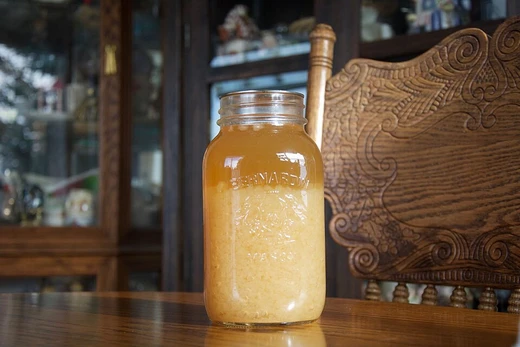
Doubanjiang
A fermented chili bean paste central to Sichuan cuisine.
Last updated

Badagnani · via Wikipedia: Doubanjiang · CC BY 3.0
It is characteristically used in Sichuan cuisine and has been called "the soul of Sichuan cuisine".[1] A Chinese bean paste known as doubanjiang is prepared from fermented broad beans, chili peppers, soybeans, salt, and flour, and is both hot and savory.[1]
Quick Facts
- Type
- Fermented bean paste
- Origin
- China (Sichuan region, with Pixian as the best-known variety)
- Key ingredients
- Broad beans
- chili peppers
- soybeans
- salt
- flour
- Known for
- Soul of Sichuan cuisine; key ingredient in mapo tofu, Sichuan hotpot, yuxiang flavoring, shuizhu
- Protected status
- Geographical indication (GI) protected product (GB/T 20560-2006)
- Varieties
- Pixian doubanjiang
- Hongyou doubanjiang
- Binzhou watermelon doubanjiang
Facts from the source article.
Key facts and history
The best-known variety is Pixian doubanjiang, named for Pixian (now Pidu District, Chengdu city) in Sichuan.[2] This environment supports microbial flora needed for fermentation, creating the unique flavor.[3] The unique taste of Pixian doubanjiang is strongly tied to the geographic setting of Pixian.[3] A reddish-brown appearance and a profound, intricate umami taste characterize Pixian doubanjiang.[4]
The typical preparation involves frying it in oil prior to adding other components.[4]
What the cited sources add
The blog China Sichuan Food states that doubanjiang literally means "bean paste"[5] It notes that Sichuan doubanjiang is made from broad beans instead of soybeans, and that Pixian doubanjiang usually goes through quite long fermentation time under sunshine.[5] The same source reports that the main market for Pixian doubanjiang is outside Sichuan province.[5] The Mashed.com article states that chili bean sauce made in Sichuan province or, more precisely, in the town of Pixian, is called doubanjiang.[6]
References
- Wikipedia, "Doubanjiang" (CC BY-SA 4.0), which cites: Chen, "Effect of stir-frying temperature on volatile aroma compounds in Pixian broad bean paste", International Journal of Gastronomy and Food Science, 2025; Holliday, "Sourcing Pixian Douban Jiang (Chili Bean Paste)", The Mala Project; Yanlin, "Sichuan Cuisine", Way of China; "Doubanjiang-Chili Bean Paste: Sichuan's Secret Weapon", malaeats.com, 2022-02-28 (we also read that source) en.wikipedia.org
- Wikipedia, "Doubanjiang" (CC BY-SA 4.0), which cites: Holliday, "Sourcing Pixian Douban Jiang (Chili Bean Paste)", The Mala Project (original not read by us) en.wikipedia.org
- Wikipedia, "Doubanjiang" (CC BY-SA 4.0), which cites: 阿, "郫县豆瓣——川菜之魂", 餐饮世界 [Catering World], 2021, p. 72–74 (original not read by us) en.wikipedia.org
- Wikipedia, "Doubanjiang" (CC BY-SA 4.0), which cites: Luo, "Doubanjiang - Broad Bean Paste(豆瓣酱)", China Sichuan Food, 18 July 2012 (we also read that source) en.wikipedia.org
- Luo, "Doubanjiang - Broad Bean Paste(豆瓣酱)", China Sichuan Food, 18 July 2012. facts only, no text reused. chinasichuanfood.com
- Lee, "Why You Should Start Keeping Chili Bean Sauce In Your Pantry", Mashed.com, 2022-01-05. facts only, no text reused. mashed.com
Each numbered sentence above was checked against the source it cites before publication. Sentences citing Wikipedia adapt text from the English Wikipedia article Doubanjiang (contributors), used under CC BY-SA 4.0; this entry is available under the same licence. Other sources were used for facts only; no text or images are copied from them.
More in Fermented Foods
Sources
Compiled from Wikipedia and the sources listed below. Text from Wikipedia is available under CC BY-SA 4.0; this entry is adapted from it.
- Wikipedia: Doubanjiang (CC BY-SA 4.0).
Spotted an error? Know more?
Reader corrections go straight into our review queue. Suggest an edit · How this site is sourced