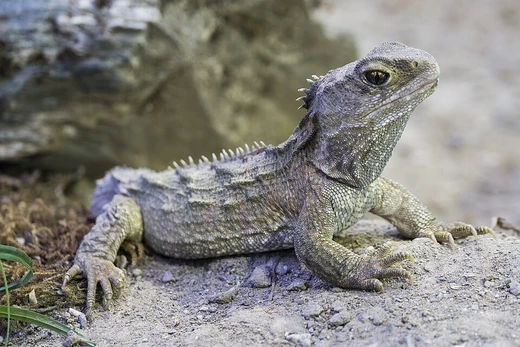
Marine iguana
The only extant lizard that spends time in a marine environment.
Last updated
The marine iguana (Amblyrhynchus cristatus) is a lizard species that lives only on the Galápagos Islands, part of Ecuador. It is also called the sea iguana, saltwater iguana, or Galápagos marine iguana. Among all living lizards, it is the only one that spends time in a marine environment, foraging in the ocean for algae, which makes up nearly its entire diet. Large males can dive for this food, while females and smaller males feed in the intertidal zone during low tide.
Reproduction and life cycle
These iguanas mainly live in colonies on rocky shores, where they bask after swimming in cold water or visiting the intertidal zone, but they can also be found in marshes, mangrove swamps, and beaches. Large males defend territories for a short period, while smaller males use other breeding strategies. After mating, the female digs a nest hole in the soil, lays her eggs, and leaves them to hatch on their own a few months later.
Their appearance varies across the different islands, and several subspecies are recognized. Although the species is locally abundant and has relatively large numbers, it is considered threatened. The main dangers are El Niño cycles, introduced predators, and chance events like oil spills.
Species description and etymology
The marine iguana was first described in 1825 by Thomas Bell, who named it Amblyrhynchus cristatus. He noted several distinctive features but mistakenly thought the specimen came from Mexico. The genus name Amblyrhynchus combines the Greek words ambly (blunt) and rhynchus (snout), while the species name cristatus is Latin for "crested," referring to the low spine crest along its back. Amblyrhynchus is a monotypic genus, containing only this one species.
Evolution
Researchers believe that Galápagos land iguanas (genus Conolophus) and marine iguanas evolved from a common ancestor that arrived on the islands from Central or South America, likely by rafting. Together, they form a clade whose closest relatives are the Ctenosaura iguanas of Mexico and Central America. One study using mtDNA estimated that marine iguanas split from land iguanas 5–15 million years ago, older than any existing Galápagos island, suggesting the ancestor lived on parts of the archipelago now submerged. A more recent study using both mtDNA and nDNA places the split at about 4.5 million years ago, close to the age of the oldest current islands, Española and San Cristóbal.
Despite millions of years of separation and being in different genera, marine and land iguanas remain mutually fertile. They have hybridized where their ranges overlap, producing a so-called hybrid iguana. This is very rare and has only been documented a few times on South Plaza, a tiny island where their usually separate breeding territories and seasons overlap. The hybrids have intermediate features, stay on land, and are infertile.
Marine iguana populations fall into three main clades: western, northeastern, and southeastern islands. These can be further divided, with each subclade generally matching iguanas from one or two main islands, except on San Cristóbal, which has two subclades (northeastern and southwestern).
Even the oldest divergence between populations is quite recent—no more than 230,000 years and likely less than 50,000 years. Occasionally, an individual reaches another island, leading to hybridization between different marine iguana populations. There is one confirmed record of a marine iguana outside the Galápagos: in 2014, one appeared on Isla de la Plata near the Ecuadorian mainland.
Subspecies
Traditionally, seven or eight subspecies have been recognized: A. c. albemarlensis (Isabela Island), A. c. ater (Pinzón Island, not always recognized), A. c. cristatus (Fernandina Island), A. c. hassi (Santa Cruz Island), A. c. mertensi (San Cristóbal and Santiago Islands), A. c. nanus (Genovesa Island), A. c. sielmanni (Pinta Island), and A. c. venustissimus (Española Island and adjacent Gardner Island). In 2017, the first comprehensive taxonomic review in over 50 years used morphological and genetic evidence to recognize five new subspecies, resulting in this list: A. c. cristatus (Isabela and Fernandina Islands, with albemarlensis and ater as junior synonyms), A. c. godzilla (northeastern San Cristóbal, named after Godzilla), A. c. hassi (Santa Cruz and smaller adjacent islands like Baltra), A. c. hayampi (Marchena Island), A. c. jeffreysi (Wolf, Darwin, and Roca Redonda Islands), A. c. mertensi (southwestern San Cristóbal), A. c. nanus (Genovesa Island), A. c. sielmanni (Pinta Island), A. c. trillmichi (Santa Fé Island), A. c. venustissimus (Española, including adjacent Gardner Island, and Floreana Island), and A. c. wikelskii.
Scientific classification
- KingdomAnimalia
- PhylumChordata
- ClassReptilia
- OrderSquamata
- SuborderIguania
- FamilyIguanidae
- GenusAmblyrhynchus
- SpeciesAmblyrhynchus cristatus
Named by Bell, 1825
Sources: Wikipedia taxobox: Marine iguana (CC BY-SA 4.0) · differs from this box at order: WoRMS AphiaID 344019 (CC BY 4.0)
Conservation status
Vulnerable (VU)
- LC
- NT
- VU▲ this species
- EN
- CR
- EW
- EX
Source: IUCN Red List assessment · GBIF copy of the Red List category
Where the marine iguana has been recorded
Each dot is a place where the species has been observed and reported (8,723 records, half-degree grid) — not a modelled range.
Map: drawn by Codexery. Data: GBIF occurrence search (records CC0 / CC BY) · Natural Earth basemap (public domain) · place coordinates: Wikipedia (CC BY-SA 4.0)
Quick Facts
- Genus
- Amblyrhynchus
- Species
- cristatus
Facts from the source article.
Lore & Background
The marine iguana was first described in 1825 as Amblyrhynchus cristatus by Thomas Bell. Its generic name, Amblyrhynchus, is a combination of two Greek words, Ambly- from Amblus (ἀμβλυ) meaning 'blunt' and rhynchus (ρυγχος) meaning 'snout'. Its specific name is the Latin word cristatus meaning 'crested,' and refers to the low crest of spines along the animal's back. Amblyrhynchus is a monotypic genus, having only one species, Amblyrhynchus cristatus.
Researchers theorize that Galapagos land iguanas (genus Conolophus) and marine iguanas evolved from a common ancestor since arriving on the islands from Central or South America, presumably by rafting. The marine iguana and Galápagos land iguana remain mutually fertile in spite of being separated by millions of years and assigned to distinct genera. They have been known to hybridize where their ranges overlap, resulting in the so-called hybrid iguana.
Reader's Guide
Marine iguanas vary in appearance between the different islands and several subspecies are recognized. Large males are able to dive to find algae, while females and smaller males feed during low tide in the intertidal zone. They mainly live in colonies on rocky shores where they bask after visiting the relatively cold water or intertidal zone, but can also be seen in marshes, mangrove swamps and beaches.
Large males defend territories for a short period, but smaller males have other breeding strategies. After mating, the female digs a nest hole in the soil where she lays her eggs, leaving them to hatch on their own a few months later. Although relatively large numbers remain and it is locally abundant, this protected species is considered threatened, primarily from El Niño cycles, introduced predators and chance events like oil spills.
Frequently Asked Questions
What is a marine iguana?
The marine iguana (Amblyrhynchus cristatus) is a medium-sized lizard found exclusively on the Galápagos Islands of Ecuador. It is the only living lizard species that actively forages in a marine environment, a trait no other extant lizard shares.
Can marine iguanas really swim in the ocean?
Yes—large males are capable of diving beneath the surface to graze on algae growing on submerged rocks, while females and smaller males typically feed in the intertidal zone during low tide. After their cold-water foraging trips, they return to rocky shores to bask and warm up.
Where do marine iguanas live?
Their entire range is restricted to the rocky coastlines of the Galápagos archipelago, which is part of Ecuador. They form colonies along these shores and do not occur naturally anywhere else on Earth.
What do marine iguanas eat?
Their diet consists almost entirely of algae, which they scrape from rocks either underwater or in the intertidal zone. This near-exclusive reliance on marine algae is what sets them apart from every other living lizard.
Also in the Codexery
More in Extant Reptiles & Amphibians
Test yourself
Three questions drawn from this entry’s sources. Pick an answer to check it.
Answers checked against the source article
Sources
Compiled from Wikipedia and the sources listed below. Text from Wikipedia is available under CC BY-SA 4.0; this entry is adapted from it.
- Wikipedia: Marine iguana (CC BY-SA 4.0).
- Classification: the source article's taxobox; compare WoRMS, the World Register of Marine Species (CC BY 4.0).
- Conservation status: IUCN Red List assessment.
- Occurrence records: GBIF (CC0 / CC BY). Basemap: Natural Earth (public domain).
- Word definitions: the Codexery glossary, each quoted from its Wikipedia article.
Spotted an error? Know more?
Reader corrections go straight into our review queue. Suggest an edit · How this site is sourced