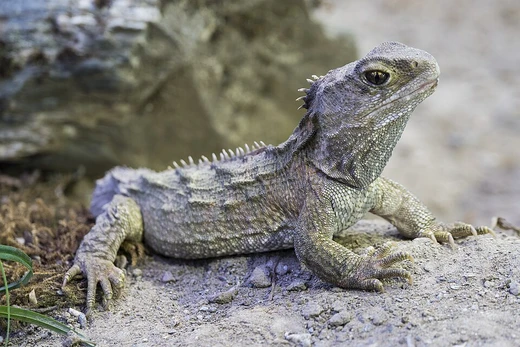
Lizard
Over 7,000 species of squamate reptiles excluding snakes.
Last updated
Most lizards are fairly small animals, though the Komodo dragon can reach nearly 3 m in length.[1] Squamate reptiles that are not snakes are referred to as lizards, and their total number of species exceeds 7,000.[2]
Quick Facts
- Taxonomic group
- Squamata (excluding snakes and most amphisbaenians)
- Number of species
- Over 7,000
- Size range
- 13.5 mm (0.531 in) to 3 m / 9 ft 10 in
- Distribution
- All continents except Antarctica, plus most oceanic island chains
Facts from the source article.
Biology and range
Lizards typically have rounded torsos, elevated heads on short necks, four limbs and long tails.[3] Lizards shed their skin in several pieces, unlike snakes.[4] Lizards are found worldwide, excluding the far north and Antarctica, and can live in elevations from sea level to 5000 m.[5] Keratin-based overlapping scales cover a lizard's skin, offering environmental protection and lessening water loss.[4]
Because of this, lizards can survive in extremely arid desert conditions.[4] While most lizards are diurnal, certain types like geckos are nocturnal.[6] Being ectothermic, lizards require basking in sunlight to elevate their body temperature for full activity.[7] Although they favor warm tropical areas, lizards can adapt to nearly any environment except the most severe ones.[5]
Ground-dwelling is the most common lifestyle for lizards, but some species are found on rocks, in trees, underground, or in aquatic settings.[5] Small terrestrial invertebrates, especially insects, are the primary prey for the majority of predatory lizard species.[8]
What the specialist sources record
The Gila monster is North America's largest lizard, named from the Gila River in Arizona and New Mexico.[9] A 2013 article notes that the Gila monster is among the few venomous lizard species, along with the Mexican beaded lizard.[9] The same source states that the Komodo dragon was also proposed to deliver venom.[9] The article adds that this tiny lizard might be as small as a lizard can be, because tiny lizards dry out quickly.[10]
According to a 2016 Guardian article, the Komodo dragon is the largest lizard globally and inhabits islands in Indonesia.[11] The Guardian also mentions that the reticulate Gila monster is a venomous lizard native to the US.[11]
References
- Wikipedia, "Lizard" (CC BY-SA 4.0), which cites: Muir, "Minute gecko matches smallest reptile record", New Scientist, 3 December 2001; "The world's top 10 reptiles – in pictures", The Guardian, 5 May 2016 (we also read that source) en.wikipedia.org
- Wikipedia, "Lizard" (CC BY-SA 4.0), which cites: "The Reptile Database", Reptile-database.reptarium.cz (original not read by us) en.wikipedia.org
- Wikipedia, "Lizard" (CC BY-SA 4.0), which cites: McDiarmid, Roy W., "Reptile Biodiversity: Standard Methods for Inventory and Monitoring", University of California Press, 2012, p. 13; Jones, "Hard tissue anatomy of the cranial joints in Sphenodon (Rhynchocephalia): sutures, kinesis, and skull mechanics", Palaeontologia Electronica, 2011, p. 1–92; "The Firefly Encyclopedia of Reptiles and Amphibians", Firefly Books, 2002, p. 139–169 (we also read that source) en.wikipedia.org
- Wikipedia, "Lizard" (CC BY-SA 4.0), which cites: "The Firefly Encyclopedia of Reptiles and Amphibians", Firefly Books, 2002, p. 139–169; "Biology: The Unity and Diversity of Life", Cengage Learning, 2012, p. 429 (we also read that source) en.wikipedia.org
- Wikipedia, "Lizard" (CC BY-SA 4.0), which cites: "The Firefly Encyclopedia of Reptiles and Amphibians", Firefly Books, 2002, p. 139–169 (we also read that source) en.wikipedia.org
- Wikipedia, "Lizard" (CC BY-SA 4.0), which cites: Pianka and Vitt, pp. 86. (original not read by us) en.wikipedia.org
- Wikipedia, "Lizard" (CC BY-SA 4.0), which cites: Pianka and Vitt, pp. 32–37.; Buckley, "Thermoregulatory behaviour limits local adaptation of thermal niches and confers sensitivity to climate change", Functional Ecology, 2015, p. 1038–1047 (original not read by us) en.wikipedia.org
- Wikipedia, "Lizard" (CC BY-SA 4.0), which cites: "The Firefly Encyclopedia of Reptiles and Amphibians", Firefly Books, 2002, p. 139–169; Pianka and Vitt, pp. 41–51.; Pianka and Vitt, pp. 53–55. (we also read that source) en.wikipedia.org
- Casey, "Don't Call It a Monster", 26 April 2013. facts only, no text reused. slate.com
- Muir, "Minute gecko matches smallest reptile record", New Scientist, 3 December 2001. facts only, no text reused. newscientist.com
- "The world's top 10 reptiles – in pictures", The Guardian, 5 May 2016. facts only, no text reused. theguardian.com
Each numbered sentence above was checked against the source it cites before publication. Sentences citing Wikipedia adapt text from the English Wikipedia article Lizard (contributors), used under CC BY-SA 4.0; this entry is available under the same licence. Other sources were used for facts only; no text or images are copied from them.
More in Extant Reptiles & Amphibians
Sources
Compiled from Wikipedia and the sources listed below. Text from Wikipedia is available under CC BY-SA 4.0; this entry is adapted from it.
- Wikipedia: Lizard (CC BY-SA 4.0).
- Word definitions: the , each quoted from its Wikipedia article.
Spotted an error? Know more?
Reader corrections go straight into our review queue. Suggest an edit · How this site is sourced