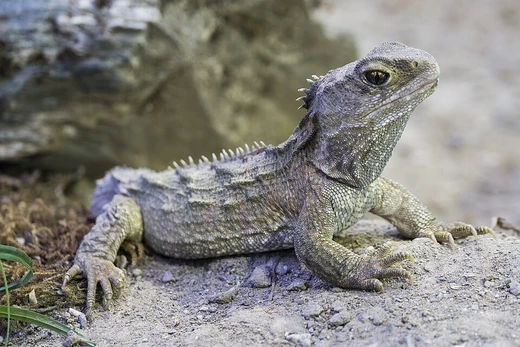
Monitor lizard
Large, intelligent lizards with venom and high metabolism.
Last updated
Monitor lizards are lizards in the genus Varanus, the only extant genus in the family Varanidae. They are native to Africa, Asia, and Oceania, with one species also found as an invasive species in the southern United States. About 94 species are recognized, ranging in adult length from 20 cm (7.9 in) to over 3 m (10 ft) for the Komodo dragon, though the extinct megalania (Varanus priscus) may have reached lengths of more than 7 m (23 ft). Most species are terrestrial, but many are arboreal or semiaquatic, and while most are carnivorous, a few species eat fruit and vegetation.
Scientific classification
- KingdomAnimalia
- PhylumChordata
- ClassReptilia
- OrderSquamata
- SuborderAnguimorpha
- FamilyVaranidae
- GenusVaranus
Named by Merrem, 1820
Sources: Wikipedia taxobox: Monitor lizard (CC BY-SA 4.0)
Lore & Background
The generic name Varanus derives from the Arabic word waral, meaning 'lizard beast'. In English, they are called 'monitors' or 'monitor lizards', a name possibly suggested by their habit of standing on hind legs or warning of venomous animals, though these explanations postdate Linnaeus naming the Nile monitor Lacerta monitor in 1758. Linnaeus may have mistakenly connected the German Waran to warnen ('to warn') or the Greek ouranós ('sky'), leading him to Latinize it as monitor ('warner' or 'adviser'). In Austronesian languages, they are known as biawak, bayawak, or variations; in South Asia, as hangkok, ghorpad, uḍumbu, gohi, and many other names; in West Africa, as awọ́nríwọ́n, mbossé, or bar; in Australia, as 'goannas' due to confusion with iguanas; and in South African English, as leguaans or likkewaans from Dutch.
Reader's Guide
Monitor lizards are significant for their unique biological traits and ecological roles. They have the highest standard metabolic rates of all extant reptiles, enabled by a heart with a well-developed ventricular septum that separates pulmonary and systemic circuits during systole, allowing mammalian-equivalent pressure differentials. Most varanids are venomous, with venom glands in the lower jaw; their venom is diverse, including anticoagulant effects and, in some species like the Komodo dragon and desert monitor, neurotoxic effects. They are also notable for their intelligence: some species can count up to six, Nile monitors cooperate when foraging, and Komodo dragons recognize keepers and show distinct personalities.
Their distribution spans Africa, Asia, and Oceania, with fossil evidence in Neogene Europe. As oviparous animals laying 7 to 38 eggs, some species like the Komodo dragon can reproduce via parthenogenesis. Their morphological conservatism despite a vast size range makes them unique among animals.
Also in the Codexery
More in Extant Reptiles & Amphibians
Sources
Compiled from Wikipedia and the sources listed below. Text from Wikipedia is available under CC BY-SA 4.0; this entry is adapted from it.
- Wikipedia: Monitor lizard (CC BY-SA 4.0).
- Word definitions: the Codexery glossary, each quoted from its Wikipedia article.
Spotted an error? Know more?
Reader corrections go straight into our review queue. Suggest an edit · How this site is sourced