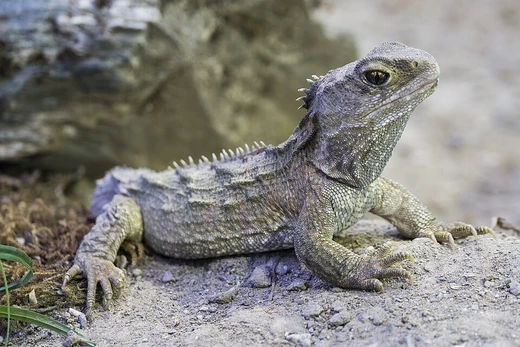
Oriental garden lizard
A highly variable agamid lizard, known for its color-changing ability and wide distribution across Indo-Malaya.
Last updated
The oriental garden lizard, also known as the eastern garden lizard, Indian garden lizard, common garden lizard, bloodsucker, or changeable lizard, is an agamid species native to the Indo-Malayan region. It has also been introduced to other parts of the world.
Description
This insectivore measures over 10 centimeters from snout to vent, with a total length including the tail reaching up to 37 centimeters. Above each ear opening are two separate clusters of spines. The dorsal crest is moderately raised on the neck and front part of the body, extending onto the tail base in large adults, while in younger individuals it gradually fades along the middle of the back. There is no fold in front of the shoulder, but the scales behind the lower jaw are noticeably smaller than others, and the throat pouch is not developed.
Around the middle of the body, there are 39 to 43 rows of scales. In adults, the hind foot is not much longer than the head, but in juveniles it is considerably longer. Coloration varies widely—sometimes uniform brown, greyish-olive, or yellowish.
Often there are broad brown bands across the back, broken by a yellowish side stripe. Black streaks radiate from the eye, some continuing obliquely backward across the throat. The belly frequently shows greyish longitudinal lines, with one along the midline being most distinct. Young and half-grown lizards have a dark, black-edged band across the area between the eyes.
The ground color is usually light brownish olive, but the lizard can change it to bright red, black, or a mix of both. This color shift may be limited to the head or spread over the entire body and tail. A common sight, as noted by T. C. Jerdon, is the lizard perched on a hedge or bush with its tail and limbs black, head and neck yellow with red accents, and the rest of the body red.
Jerdon and Blyth agreed that these bright, changeable colors are exclusive to males during the breeding season, which runs from May to early October. Albert Günther noted that Alexandre Henri Mouhot collected one of these fine color variations in Siam, though they appear endless. The species has the usual cross streaks between the eyes and radiating lines, ranging from continental India to China. It is very common in Sri Lanka, where specimens are generally larger—one measured 16 inches, with the tail accounting for 11 inches.
It lives in hedges and trees. In Sri Lanka, it is called "Bloodsucker," a name whose origin is unclear; Kelaart believed it came from the occasional reddish hue of the throat and neck. In Bengali, it is also known as "Roktochosha," which translates to "bloodsucker."
The female lays five to sixteen soft, oval eggs, about 5/8 of an inch long, in tree hollows or holes in the soil she has burrowed, then covers them. The young emerge in about eight to nine weeks. On a hot, sunny day, a solitary bloodsucker may be seen basking on a twig or wall with its mouth wide open.
After a rain shower, many come down to the ground to pick up larvae and small insects that have fallen from the trees. They escape danger by darting to the nearest tree; if a predator gets closer, they scale the side facing away and swiftly climb up, leaving the predator looking behind the tree only to find the lizard already in the branches. During the breeding season, the male's head and shoulders turn bright orange to crimson, and his throat becomes black. Males also develop a red head after a successful fight with rivals.
Both sexes have a crest from the head nearly to the tail, giving them the other common name "crested tree lizard." Unlike some lizards, they do not drop their tails (autotomy), and their tails can be very long, stiff, and pointed. Like other reptiles, they shed their skin. Like chameleons, they can move each eye in different directions.
Distribution
The species' native range includes southeastern Iran, Afghanistan, Bangladesh, Bhutan, Cambodia, India (including the Andaman Islands), Indonesia (Sumatra), Malaysia (western), Maldives, Mauritius (Reunion, Rodrigues), Myanmar, Nepal, Pakistan, Philippines, Sri Lanka (Ceylon), Thailand, and Vietnam (including Pulo Condore Island). It has been introduced to Brunei, Celebes, Oman, Seychelles, Singapore, and the United States. The lizards were introduced to Singapore from Malaysia and Thailand in the 1980s, where they threaten the native green-crested lizard.
The changeable lizard is relatively common and found in a wide range of habitats, adapting well to humans and thus not endangered. It is commonly found among undergrowth, in open habitats, and in highly urban areas. However, in China, people regularly kill them, viewing them as pests.
Diet
Changeable lizards eat mainly insects such as ants, beetles, dragonflies, and grasshoppers, as well as small vertebrates including rodents and other lizards (agamids, geckos, and lizards). Their teeth are designed for gripping prey, not tearing, so they usually shake prey to stun it and then swallow it whole.
Sometimes young, inexperienced lizards may choke on prey that is too large. They also occasionally consume plant matter. Males become highly territorial during the breeding season and discourage intruding males.
Scientific classification
- KingdomAnimalia
- PhylumChordata
- ClassReptilia
- OrderSquamata
- SuborderIguania
- FamilyAgamidae
- GenusCalotes
- SpeciesCalotes versicolor
Named by (Daudin, 1802)
Sources: Wikipedia taxobox: Oriental garden lizard (CC BY-SA 4.0) · order, family and genus agree with WoRMS AphiaID 1488201 (CC BY 4.0)
Conservation status
Least Concern (LC)
- LC▲ this species
- NT
- VU
- EN
- CR
- EW
- EX
Source: IUCN Red List assessment · GBIF copy of the Red List category
Where the oriental garden lizard has been recorded
Each dot is a place where the species has been observed and reported (25,907 records, half-degree grid) — not a modelled range. 213 inland records left out (institution coordinates).
Map: drawn by Codexery. Data: GBIF occurrence search (records CC0 / CC BY) · Natural Earth basemap (public domain) · place coordinates: Wikipedia (CC BY-SA 4.0)
Quick Facts
- Genus
- Calotes
- Species
- versicolor
Facts from the source article.
Lore & Background
Calotes versicolor is an insectivore, and the male gets a bright red throat in the breeding season. It measures over 10 cm (3.9 in) in length snout-to-vent. Total length including the tail is up to 37 cm (14.5 in).
Two small groups of spines, perfectly separated from each other, above each tympanum. Dorsal crest moderately elevated on the neck and anterior part of the trunk, extending on to the root of the tail in large individuals, and gradually disappearing on the middle of the trunk in younger ones. No fold in front of the shoulder, but the scales behind the lower jaw are much smaller than the others; gular sac not developed. From thirty-nine to forty-three series of scales round the middle of the trunk.
The hind foot (measured from the heel to the extremity of the fourth toe) is not much longer than the head in the adult, whilst it is considerably longer in the young. The coloration is very variable, sometimes uniform brownish or greyish-olive or yellowish. Generally broad brown bands across the back, interrupted by a yellowish lateral band.
Black streaks radiate from the eye, and some of them are continued over the throat, running obliquely backwards, belly frequently with greyish longitudinal stripes, one along the median line being the most distinct; young and half-grown specimens have a dark, black-edged band across the inter-orbital region. The ground-colour is generally a light brownish olive, but the lizard can change it to bright red, to black, and to a mixture of both. This change is sometimes confined to the head, at other times diffused over the whole body and tail. A common state in which it may be seen (as stated by T. C. Jerdon) is, seated on a hedge or bush, with the tail and limbs black, head and neck yellow picked out with red, and the rest of the body red.
Jerdon and Blyth agree that these bright, changeable colours are peculiar to the male during the breeding-season, which falls in the months of May to early October. Albert Guenther mentioned that Alexandre Henri Mouhot had collected in Siam one of those fine variations of colours, which, however, appear to be infinite. It has the usual cross streaks between the eyes and the radiating lines continent of India to China; it is very common in Sri Lanka, not extending into the temperate zone of the Himalayas.
Reader's Guide
The native range of the species includes southeastern Iran, Afghanistan, Bangladesh, Bhutan, Cambodia, India (including the Andaman Islands), Indonesia (Sumatra), Malaysia (western), Maldives, Mauritius (Reunion, Rodrigues), Myanmar, Nepal, Pakistan, Philippines, Sri Lanka (Ceylon), Thailand, Vietnam (including Pulo Condore Island). It has been introduced to Brunei, Celebes, Oman, Seychelles, Singapore and United States. The lizards were introduced to Singapore from Malaysia and Thailand in the 1980s. In Singapore, they are a threat to the native green-crested lizard.
The changeable lizard is relatively common and found in a wide range of habitats. They appear to adapt well to humans and are thus not endangered. They are commonly found among undergrowth, in open habitats as well as highly urban areas. However, in China people regularly kill them, as they are viewed as pests.
Diet: Changeable lizards eat mainly insects such as ants, beetles, dragonflies, and grasshoppers; as well as small vertebrates, including rodents and other lizards including agamids, geckos, and lizards. They have teeth which are designed for gripping prey and not tearing, and thus they usually shake prey to stun it then swallow it whole. Sometimes, young, inexperienced changeable lizards may choke on prey that is too large.
Changeable lizards also occasionally consume plant matter. Reproduction: Males become highly territorial during breeding season. They discourage intruding males by brightening their red heads and doing 'push-ups'. Each tries to attract a female by inflating his throat and drawing attention to his handsomely colored head.
Oviparous; about 10—20 eggs are laid, buried in moist soil. The eggs are long, spindle-shaped and covered with a leathery skin. They hatch in about 6–7 weeks. They are able to breed at about 1 year old.
Also in the Codexery
More in Extant Reptiles & Amphibians
Sources
Compiled from Wikipedia and the sources listed below. Text from Wikipedia is available under CC BY-SA 4.0; this entry is adapted from it.
- Wikipedia: Oriental garden lizard (CC BY-SA 4.0).
- Classification: the source article's taxobox; order, family and genus checked against WoRMS, the World Register of Marine Species (CC BY 4.0).
- Conservation status: IUCN Red List assessment.
- Occurrence records: GBIF (CC0 / CC BY). Basemap: Natural Earth (public domain).
Spotted an error? Know more?
Reader corrections go straight into our review queue. Suggest an edit · How this site is sourced