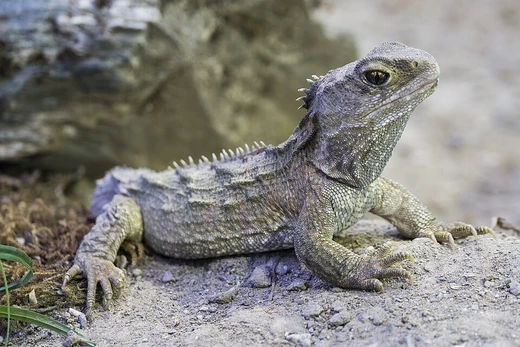
Iguana
A genus of herbivorous lizards native to tropical areas of Mexico, Central America, South America, and the Caribbean.
Last updated
Iguanas are a genus of plant-eating lizards native to tropical parts of Mexico, Central America, South America, and the Caribbean. The Austrian naturalist J.N. Laurenti first described the genus in 1768. It contains two species: the green iguana, common across its range and often kept as a pet, and the Lesser Antillean iguana, which lives only in the Lesser Antilles.
Genetic work suggests the green iguana might actually be a group of several species, some only recently identified, though the Reptile Database still treats them as subspecies. The name "iguana" comes from the Taino word iwana. Several other lizards in related genera also carry "iguana" in their common names.
Iguanas are popular pets, and people have introduced them outside their native range to places like Ishigaki Island, Florida, Hawaii, Singapore, Thailand, Taiwan, and many islands in the Lesser Antilles that already have native iguana populations.
Anatomy and physiology
These large lizards can grow from 4 to 6.5 feet long, including the tail. They have a dewlap and a row of elongated scales running from the middle of the neck down to the tail. Different parts of the body have different scale types: large, round tuberculate scales are scattered on the sides of the neck among smaller, overlapping ones.
The scales on the back are thicker and more tightly packed than those on the belly. These scales can be various colors and are not always obvious up close. A large, round scale called the subtympanic shield sits on each cheek.
Iguanas have excellent eyesight, able to see shapes, shadows, colors, and movement from far away. This helps them move through dense forests and find food.
They also use visual signals to communicate with each other. The eardrum, or tympanum, sits above the subtympanic shield behind each eye, though the Lesser Antillean iguana lacks this shield. Their coloration helps them blend into their surroundings and hide from predators.
Like most reptiles, iguanas have a three-chambered heart with two atria, one ventricle, and two aortae. Their muscles are very pale because they contain a high proportion of fast-twitch, glycolytic fibers. These fibers have few blood vessels and little myoglobin, giving the muscles a light color. This allows iguanas to move very quickly in short bursts, but the anaerobic respiration in these fibers makes long-distance movement inefficient.
Parietal eye
A pale scale on the back of the head marks the parietal eye, an organ sensitive to changes in light. It sends signals to the pineal gland to track day and night. A photopigment called parapinopsin, also found in lampreys, is sensitive to ultraviolet light and helps with this signaling.
Skull morphology and diet
Iguanas eat only plants. To handle tough vegetation, they need a strong bite force relative to their size. Their skulls are taller and wider, with shorter snouts and larger bodies compared to meat-eating reptiles. These modifications allow for more muscle and greater strength. Their teeth sit on top of the jawbone (acrodontal) and are small and serrated, good for grasping and shearing plant matter.
Reproduction
Male iguanas have two hemipenes, and during mating, one is inserted into the female’s cloacal vent. Females can store sperm from previous mates for several years to fertilize eggs later if no male is available. The number of eggs in a clutch depends heavily on the female’s body size and on climate and environment. Green iguanas can lay up to 71 eggs, while Lesser Antillean iguanas lay up to 30.
A hybrid female between the two species has been recorded with 35 eggs. In some cases, an iguana can produce hatchlings without mating. Mating usually happens during the dry season so that offspring hatch in the wet or rainy season. Iguanas tend to have a promiscuous or polygynandrous mating system.
Scientific classification
- KingdomAnimalia
- PhylumChordata
- ClassReptilia
- OrderSquamata
- SuborderIguania
- FamilyIguanidae
- GenusIguana
Named by Laurenti, 1768
Sources: Wikipedia taxobox: Iguana (CC BY-SA 4.0)
Lore & Background
The genus Iguana was first described by Austrian naturalist J.N. Laurenti in 1768. Genetic analysis indicates that the green iguana may comprise a complex of multiple species, some of which have been recently described, but the Reptile Database considers all of these as subspecies of the green iguana. The Reptile Database synonymizes I. rhinolopha with I. iguana, only considering it a distinctive population, and recognizes I. insularis and I. melanoderma as subspecies of I. iguana.
Reader's Guide
Iguanas are large lizards that can range from 4 to 6.5 ft in length, including their tails. They possess a dewlap and a row of elongated scales running from the midline of their necks down to their tails. They have a large, round scale on their cheeks known as a subtympanic shield. Iguanas have keen vision and can see shapes, shadows, colors, and movement at long distances.
The tympanum is located above the subtympanic shield behind each eye (though the Lesser Antillean iguana lacks this shield). Like most reptiles, an iguana has a three-chambered heart. The muscles of an iguana are very light in color due to the high proportion of fast-twitch, glycolytic muscle fibers. Several species of lizards, including iguanas, have a pale scale towards the back of their heads marking the parietal eye.
Iguanas have developed an herbivorous lifestyle, foraging exclusively on vegetation and foliage. Their teeth are acrodontal, small, and serrated. Male iguanas have two hemipenes.
A female can store sperm from previous mates for several years. Clutch size within Iguana iguana has been recorded up to 71 eggs, whilst maximum clutch size for Iguana delicatissima is 30. Iguanas tend to follow a promiscuous or polygynandrous mating style during the dry season. After copulation, eggs are laid within a nest underground from which the hatchlings emerge after >85 days of incubation.
Frequently Asked Questions
What is Iguana?
Iguana is a genus of large, herbivorous lizards belonging to the family Iguanidae. It was first formally described in 1768 by the Austrian naturalist J.N. Laurenti.
Where do Iguanas live in the wild?
These lizards are native to tropical regions spanning Mexico, Central America, South America, and the Caribbean. They are not found outside the Americas in their natural range.
What do Iguanas eat?
Iguanas are strictly herbivorous, feeding on leaves, flowers, and fruit. They do not consume meat as part of their natural diet.
Also in the Codexery
More in Extant Reptiles & Amphibians
Sources
Compiled from Wikipedia and the sources listed below. Text from Wikipedia is available under CC BY-SA 4.0; this entry is adapted from it.
- Wikipedia: Iguana (CC BY-SA 4.0).
- Word definitions: the Codexery glossary, each quoted from its Wikipedia article.
Spotted an error? Know more?
Reader corrections go straight into our review queue. Suggest an edit · How this site is sourced