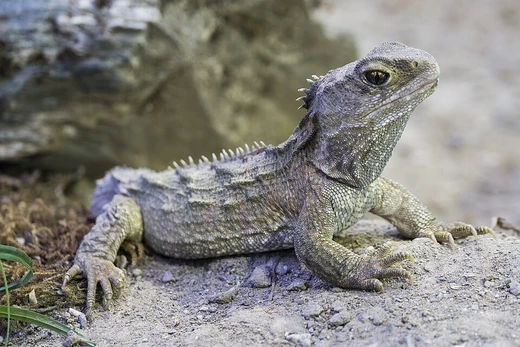
Mediterranean house gecko
A nocturnal, insectivorous gecko native to the Mediterranean, now widespread due to its affinity for human homes.
Last updated
The Mediterranean house gecko, known scientifically as Hemidactylus turcicus, originally hails from the Mediterranean region but has since spread to parts of East Africa, South America, the Caribbean, and the southern and southeastern United States. Its Latin name gives it the common name Turkish gecko, and it is also called the moon lizard because it typically comes out at night. A study in Portugal found this species to be strictly nocturnal, with peak activity around 2:00 a.m.
It eats insects, rarely grows longer than 15 centimeters, and has large, lidless eyes with elliptical pupils. Its skin is purple or tan with black spots, often with stripes on the tail, and its belly is somewhat translucent. The impact of this gecko on native wildlife in areas where it has been introduced is not yet known.
In many parts of the world, the range of this gecko is expanding. Unlike many other reptiles, it appears highly resistant to pesticides.
This growth may be due to few predators in introduced areas and its habit of hiding in cracks and hidden spots inside human homes, such as within walls. Its reliance on human dwellings, similar to rodents, has helped it thrive. In some Eastern Mediterranean countries like Greece, Turkey, and Cyprus, harming this gecko is considered taboo because it is harmless, and it is often kept as a pet.
Description
The Mediterranean gecko is a small lizard, usually 4 to 5 inches long, with sticky toe pads, vertical pupils, and large eyes without eyelids. Its snout is rounded, about as long as the space between the eye and ear opening, and slightly longer than the diameter of the eye socket. The forehead is slightly concave, and the ear opening is oval and about half the eye’s diameter. Its body and limbs are moderate in size.
The toes vary in length, with the inner toe always well developed; there are 6 to 8 lamellae under the inner toes, 8 to 10 under the fourth finger, and 9 to 11 under the fourth toe. The head has large granules in front and smaller ones mixed with round tubercles toward the back. The rostrum is four-sided, less than twice as broad as deep, with a cleft in the middle above.
The nostril sits between the rostrum, the first labial, and three nasal scales. There are 7 to 10 upper labials and 6 to 8 lower labials. The mental scale is large, triangular, and at least twice as long as the adjacent labials, with its point between two large chin shields that may touch behind it; a smaller chin shield lies on each side of the larger pair. The upper body is covered with tiny granules mixed with large tubercles, which are often bigger than the spaces between them, suboval and trihedral, arranged in 14 or 16 regular longitudinal rows.
The belly scales are small, smooth, roundish-hexagonal, and overlapping. Males have a short angular series of 4 to 10 (rarely 2) preanal pores. The tail is cylindrical, slightly flattened, and tapering, covered above with tiny scales and a transverse row of large, keeled tubercles, and below with a series of large, wide plates.
Its color is light brown or grayish above with darker spots; many tubercles and the lower surfaces are white. Some individuals are completely translucent except for the spots, while others are darker. When fleeing, they often seek darkness. They may be seen alone or in groups of up to five or more.
Geographic distribution
Native to the Mediterranean region, this gecko is one of the most successful gecko species worldwide. It has spread far beyond its original range and established stable populations, holding no threatened or endangered status. It can be found in countries with Mediterranean climates, including Portugal, Spain, France, Italy, Greece, Israel, Malta, southern Bulgaria, North Macedonia, coastal Croatia (except western Istria), Bosnia and Herzegovina, the Adriatic islands, coastal Montenegro, coastal Albania, Cyprus, Turkey, northern Morocco, Algeria, Tunisia, Jordan, Syria, Libya, Egypt, Lebanon, northern Yemen (the Socotra Archipelago), Somalia, Eritrea, Kenya, southern Iran, Iraq, Oman, Qatar, Saudi Arabia, Pakistan, India, the Balearic Islands (Island Addaya Grande), the Canary Islands (introduced to Gran Canaria and Tenerife), Panama, Puerto Rico, Belize, and Cuba. As of 1974, it was known from scattered records in the southwestern United States, including Arizona, California, Nevada, and New Mexico, and more extensively in the southern United States, including Alabama, Arkansas, Florida, Georgia, Kansas, Kentucky, Louisiana, Maryland, Mississippi, Missouri, North Carolina, Oklahoma, South Carolina, Texas, and Virginia, especially well-established in Gulf Coast states.
More recently, records have come from several places in Pennsylvania and Tennessee. It was reported from Indiana in 2019, but it was unknown at that time if that individual represented an established population. In Mexico, introductions are known in the states of Tamaulipas, Veracruz, Tabasco, Campeche, Yucatán, Baja California, Chihuahua, Coahuila, Sonora, Durango, and Nuevo León.
Habitat
These geckos live in a wide range of habitats near people, such as university campuses, cemeteries, coastal areas, and shrublands. In urban or suburban settings, they are often seen in the cracks of old brick buildings.
Compared to natural settings, these urban environments offer less complex habitats, which helps their success across their range. They can also be found on mountain cliffs and in caves. Their nests are built in hidden spots.
Scientific classification
- KingdomAnimalia
- PhylumChordata
- ClassReptilia
- OrderSquamata
- SuborderGekkota
- FamilyGekkonidae
- GenusHemidactylus
- SpeciesHemidactylus turcicus
Named by (Linnaeus, 1758)
Sources: Wikipedia taxobox: Mediterranean house gecko (CC BY-SA 4.0)
Conservation status
Least Concern (LC)
- LC▲ this species
- NT
- VU
- EN
- CR
- EW
- EX
Source: IUCN Red List assessment · GBIF copy of the Red List category
Where the mediterranean house gecko has been recorded
Each dot is a place where the species has been observed and reported (54,924 records, half-degree grid) — not a modelled range. 333 inland records left out (institution coordinates).
Map: drawn by Codexery. Data: GBIF occurrence search (records CC0 / CC BY) · Natural Earth basemap (public domain) · place coordinates: Wikipedia (CC BY-SA 4.0)
Quick Facts
- Genus
- Hemidactylus
- Species
- turcicus
Facts from the source article.
Lore & Background
In many parts of the world, the range of H. turcicus is increasing, and unlike many other reptiles, it appears to be highly resistant to pesticides. The increase may be explained as a consequence of having few predators in places where it has been introduced, and also of its tendency to take shelter in the cracks and unseen areas of human homes. Reliance on human habitation has thus contributed to the species' proliferation, similar to rodents. In some Eastern Mediterranean countries such as Greece, Turkey and Cyprus, harming H. turcicus is taboo due to its benign nature, and it is often kept as a house pet.
Reader's Guide
The Mediterranean gecko is a very small lizard generally measuring 4–5 in in length, with sticky toe pads, vertical pupils, and large eyes that lack eyelids. It is insectivorous, rarely exceeds 15 cm in length, and has purple or tan-colored skin with black spots, often with stripes on the tail. Its belly or undersides are somewhat translucent.
A study in Portugal found H. turcicus to be totally nocturnal, with its highest activity around 02:00. They emit a distinctive, high-pitched call somewhat like a squeak or the chirp of a bird. They are voracious predators of moths and small roaches and are attracted to outdoor lights in search of these prey. Mediterranean house geckos reach sexual maturity within four months to a year.
The breeding season is typically from April to August each year and eggs are laid mid-May to August in an average clutch size of two. Female house geckos experience delayed fertilization and can store sperm; exact gestation time is unknown, but is estimated to be around 40–60 days. Neither males nor females have been observed providing any parental care.
Also in the Codexery
More in Extant Reptiles & Amphibians
Sources
Compiled from Wikipedia and the sources listed below. Text from Wikipedia is available under CC BY-SA 4.0; this entry is adapted from it.
- Wikipedia: Mediterranean house gecko (CC BY-SA 4.0).
- Conservation status: IUCN Red List assessment.
- Occurrence records: GBIF (CC0 / CC BY). Basemap: Natural Earth (public domain).
- Word definitions: the Codexery glossary, each quoted from its Wikipedia article.
Spotted an error? Know more?
Reader corrections go straight into our review queue. Suggest an edit · How this site is sourced