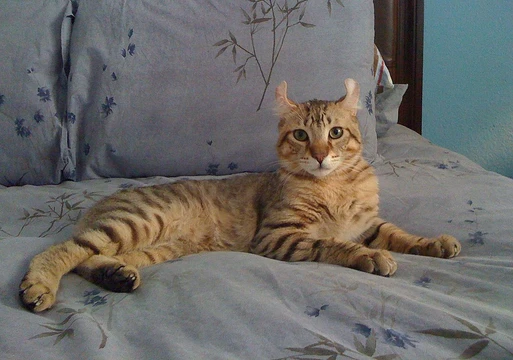
Tasman Manx cat
Tailless cat breed from the Isle of Man, prized as hunters.

The Manx cat is a breed of domestic cat originating on the Isle of Man, characterized by a mutation that shortens the tail. Many have a small stub of a tail, but they are best known as being entirely tailless, along with elongated hind legs and a rounded head. They come in all coat colours and patterns, though all-white specimens are rare.
Quick Facts
- Nickname
- Stubbin, rumpy
- Country
- Isle of Man
- Cfastd
- http: · www.cfa.org/Portals/0/documents/breeds/standards/manx.pdf
- Fifestd
- http: · www1.fifeweb.org/dnld/std/MAN-CYM.pdf
- Ticastd
- https: · www.tica.org/phocadownload/mx.pdf
- Wcfstd
- http: · www.wcf-online.de/WCF-EN/library/MAN_en_2010-01-01.pdf
- Ffestd
- http: · www.ffe-europe.de/standard/manx_e.htm
- Acfstd
- https: · www.acf.asn.au/notices/notices/standards/Group%20Three/Manx.pdf
- Acfastd
- http: · www.acfacat.com/Breed%20Standards/MANX.pdf
- Cccastd
- https: · www.cccofa.com.au/files/files/std/Manx%20-%20November%202023(1).pdf
- Cffstd
- http: · cffinc.org/files/pdf/MANX.pdf
- Ccastd
- https: · www.cca-afc.com/documents/BreedStandards/MANX_20200203_010625.pdf
Facts from the source article.
Lore & Background
Tailless cats, then called stubbin in colloquial Manx language, were known by the early 19th century as cats from the Isle of Man. Some folklore claims they were brought by sea, possibly from a shipwreck of the Spanish Armada, though tailless cats are not commonly known in Spain. The dominant trait of taillessness arises from a spontaneous mutation that became common due to limited genetic diversity on the island.
Reader's Guide
The Manx cat is significant as a distinct breed recognized since the late 1800s, with the first known breed standard published in 1903. They have been exhibited in cat shows and were one of the first breeds recognized by the Cat Fanciers' Association, with records in North America going back to the 1920s. Their taillessness is caused by a dominant gene that does not breed true, leading to a range of tail lengths from rumpy (no tail) to longy (normal tail). The breed is prized as skilled hunters, often sought by farmers and as ship's cats. Folktales about the Manx are of relatively recent origin, focused entirely on the lack of a tail, and include stories such as Noah accidentally cutting off the tail on the Ark. Populations of tailless cats exist elsewhere in Europe, including Cornwall and Reersø in Denmark, but their genetic relationship to Manx cats is uncertain.
Did You Know?
- The Manx cat's taillessness arises from a spontaneous mutation that became common due to the founder effect and limited genetic diversity on the Isle of Man.
- Local terms for the cats on the Isle of Man are stubbin (short tail) and rumpy (no tail).
- The Manx was accepted for registration by the Cat Fanciers' Association in the 1920s, but did not achieve championship status until the 1940s or 1950s, depending on the association.
More in Experimental cat breeds 1-24
Spotted an error? Know more?
Reader corrections go straight into our review queue. Suggest an edit · How this site is sourced