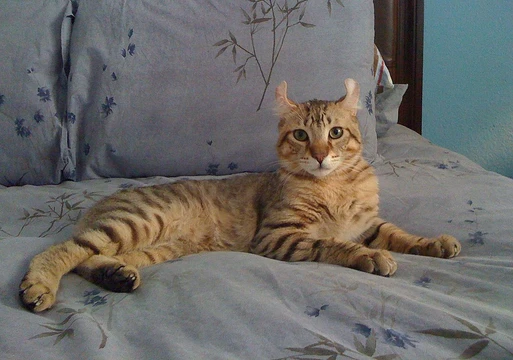
Highlander cat
A new bobtailed breed with curled ears and a wild look.

The Highlander, also known as the Highlander Shorthair and originally as the Highland Lynx, is a new breed of cat developed from a deliberate cross between the Desert Lynx and the Jungle Curl breeds. Its unique appearance, including a bobbed tail, curled ears, and muscular body, gives it a wild, bobcat-like look, though the breed is known for being human-oriented, friendly, and playful.
Quick Facts
- Ticastd
- https: · tica.org/wp-content/uploads/2024/08/hg.pdf
- Acfastd
- https: · acfacat.com/Breed%20Standards/Highlander%20Combined%20Standards.pdf
- Stock
- Domestic cats with shorttails and 1 curled cat from Canada
Facts from the source article.
Lore & Background
The Highlander originated as a crossbreed of the experimental Desert Lynx breed and the Jungle Curl breed, with the goal of adding the Jungle Curl's curled ears to the Desert Lynx's appearance. Breed refinement began in 2004 to distinguish the Highlander from its foundation stock and to seek competition status in major registries. The name Highlander was adopted in late 2005.
Reader's Guide
The Highlander represents a recent effort in cat breeding to create a domestic cat with a wild, bobcat-like appearance while maintaining a friendly temperament. Its development highlights the ongoing experimentation in feline genetics, combining traits from two other recently developed breeds. The breed's recognition by TICA in 2008 as a Preliminary New Breed and its advancement to Advanced New Breed in 2016, followed by ACFA championship status in 2022, mark milestones in its acceptance. The breed's standard prohibits bi-colored cats and disqualifies polydactyl cats in the show ring, reflecting the careful selection for specific traits. As a new breed, the Highlander illustrates how modern cat fancy continues to evolve, with breeders working to stabilize and promote novel combinations of physical features.
Did You Know?
- The Highlander was originally called the Highland Lynx before the name was changed in late 2005.
- Females weigh between 10 and 14 pounds, while males weigh between 15 and 20 pounds.
- Polydactyl cats are not part of the breed standard and are disqualified in the show ring.
- The breed was recognized by TICA for competition in the Preliminary New Breed class starting May 1, 2008.
A Deliberate Cross of Two Young Breeds
The Highlander cat was not the product of chance but of a very specific breeding goal. Breeders took two relatively new, experimental lines—the Desert Lynx and the Jungle Curl—and combined them with the clear intention of grafting the latter's distinctive curled ears onto the former's frame. Both parent breeds were themselves recently developed, making the Highlander a second-generation novelty in the world of cat genetics. The project carried the working name Highland Lynx before settling on its current identity, and it is also sometimes referred to as the Highlander Shorthair to distinguish the shorter-coated variety. Because both foundation breeds were still in experimental status, the resulting cross represented a bold step: a brand-new breed built entirely from other brand-new breeds rather than from long-established lines. This origin story gives the Highlander a uniquely modern pedigree, one that owes its very existence to the desire to merge two cutting-edge traits into a single, cohesive animal.
A Bobcat's Silhouette in Feline Form
At first glance, the Highlander reads like a miniature bobcat brought into the living room. The cat sports a long, sloping forehead that flows into a blunt muzzle capped by an unusually wide nose, while its wide-set eyes and upright ears—each tipped with a subtle curl and a gentle backward turn—complete a face that is unmistakably wild-looking. The coat pattern leans heavily on spotted, classic bullseye, and mackerel tabby markings, and the tail is either bobbed or notably short, reinforcing that lynx-like silhouette. Under the fur, the body is substantial and heavily muscled, with males reaching fifteen to twenty pounds and females landing between ten and fourteen. Coloration follows tabby or lynx point and solid point schemes in a range of hues, though bi-colored cats are explicitly excluded from the standard. Polydactyly, while occasionally seen in the breed, is treated as a disqualification in the show ring. TICA formally splits the breed into two varieties: the Highlander Shorthair and the longer-coated Highlander.
Big-Cat Stare, Housecat Heart
The most striking paradox of the Highlander is the gap between its appearance and its disposition. Everything about the cat's build—the muscular frame, the wide nose, the bobcat-reminiscent markings, the slightly curled ears—screams wild predator. Yet in practice, the Highlander is described as a deeply human-oriented companion: friendly, playful, highly active, and confident in its interactions with people. The breed does not carry the aloofness or wariness one might expect from a cat that looks like it stepped out of a desert scrub. Instead, it seeks engagement, moves with purpose and energy, and carries itself with an assuredness that reads as confidence rather than aggression. This combination of a big-cat look and a genuinely sociable, lively temperament is what makes the breed distinctive in the domestic cat world. The Highlander was, in effect, engineered to look like something far wilder than it actually is, and that contrast between visual drama and approachable personality is central to its appeal.
From Experimental Cross to Championship Status
The road from a deliberate cross to a recognized championship breed took nearly two decades of steady refinement. In 2004, breeders formally began the process of distinguishing the Highlander from its foundation stock, with the explicit goal of earning competition eligibility in major registries. The name Highlander itself was not locked in until late 2005, replacing the earlier Highland Lynx designation. A significant milestone arrived on May 1, 2008, when The International Cat Association opened its Preliminary New Breed class to the breed, allowing Highlanders to compete for the first time. Eight years later, in 2016, TICA promoted the breed to Advanced New Breed status, reflecting accumulated progress in type consistency and breed definition. The final major recognition came in 2022, when the American Cat Fanciers Association accepted the Highlander as a full championship breed. Throughout this journey, TICA maintained its two-variety structure—Highlander Shorthair and the longer-haired Highlander—giving the breed a clear internal taxonomy even as it climbed the registry ladder.
Frequently Asked Questions
What is the Highlander cat?
The Highlander is a relatively new shorthair breed produced by intentionally crossing the Desert Lynx with the Jungle Curl. It goes by a few names—Highlander Shorthair, and originally Highland Lynx—before settling on its current title.
What makes the Highlander cat look so different from other breeds?
It sports a naturally bobbed tail, tightly curled ears, and a heavily muscled frame that together give it a striking bobcat-like silhouette. Despite that wild exterior, the breed is described as affectionate, playful, and very people-oriented.
How was the Highlander cat created?
Breeders deliberately mated a Desert Lynx with a Jungle Curl to combine the bobtail and muscular build of the former with the curled ears of the latter. The goal was to establish a stable, recognizable new type rather than a one-off cross.
What is the Highlander cat's current show-recognition status?
TICA first granted it Preliminary New Breed status in 2008 and later elevated it to Advanced New Breed in 2016. As of 2024, the ACFA has not yet awarded the breed full championship standing.
Why is the Highlander cat significant in the cat-breeding world?
It stands as a clear example of two distinct breeds being crossed to yield a stable, visually unique new type with a wild aesthetic. Its progression from a small experimental cross to TICA-recognized status illustrates how deliberate, multi-generation breeding can forge an entirely new breed identity.
More in Experimental cat breeds 1-24
Spotted an error? Know more?
Reader corrections go straight into our review queue. Suggest an edit · How this site is sourced