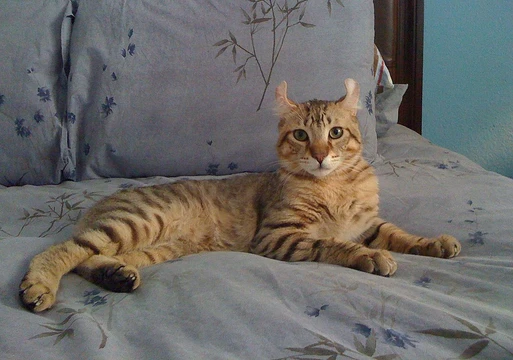
Aphrodite cat
A distinct landrace from Cyprus, now being standardized as the Aphrodite's Giant.

Cyprus cats, also known as Cypriot cats, Saint Helen cats, and Saint Nicholas cats, are a landrace of domestic cat found across the island of Cyprus. A standardized breed is being developed from them; among cat fancier and breeder organizations, it is presently fully recognized by the World Cat Federation (WCF), with breeding regulated by the World Cat Congress (WCC), under the name Aphrodite's Giant; and provisionally by The International Cat Association (TICA) as the Aphrodite. All three organizations permit shorthaired and semi-longhaired versions and no out-crossing to other breeds.
Quick Facts
- Country
- foundation stock likely from Ancient Egypt
- Notrecognized
- yes
- Note
- Cyprus cats are a landrace, not a standardized breed.
Facts from the source article.
Lore & Background
The earliest known written record of cats on Cyprus refers to a story of Saint Helen of Constantinople sending two boatloads of cats to a monastery on the island from Egypt or Palestine in the 4th century AD to deal with an infestation of snakes. Cats on Cyprus have been able to breed for centuries with comparatively little outside influence; this has resulted in a distinct, locally adapted variety of cat which appears to have developed as a feral population in the inner highlands, though is found throughout the island in modern times. While wildcats in association with humans on Cyprus date to at least 7500 BC – the earliest proven association of cats with humans – there is no known connection between those ancient tamed-wild specimens and modern domesticated Cyprus cats, despite breeder claims to the contrary.
Reader's Guide
The WCF standard calls for the Aphrodite's Giant to be large, strong, and muscular but not cobby, and big-boned even as kittens. The cats may be shorthaired or semi-longhaired and of any colors other than colorpoint or mink (which comes from the Burmese gene), nor with any white spots if otherwise solid-colored. 'In bicolour, non-regular colour setting is desired.' The coat should be soft and wooly, and is expected to be longer and with an undercoat in winter, and always lacking any top coat except possibly on the back.
Did You Know?
- A 2004 study found that a 9,500-year-old grave in Cyprus contained the oldest example of a cat in close association with humans discovered so far.
- Genetic testing in the early 2010s showed that Cyprus cats are distinct enough from mainland Turkish cats that a breed could be developed from them.
- The World Cat Congress is of the opinion that Cyprus cats developed over time in mountainous inner Cyprus and became large and bushy-haired to cope with hunting comparatively large prey.
Origins & Natural Heritage
The Aphrodite cat is a landrace native to the island of Cyprus, existing as a localized variant within the broader Aegean cat population. Unlike breeds created through deliberate crossbreeding programs, this cat emerged naturally over generations, making it part of what is considered one of the oldest distinct populations of the domestic cat. The Aegean lineage it belongs to was formally developed starting in the 1990s by the Feline Federation of Greece, drawing on cats originally found around the Cyclades and the wider Aegean Sea region. These cats are noted for their affinity for fishing and water, thriving in coastal communities and Greek fishing ports. Physically, the Aegean type is medium-sized and muscular, carrying a lighter European or Continental body frame, medium round paws, and striking green almond-shaped eyes. The coat always presents in two or three colors, with white invariably one of them. The Aegean population is also noted for being largely free from common feline diseases. The Cypriot Aphrodite carries this same ancient genetic foundation while expressing its own island-specific character, a heritage that predates any formal breed standard by centuries.
The Road to Recognition
The Aphrodite cat's journey toward formal breed status illustrates the broader challenges faced by minority and experimental breeds in the global cat fancy. As of the available information, its recognition under the name Aphrodite remains limited. The World Cat Federation and World Cat Congress have acknowledged the breed since 2012, while The International Cat Association granted it provisional recognition in 2017. At the local level, the Cyprus Cats National Breed Association and the Cyprus Feline Society also support the breed. However, it has not yet achieved full standing with the major international registries such as the Governing Council of the Cat Fancy, the Fédération Internationale Féline, or the Cat Fanciers' Association. This pattern is common among landraces in regions where formal cat fancy is still in its infancy. Breeders actively seek major recognition, but the process can be lengthy, and some breeds ultimately prove non-viable over the longer term or face rejection due to over-similarity to existing breeds or other concerns. The Aphrodite sits in this transitional space, with experimental conformation standards in place but full universal acceptance still ahead.
Naming & Identity
One of the most distinctive aspects of the Aphrodite cat is the multiplicity of names under which it is known. Beyond the primary Aphrodite designation, the breed also goes by Cyprus cat, Cypriot, Aphrodite's Giant, St. Helen, and St. Nicholas cat, with different breeder groups adopting different names as they work to establish a standardized breed. This naming fragmentation is not unique to the Aphrodite; the broader world of experimental and minority cat breeds is riddled with similar confusion. For instance, a breed called Burmilla Longhair in Australia corresponds to the Asian Semi-longhair or Tiffanie in Britain, yet Australia separately has an Australian Tiffanie, and the United States recognizes a Tiffany or Chantilly-Tiffany that is yet another distinct cat. These discrepancies have historically caused significant confusion among fanciers and registries. Fortunately, improved communication between registries, largely facilitated by the Internet and the World Cat Congress, has been reducing such conflicts. For the Aphrodite, the challenge of settling on a single universally accepted name remains part of its ongoing development as a recognized breed.
Breed Development & the Path Ahead
The Aphrodite cat is currently in a phase of active breed development, where breeders are working to true-breed specific traits and establish a consistent, standardized breed from the naturally occurring Cypriot population. This process mirrors the broader trajectory of many minority breeds that begin as landraces and gradually move toward formal recognition. In regions where the structured cat fancy is still maturing, naturally occurring native varieties can be classified as minority breeds once selective breeding begins to produce a formal natural breed with consistent traits. The Aphrodite fits this description precisely. Its provisional status with TICA since 2017 and its standing with the World Cat Federation since 2012 suggest that experimental conformation standards are already in place, but the breed has not yet secured full, unqualified recognition across all major registries. The path forward involves demonstrating long-term viability, distinguishing the breed sufficiently from the closely related Aegean to avoid over-similarity concerns, and building a stable breeding population. For now, the Aphrodite remains a work in progress, a living bridge between ancient Cypriot cat heritage and the modern world of standardized feline breeds.
Frequently Asked Questions
Who is Aphrodite cat?
The Aphrodite cat, also called the Aphrodite's Giant, is a standardized feline breed derived from the native Cyprus cat landrace. It holds full recognition from the World Cat Federation and provisional status with TICA.
What are Aphrodite cat's powers/role?
Rather than supernatural abilities, the breed's signature trait is its large, heavily muscled frame with hind legs set noticeably longer than its forelegs. This gives it a distinctive, powerful silhouette that sets it apart from most domestic cats.
Why is Aphrodite cat important?
The breed functions as a conservation effort to codify and protect the unique traits of a feral population that has naturally adapted to the Cypriot environment over many centuries. Without formal recognition, those locally evolved characteristics could be diluted through uncontrolled crossbreeding.
Where does Aphrodite cat come from?
It was developed directly from the indigenous Cyprus cat landrace on the island of Cyprus. The breed represents a formalization of that long-standing, locally adapted feral population into a registrable, standardized type.
More in Experimental cat breeds 1-24
Spotted an error? Know more?
Reader corrections go straight into our review queue. Suggest an edit · How this site is sourced