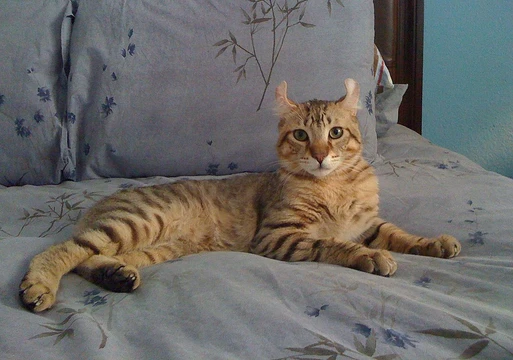
Alpine Lynx cat
A white, short-tailed breed with curled or straight ears.

The Alpine Lynx is a medium-sized cat with a white coat and a short tail. Its ears may be curled or straight, and its coat can be either short or long, sometimes with tufted toes. A distinctive feature is that its back legs are longer than its front legs. This breed originated from a cross between a Highlander and a white barn cat. It is recognized by the Rare and Exotic Feline Registry, a smaller registry, but not by any major national or international cat registries.
- Field
- Experimental cat breed
- Known for
- White coat, short tail, curled or straight ears, longer back legs
- Registry
- Rare and Exotic Feline Registry (REFR)
Lore & Background
The Alpine Lynx is a minority cat breed developed from a cross between a Highlander and a white barn cat. It is recognized only by the Rare and Exotic Feline Registry, a smaller cat registry, and does not have recognition from major national or international cat registries such as The International Cat Association or the Cat Fanciers' Association. The breed is characterized by its white coat, short tail, and the ability to have either curled or straight ears.
Reader's Guide
The Alpine Lynx represents a category of experimental cat breeds that lack recognition from major registries but are acknowledged by smaller organizations like the Rare and Exotic Feline Registry. Its development from a Highlander and a white barn cat illustrates the private breeding efforts that sometimes attract informal followings. The breed's distinctive traits—white coat, short tail, variable ear shape, and longer back legs—highlight the diversity within minority breeds. As with many such breeds, the Alpine Lynx's status remains provisional, and its long-term viability is uncertain. Its existence underscores the ongoing efforts of breeders to create new varieties outside the mainstream cat fancy, often for personal or aesthetic reasons, and the challenges these breeds face in gaining wider acceptance.
Physical Profile and Distinctive Traits
The Alpine Lynx presents a striking and somewhat unusual silhouette among domestic cats. Its coat is uniformly white, and the tail is notably short, giving the breed a compact, bob-like rear profile. One of the breed's most visually arresting features is its ear variation: individuals may display either curled or straight ears, meaning two cats of the same pedigree can look markedly different in head structure. Coat length is equally variable, with both short-haired and long-haired expressions occurring within the breed. Some specimens also carry tufted toes, a trait that adds a wild, lynx-like flourish to an otherwise domestic appearance. In terms of build, the Alpine Lynx is classified as medium-sized, but its proportions are distinctive: the hind legs are longer than the front legs, creating a slightly rumped, spring-loaded stance that sets it apart from the level-topped conformation seen in most common house cats. Together, these traits—white coloring, short tail, ear and coat variation, tufted toes, and the longer rear limbs—form a cohesive yet flexible physical identity that breeders have worked to stabilize.
Origins and Breeding Lineage
The Alpine Lynx did not emerge from a single, carefully planned breeding program in the way many modern pedigreed cats did. Instead, it was developed through a cross between two quite different source animals: a Highlander cat and a white barn cat. The Highlander, a recognized breed in its own right, contributed structural and possibly coat-related characteristics, while the white barn cat brought the breed's signature solid white coloring and a more rustic, utilitarian genetic base. This pairing of a pedigreed line with a common farm cat is characteristic of many experimental and minority breeds, where breeders work from available stock rather than from a closed, multi-generation pedigree. The result is a cat that carries the genetic diversity of both parents, which helps explain the breed's notable variation in ear shape, coat length, and even toe tufting. Because the Alpine Lynx is fundamentally a crossbreed, it occupies a space in the cat fancy that sits between established pedigreed breeds and the countless unnamed mixed cats found in households and barns worldwide, and its identity as a distinct breed rests largely on the consistency of the traits its developers have chosen to select for.
Registry Standing and the Path to Recognition
The Alpine Lynx currently holds recognition from the Rare and Exotic Feline Registry, a smaller body that sits well outside the circle of the major international cat registries. It is not listed by The International Cat Association, the Cat Fanciers' Association, the Governing Council of the Cat Fancy, the Fédération Internationale Féline, or the World Cat Federation based in Germany. This means that, in the eyes of the institutions that govern most of the global cat fancy, the Alpine Lynx remains an experimental or minority breed rather than a fully established one. Being catalogued among breeds that lack major-registry approval places it in a category that includes many other crossbred and privately developed lines. Smaller registries like the Rare and Exotic Feline Registry serve as a crucial intermediate step, offering a formal record and a conformation standard even when the breed has not yet cleared the higher hurdles of the larger organizations. For the Alpine Lynx, this status reflects both the novelty of its lineage and the ongoing challenge that many minority breeds face in transitioning from private breeding projects to widely accepted pedigreed status.
Place Among Experimental and Minority Breeds
The Alpine Lynx is one entry in a broader and often confusing landscape of experimental cat breeds and crossbreeds that have not yet earned the endorsement of the major national or international registries. Many of these breeds, like the Alpine Lynx, are recognized by at least one extant multi-breed registry, which distinguishes them from entirely informal or unrecorded lines. Breeders of such minority cats frequently pursue major recognition, yet the path is fraught with obstacles: a breed may be turned down because it is deemed too similar to an already-recognized type, because statistical links to heritable medical problems have surfaced, or simply because the conformation standard has not proven stable over successive generations. Some breeds hold only a preliminary or experimental status in one registry while remaining invisible in another, and discrepancies in naming between registries can make the situation even more tangled. The Alpine Lynx, with its mixed Highlander and barn-cat heritage and its recognition limited to the Rare and Exotic Feline Registry, exemplifies this in-between stage—a breed with a defined identity and a small but real following, still waiting for the broader cat fancy to take notice.
Frequently Asked Questions
What is an Alpine Lynx cat?
The Alpine Lynx is a medium-sized experimental cat breed known for its all-white coat and notably short tail. It is classified as an experimental line rather than a fully established breed.
What does an Alpine Lynx cat look like?
These cats have a white coat that can be either short or long, sometimes featuring tufted toes, and their ears may be either curled or straight. A standout physical trait is that their hind legs are visibly longer than their front legs.
Where did the Alpine Lynx cat originate?
The breed was developed by crossing a Highlander cat with a white barn cat, producing this distinctive experimental line. No other ancestral breeds are cited in its origin.
Is the Alpine Lynx cat recognized by major cat registries?
No, the Alpine Lynx is not accepted by any major national or international cat registry. It holds recognition only through the Rare and Exotic Feline Registry (REFR), a smaller organization.
What makes the Alpine Lynx cat unique among experimental breeds?
Its combination of a white coat, short tail, variable ear shape, and disproportionately longer back legs sets it apart from other experimental lines. The tufted-toe variation adds further distinction within the breed.
More in Experimental cat breeds 1-24
Spotted an error? Know more?
Reader corrections go straight into our review queue. Suggest an edit · How this site is sourced