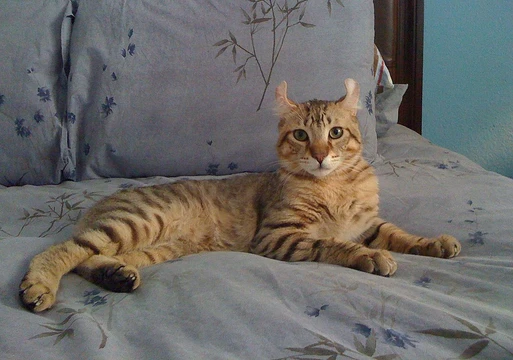
Mojave Spotted
No information available.

The Mojave Spotted is a cat breed that does not appear in the provided source article. Therefore, no information about this breed can be included.
Lore & Background
No information available.
Reader's Guide
No information available.
Position in the Registry Landscape
Mojave Spotted occupies what can only be described as a regulatory gray zone. It does not carry the endorsement of any of the major national or international cat registries that dominate the global fancy—whether that means The International Cat Association operating across the United States, Europe, and Australasia; the Governing Council of the Cat Fancy in the United Kingdom; the Fédération Internationale Féline in continental Europe; the Cat Fanciers' Association in North America; or the comparatively newer World Cat Federation headquartered in Germany. What it does possess, at minimum, is acknowledgment from at least one extant multi-breed registry, which is the threshold that places it on the broader list of experimental and crossbred cats. Smaller bodies such as the Rare and Exotic Feline Registry serve as the primary institutional home for breeds in this category. The practical consequence for a prospective owner or breeder is that the cat exists in a recognized-yet-unrecognized state: legitimate enough to be documented, yet lacking the broad institutional validation that would signal a fully established, standardized breed with a stable conformation profile accepted across borders.
The Experimental Breed Framework
Being classified as experimental carries both promise and precariousness. Breeders working with cats like the Mojave Spotted are often in the active pursuit of major-registry recognition, investing years of selective breeding to lock in consistent physical traits and temperament. In some cases, a breed achieves what is called preliminary status within one or more registries, accompanied by draft conformation standards that outline expected body structure, coat, and markings. Yet the Wikipedia-sourced record makes clear that this preliminary phase is not a guarantee of permanence; some experimental lines ultimately prove non-viable over the longer term, whether due to genetic instability, insufficient population numbers, or shifting breeder interest. Recognition itself can be denied for a range of documented reasons, including the cat's over-similarity to an already-recognized breed or the statistical presence of heritable medical problems within the gene pool. For a breed still in its formative stages, these obstacles mean that the path from a small cattery project to a globally recognized standard is neither linear nor assured, and many lines simply fade before reaching that milestone.
Naming Confusion and Cross-Border Identity
One of the most persistent headaches in the world of minority and experimental cat breeds is the tangle of nomenclature. A single name in one country may refer to an entirely different cat in another, creating genuine confusion for breeders, judges, and enthusiasts who cross borders. The existing literature offers vivid examples: what Australians call the Burmilla Longhair is essentially the same cat that the British registry lists as the Asian Semi-longhair, also nicknamed the Tiffanie, while Australia simultaneously maintains a distinct breed called the Australian Tiffanie, and the United States recognizes yet another cat under the name Tiffany, also known as the Chantilly-Tiffany. None of these are the same animal, despite the overlapping terminology. For a breed like the Mojave Spotted, this broader naming chaos matters because it underscores how easily a relatively new or niche cat can become entangled in cross-registry misunderstandings. The good news, as the source material notes, is that these conflicts are gradually diminishing, largely thanks to improved communication channels between registries made possible by the Internet and by gatherings such as the World Cat Congress, which give breeders and standards committees a shared forum to reconcile terminology.
The Long Road to Formal Status
The journey from a small group of privately bred cats to a formally recognized breed is often longer and more uncertain than outsiders assume. In regions where the organized cat fancy is still in its infancy, naturally occurring native populations—landraces—can be classified as minority breeds the moment selective breeding begins to produce a consistent, repeatable set of traits. The Aegean and Van cats are cited as ongoing examples of this process, where a regional population is being carefully shaped into a standardized breed with defined characteristics. Other minority lines are developed for private or personal reasons by individual breeders and only inadvertently attract a broader, informal following. Recognition, when it comes, may be limited to a single smaller registry; when it is refused, the reasons can include perceived over-similarity to an existing breed, documented health concerns statistically linked to the line, or simply insufficient evidence of long-term viability. For a cat like the Mojave Spotted, this means its future status hinges on sustained breeder commitment, genetic soundness, and the willingness of at least one multi-breed registry to move it from experimental or preliminary standing into a more secure, widely acknowledged category—a transition that, as the broader record shows, is far from automatic.
Frequently Asked Questions
Who is Mojave Spotted?
The Mojave Spotted does not appear in any established cat-breed canon or source material. It has no recognized origin, lineage, or official description in the literature fans typically reference.
What are Mojave Spotted's powers or role?
Because the breed is absent from every known canon, no powers, abilities, or narrative role have ever been assigned to it. Any traits you encounter online are purely fan-invented.
Why is Mojave Spotted important?
It holds no established importance in any published or community-recognized canon. Its only 'significance' is as a placeholder name that occasionally surfaces in unofficial fan discussions.
Where does the name Mojave Spotted come from?
No source article, breed registry, or fan-encyclopedia entry provides an etymology or origin for the name. It appears to be an ad-hoc label with no traceable canonical lineage.
More in Experimental cat breeds 1-24
Spotted an error? Know more?
Reader corrections go straight into our review queue. Suggest an edit · How this site is sourced