Exoplanets
21 entries in the Exoplanets compendium.
Exoplanets — Era Chart
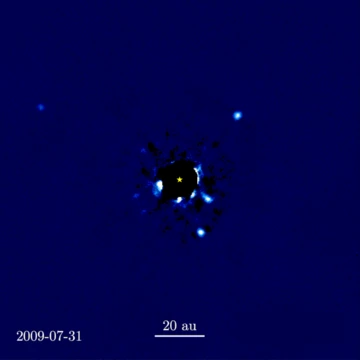
Proxima Centauri bClosest known exoplanet to the Solar System.TRAPPIST-1 systemSeven Earth-sized planets orbit an ultra-cool dwarf star.Kepler-452bA confirmed super-Earth in a Sun-like star's habitable zone.51 Pegasi bFirst exoplanet found orbiting a Sun-like star.HD 189733 bFirst exoplanet with a thermal map and notable atmospheric studies.Kepler-22bFirst transiting exoplanet found in a Sun-like star's habitable zone.Gliese 581gGliese 581g was a proposed exoplanet that astronomers thought might orbit a star twenty liK2-18bA sub-Neptune exoplanet in the habitable zone of a red dwarf.55 Cancri eFirst super-Earth discovered around a main sequence star.WASP-12bA hot Jupiter being consumed by its star.TOI-700 dFirst Earth-sized habitable-zone exoplanet discovered by TESS.Kepler-186fFirst Earth-sized exoplanet found in another star's habitable zone.PSR B1257+12 planetsFirst confirmed exoplanets, orbiting a pulsar.HR 8799 systemFirst directly imaged multiple-planet system with four giant planets.The habitable zoneThe orbital region where liquid water may exist on a planet's surface.Hot JupitersGas giants orbiting extremely close to their host stars.Super-EarthsExoplanets more massive than Earth but lighter than ice giants.Rogue planetsInterstellar planetary-mass objects not bound to any star.The transit methodDetects exoplanets by measuring starlight dimming during transit.The Kepler space telescopeNASA telescope that discovered thousands of exoplanets.The James Webb Space TelescopeLargest space telescope, observing the universe in infrared.
Browse Exoplanets in the interactive codex →